

48V vs. 60V Electric Dirt Bike: Is the High-Voltage Upgrade Actually Worth It?
If you’ve been scrolling through valtinsusport.com or lurking in E-Moto forums lately, you’ve seen the debate. One side says 48V is plenty for play, while the other swears you aren’t even "really riding" unless you’re pushing a 60V or 72V system.
So, what’s the real deal? Does more voltage actually equal more fun, or is it just a way to drain your wallet faster?
As someone who has spent way too many hours swapping battery packs and testing peak power on steep hill climbs, I’m breaking down the "Voltage Gap" so you can figure out which electric dirt bike is worth your hard-earned cash.

The Basics: What Does Voltage Actually Do?
Think of voltage like the "size of the pipe" for your power. In the world of electric motocross, more voltage generally means two things: higher top speeds and better efficiency.
-
48V Systems (The Playful Commuter): These are usually lighter and more manageable. If you’re a beginner or looking for a "backyard shredder" like our EM-5, 48V is a blast. It’s enough torque to lift the front wheel, but it won’t try to buck you off the moment you touch the throttle.
-
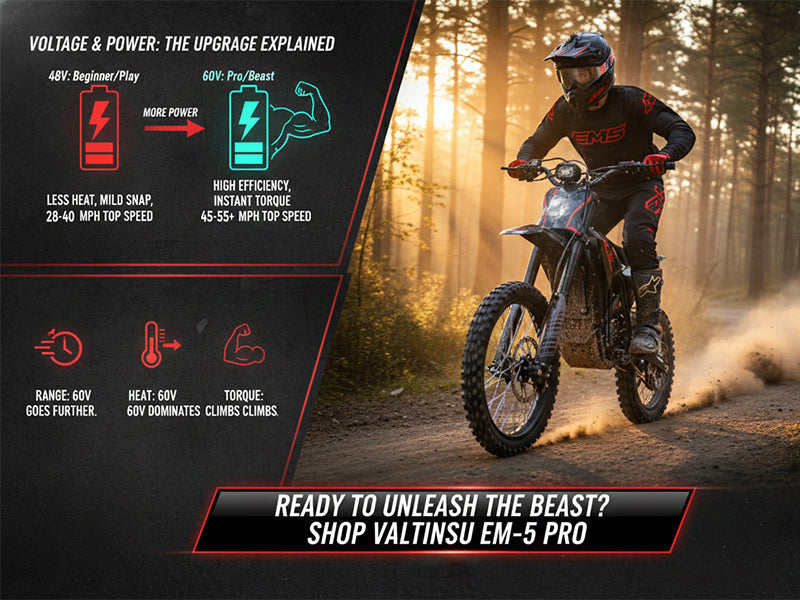
60V Systems (The Trail Beast): This is the industry standard for serious off-road performance. Jumping from 48V to 60V (like the EM-23 or EM-5 PRO) isn’t just a small step—it’s a massive leap in how the bike handles technical terrain.

1. Speed & "Snap" (Throttle Response)
Let’s be honest: we all want to go fast. A 60V electric dirt bike provides a much higher "ceiling" for speed. While a 48V bike might top out around 25-30 mph, a 60V system with a 4000W-4800W peak motor will easily push you past the 40-45 mph mark.
More importantly, it’s about the "Snap." When you’re at the bottom of a ravine and need instant power to clear a log or a rock garden, the 60V system responds with an aggression that 48V simply can’t match.
2. Efficiency & Heat (The Silent Killer)
Here is the nerdy part that actually matters for your riding time. High-voltage systems are actually more efficient. When you’re pushing a bike hard on a trail, a 48V motor has to work overtime, which creates heat. Heat is the enemy of your Lithium-ion battery and your controller.
By upgrading to a 60V 27Ah setup, your bike can produce the same amount of power with less stress on the components. Result? You stay on the trails longer, and your hardware lasts years, not months.
3. Range Anxiety is Real
Most people think a bigger battery is only about speed. Wrong. It’s about range. A 60V system allows you to cover more ground because you aren't constantly "redlining" the system to maintain trail speeds. If you’re planning on 2+ hour trail rides deep into the woods, the 60V upgrade isn’t just "worth it"—it’s essential.

The Verdict: Which One Should You Buy?
Choose 48V (EM-5) if:
-
You’re a younger or lighter rider.
-
You mainly ride in flat backyards or urban environments.
-
You’re on a budget but want a reliable stealth ride.
Choose 60V (EM-23 or EM-5 PRO) if:
-
You weigh over 180 lbs (you’ll appreciate the extra grunt).
-
You want to hit motocross tracks or steep mountain trails.
-
You want a bike that grows with your skill level rather than one you’ll outgrow in a month.
Final Thoughts
Is the high-voltage upgrade worth it? Absolutely. If you can swing the extra cost, the jump to 60V transforms the bike from a "cool gadget" into a high-performance off-road machine.
Ready to feel the difference for yourself? Check out the Valtinsu EM-5 PRO and see what 4800W of peak power actually feels like.


Looking for something else?

Guía completa de la moto eléctrica todoterreno EM-5: características, especificaciones y opiniones de los usuarios
LEARN MORE
Stop Looping Out: How to Master the Rear Brake on Your Electric Dirt Bike
LEARN MORE
48V vs. 60V Electric Dirt Bike: Is the High-Voltage Upgrade Actually Worth It?
LEARN MORE
Is Your Battery Dying? 5 Habits That Are Killing Your E-Dirt Bike Range
LEARN MORELooking for something else?

The Best Electric Dirt Bike for Teens and Adults: Sizing Guide
LEARN MORE
The 15-Minute Post-Ride Ritual: Keep Your Valtinsu Running Like New
LEARN MORE


