Can You Ride a Dirt Bike on the Sidewalk? Laws, Fines & Where It’s Legal
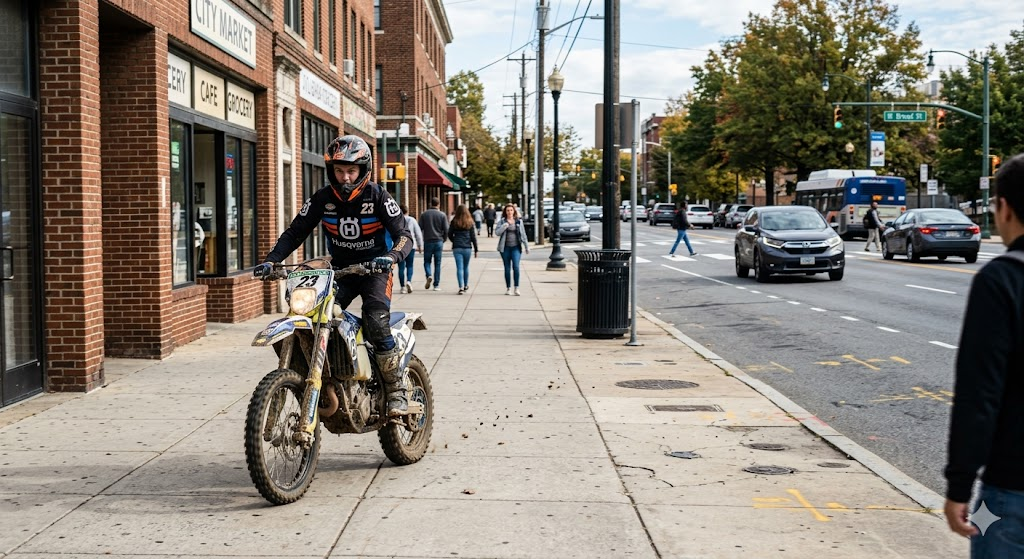
Jordan tried it once. Rolled his dirt bike off the driveway, eased onto the sidewalk for the half-block to the empty lot at the end of the street. He made it maybe forty feet before a neighbor was already on the phone.So, can you ride a dirt bike on the sidewalk? No, you generally cannot ride a dirt bike on a public sidewalk. Sidewalks are reserved for pedestrians, and gas or electric dirt bikes are usually classified as motor vehicles or OHVs, not bicycles. Turning off the engine does not automatically make riding legal. You may be allowed to walk the bike in some areas, but local rules should be checked first.
Sidewalks are built for people walking. A standard dirt bike, gas or electric, is a motor vehicle or an off-highway vehicle in the eyes of the law. That includes an Adult Electric Off-Road Motorcycle like the ones Valtinsu builds. Here’s what the rules actually say — sidewalks, neighborhood streets, fines, and the places you can ride without looking over your shoulder.
|
Quick answer
No — you can’t ride a dirt bike on a public sidewalk. They’re reserved for pedestrians, and a dirt bike counts as a motor vehicle or OHV, not a bicycle. Turning the engine off doesn’t fix it: if you’re sitting on it and it’s moving under power, an officer can still treat it as illegal sidewalk operation. Get caught and you’re looking at fines, possible impoundment, and in some states a misdemeanor on your record.
|
Sidewalk Rules for Dirt Bikes
Across nearly every U.S. city and town, no. Local traffic codes treat dirt bikes as off-road motor vehicles, and motor vehicles don’t belong on a strip of concrete meant for foot traffic. Ohio law puts it bluntly: no person shall drive any vehicle other than a bicycle on a sidewalk, except across a driveway. Break that and it’s a minor misdemeanor — one that escalates fast with repeat stops inside a year.
Turning off the engine doesn’t make it legal
People assume a dead engine buys them a pass. It doesn’t. If you’re astride the bike and it’s rolling under its own power — or even coasting in a way an officer reads as operation — the sidewalk rule still applies. The fix isn’t a quiet motor. It’s getting off and walking it.
Does engine size change anything?
A smaller engine doesn’t open a loophole. A 49cc pit bike is still a motorized vehicle built for powered travel, so a neighborhood that bans dirt bikes bans that too. Engine size affects licensing and registration class. It doesn’t make a bike safe — or legal — among people on foot.
Why Dirt Bikes Are Banned From Sidewalks
Three reasons, and none of them care how new or quiet your bike is. Pedestrian safety comes first. A sidewalk gives a rider almost no room to dodge a kid, a dog, or someone stepping out of a doorway, and a dirt bike accelerates harder and weighs more than any bicycle sharing that space.
-
Pedestrian safety. Blind corners, driveways, parked cars — a narrow path leaves no margin. Even a low-speed clip can hurt someone or throw the rider into the road.
-
Vehicle classification. Off-road dirt bikes ship without mirrors, signals, a horn, or road tires, so they’re barred from roads, sidewalks, and bike lanes alike.
-
Property damage. Knobby tires and sudden torque tear up grass, curbs, and soft shoulders. The owner usually pays for it.
Electric models don’t escape any of this. They’re quieter, sure, but a quiet motor doesn’t lower the speed or the weight. The USDA Forest Service files high-power electric motorcycles like Sur-Ron, Talaria, and Valtinsu’s lineup as off-highway vehicles — not e-bikes, not mopeds. Same rules, softer soundtrack.

Sidewalk Laws by State and City
There’s no single national rule, which is exactly where riders trip up. State law usually controls registration, licensing, insurance, and OHV decals. Your city or county controls sidewalks, parks, alleys, and neighborhood streets. Two layers, and a bike that clears the state layer can still be illegal under a local one.
A public sidewalk sits inside a government right-of-way even when the homeowner pours and sweeps it. Owning the house doesn’t turn the concrete out front into a private track. Below is how a few representative codes treat motorized use on sidewalks and around town.
|
Jurisdiction
|
Sidewalk Riding
|
What the Code Says
|
|
Ohio
|
Banned
|
§4511.711 — no vehicle but a bicycle on a sidewalk; minor misdemeanor, escalates on repeat.
|
|
California
|
Banned
|
Veh. Code §21663 — motor vehicles only cross a sidewalk at a driveway.
|
|
Most U.S. cities
|
Banned
|
Local traffic codes classify dirt bikes as motor/off-road vehicles — roadways or trails only.
|
|
Bike lanes / shared paths
|
No
|
Built for bicycles and certain low-power e-bikes — not high-power eMotos.
|
|
Find your own rules: Start with your state DMV or licensing site (search “off-highway motorcycle,” “OHV registration,” “sidewalk motor vehicle”). Then read your city or county code under traffic, parks, and public ways. The restriction you need often hides outside the main traffic chapter.
|
||
What Happens If You Get Caught
A quiet motor doesn’t make you invisible. Police stop dirt bikes — gas and electric — most often near schools, parks, and quiet residential blocks, the exact places neighbors call it in. And the cost runs well past a warning.
One ride can stack citations: unregistered vehicle, sidewalk operation, no insurance, no Class M endorsement. Fines for operating an unregistered motor vehicle usually land between $200 and $500 a stop, and they climb on the second offense. In Texas, riding an OHV without the required $16 OHV decal where it’s mandated is a Class C misdemeanor carrying $25 to $500.
|
Violation
|
Typical Consequence
|
|
Riding on a sidewalk
|
Citation; minor misdemeanor in states like Ohio
|
|
Unregistered motor vehicle on a public road
|
$200–$500 fine; repeat offenses escalate
|
|
No OHV decal where required (TX)
|
Class C misdemeanor, $25–$500
|
|
Reckless riding / fleeing
|
Added charges; impoundment more likely
|
|
Accident while unregistered
|
Insurer can deny the claim — full personal liability
|
Police can tow or impound the bike when local law allows it — more likely if it’s unregistered, if you run, or if it’s happened before. Getting it back means ownership paperwork plus towing and storage fees that can outrun the original ticket. The crash is the worst case: ride unregistered on a public road, and your insurer can walk away from the whole claim.
Can a Street-Legal Dirt Bike Use the Sidewalk?
Still no. A street-legal dirt bike — riders call it a dual-sport — is factory-built for pavement with DOT lights, mirrors, a horn, road tires, a road VIN, registration, and a Class M license. That gets it onto approved roads. It does not turn the motorcycle into a bicycle or buy it a lane on the sidewalk.
Bolting lights onto a pure off-road bike doesn’t promote it to dual-sport, either. If the VIN and title read “off-road use only,” plenty of DMVs won’t register it no matter what you installed — and the paper wins. If conversion is the path you’re weighing, the street-legal dirt bike conversion guide walks through the DOT equipment and the title limits that quietly end most attempts.
Are Electric Dirt Bikes Legal on Sidewalks?
An electric dirt bike is not automatically a legal e-bike. Low-power, pedal-assist e-bikes cap near 750W and 28 mph and live in the bike lane. A high-power electric dirt bike is a different machine. The EM-5 Pro runs 60V and 5,600W peak to 52 mph with no pedals anywhere — that’s a motor vehicle, full stop.
Rated power, assisted-speed limit, throttle, pedals, and the manufacturer’s classification all decide where a bike falls. Once a machine clears the e-bike definition on power and speed, it usually needs motorcycle or OHV registration — even when it looks bicycle-shaped from across the street. A quiet motor doesn’t qualify it for the sidewalk.
|
Spec
|
Pedal-Assist E-Bike
|
Valtinsu EM-5 Pro (Electric Dirt Bike)
|
|
Peak power
|
≤ 750W
|
60V · 5,600W
|
|
Top speed
|
~20–28 mph
|
52 mph
|
|
Pedals
|
Yes
|
None
|
|
Where it rides
|
Bike lane / road
|
Off-road, OHV parks, private land
|
|
Legal class
|
Bicycle class
|
Off-highway vehicle / motorcycle
|
Can You Ride a Dirt Bike in a Neighborhood?
Not legally, in most cases. Neighborhood streets are public roads. A standard off-road dirt bike doesn’t belong there just because traffic is light or the trip is two blocks — the first block past your driveway already counts as a public road. A road-registered dual-sport may use the street if you’ve cleared licensing and insurance, and even then it obeys every speed limit and signal.
Alleys and parking lots aren’t automatic exceptions; many are public traffic areas where the same rules apply, and private lots need the owner’s permission. Private land is often the cleanest legal option — with clear permission and enough room to stay away from roads, homes, and people. Shopping for a younger rider raises the bar further, and the electric dirt bike for teens guide covers the age and location checks worth making first.
|
Noise counts, even on private land. Cities and counties cap sound, dust, and repeated disturbance regardless of who owns the dirt. A legal spot can still draw a complaint if the bike runs for hours near a property line. Keep the exhaust in good shape and ride at reasonable hours.
|
Can You Cross a Sidewalk With a Dirt Bike?

Yes — the right way. The safe and usually lawful move is to dismount and walk the bike straight across, between the driveway and your legal loading or riding area. California’s code allows a motor vehicle to cross a sidewalk only at a driveway, never to ride along it.
-
Kill the engine first. Even an electric bike can creep on a feather of throttle. Switch it off, keep fingers clear of the throttle, and use neutral if you have it.
-
Yield to people on foot. Wait for a clear path. Don’t block ramps used by wheelchairs or strollers.
-
Use the driveway, not the curb. Cross where the concrete dips. It protects pedestrians, the wheels, and the suspension.
Where You Can Legally Ride a Dirt Bike
Know the location before you load the truck — the rules don’t bend, they flip completely depending on where the tires land. Riders who get the most out of the full electric dirt bike lineup treat legal access like part of the checklist, right alongside battery charge and tire pressure.
Public roads & neighborhood streets Register the motorcycle, install DOT-required equipment, carry insurance, and hold a valid Class M license.
Bike lanes & sidewalks Do not ride here; dirt bikes are not classified as e-bikes under state law.
Designated OHV parks Obtain the required OHV decal or trail permit, and check the rules set by the state and land manager.
Federal OHV trails (BLM/USFS) Register the OHV and meet applicable state, spark-arrestor, and sound-limit requirements.
Private land Get the owner’s permission and follow local noise and protective-gear rules.
Crossing a road to reach a trail Check state law and, where permitted, cross the road directly rather than riding along it.
OHV parks and public trails are the real answer. Texas requires a current decal at covered venues; the Bureau of Land Management and Forest Service open thousands of trail miles but require state registration, an approved spark arrestor on gas bikes, and adherence to the posted motor-vehicle use map. A street license doesn’t let you wander off the marked route.
Valtinsu Electric Dirt Bike and OHV Rider Guide — Know Before You Load
Two habits keep a Saturday from getting wasted. First, confirm the area before you go: not every OHV park allows electric motorcycles, and not every e-bike-friendly trail welcomes a high-power eMoto. Look for “OHV,” “motorized,” or “eMoto permitted” signage, and call the land manager if you’re unsure. Five minutes on the phone beats a 50-mile drive to a locked gate.
Second, transport the bike — don’t ride it there. Two miles of public road between the garage and the trailhead is still two miles of public road. Load it, drive it, drop the tailgate. The truck trip isn’t the boring part; it’s the legal part.

Match the bike to the rider’s age
Valtinsu runs a strict age ladder and doesn’t bend it. The EM-5 is the only model rated under 18 (13+). The EM-23 is built for 16+, and both the EM-5 Pro and the flagship are 18+, adults only — no “he’s mature for his age.” Shopping for someone under 18? It’s the EM-5. Full stop.
Which Valtinsu Fits Your Riding?
|
EM-5 — Ages 13+ · Trail Starter
48V · 3,840W peak · 148 lb-ft (200 N·m) · 40 mph · IPX6 · three ride modes (22 / 32 / 40 mph). The only Valtinsu model rated under 18. Approachable geared-motor torque for first dirt rides on private land and OHV parks.
From $1,259 USD · View the EM-5 →
|
|
EM-5 Pro — Adults 18+ only · Performance Trail
60V · 5,600W peak · 177 lb-ft (240 N·m) · 52 mph · IPX6 · Black or Volt Green. A performance trail motorcycle for adult riders — geared-motor torque for fire roads, singletrack, and 45° grades, without a $4,000 race-bike price.
From $1,699 USD · View the EM-5 Pro →
|
|
Age rule — no exceptions: EM-5 = 13+ · EM-23 = 16+ · EM-5 Pro = 18+ adults only. Parents shopping for a rider under 18 must choose the EM-5.
|
Conclusion
So — can you ride a dirt bike on the sidewalk? No, and the motor has nothing to do with it. Sidewalks are for people on foot, and a dirt bike, gas or electric, is a motor vehicle the moment it moves under power. A 49cc engine doesn’t shrink that rule, and a silent electric motor doesn’t dodge it.
The path that keeps your bike out of impound is simple. Transport it to private land you have permission to ride, a motocross track, or a designated OHV park, and check the state and local rules before every trip — permits, decals, and age limits shift from one place to the next. Walk it across the sidewalk, ride it on the dirt, and the legal part takes care of itself.
FAQs
Can I ride my dirt bike on the sidewalk?
Usually no. Public sidewalks are for pedestrians, and dirt bikes — gas or electric — count as motor vehicles. States like Ohio ban any vehicle but a bicycle from the sidewalk outright. Check your city code for the exact penalty.
What happens if you get caught riding a dirt bike on the road?
You can get cited for an unregistered motor vehicle, and the bike may be towed or impounded. Fines often run $200 to $500, and extra charges stack if it’s uninsured or missing road equipment. In Texas, missing the required OHV decal is a Class C misdemeanor.
Is it illegal to ride a dirt bike around town?
A standard off-road dirt bike is illegal on public streets, sidewalks, and bike lanes. A registered dual-sport may use approved roads if you hold the licensing and insurance. The quiet block past your driveway is still a public road.
Can you ride a 49cc dirt bike in a neighborhood?
The small engine doesn’t make it legal. A 49cc dirt bike is still a motorized vehicle restricted from neighborhood streets and sidewalks. Engine size changes licensing class, not where you’re allowed to ride.
Why is it illegal to ride a dirt bike on roads and sidewalks?
Most dirt bikes are built for off-road use and lack DOT lights, mirrors, signals, a horn, and road tires. Near pedestrians and traffic they also raise real safety, noise, and property-damage risks. That’s why the law keeps them on trails and tracks.
Can police take your dirt bike?
Yes, when local law allows it. Impoundment is more likely after illegal road use, reckless riding, registration violations, or repeat offenses. Recovering it means ownership paperwork plus towing and storage fees.
Can you push a dirt bike on the sidewalk?
Walking a switched-off bike is far safer than riding it, and many codes allow a motor vehicle to cross a sidewalk at a driveway. Dismount, kill the engine, yield to people on foot, and cross where the curb dips. Local rules still apply, so check first.
Where can you legally ride a dirt bike?
Private land with permission, motocross tracks, designated OHV parks, and marked public trails on BLM or Forest Service land. Many require registration, an OHV decal, a spark arrestor, or a trail pass. Confirm the rules for that exact spot before you go.
Sources
-
Ohio Revised Code §4511.711 — Driving on Sidewalk
-
California Vehicle Code §21663 — Motor Vehicles on Sidewalks
-
California DMV — Register an Off-Highway Vehicle (OHV)
-
Texas Parks & Wildlife Department — Texas OHV Program FAQs
-
Bureau of Land Management — Off-Highway Vehicles on Public Lands
-
USDA Forest Service — Register Vehicles and E-Motorcycles for OHV Trails
-
Valtinsu — Electric Dirt Bike Collection
-
Valtinsu — EM-5 Electric Off-Road Adult Dirt Bike


Looking for something else?
Electric Dirt Bike Replacement Parts Availability: What Buyers Should Verify Before Ordering
LEARN MORE
How to Check an Electric Dirt Bike for Safety Recalls by Model and Serial Number
LEARN MORE
How to Choose an Electric Dirt Bike Repair Shop: Questions to Ask Before Service
LEARN MORE
How to Lift a Fallen Electric Dirt Bike Without Hurting Yourself or the Bike
LEARN MORELooking for something else?
Electric Dirt Bike Fall Riding on Wet Leaves: Grip, Hidden Obstacles and Braking
LEARN MORE
Electric Dirt Bike Trailside Power Loss: Recovery Plan When the Battery Is Dead
LEARN MORE
Electric Dirt Bike Plastics Replacement Guide: Fitment, Color Kits and Install Order
LEARN MOREYou may also like
VALTINSU EM-5 Off-Road Electric Dirt Bike
$969.00
$1,559.00
VALTINSU EM-5 Pro Off-Road Black Electric Dirt Bike
$1,699.00
$1,899.00
VALTINSU EM-5 Pro Green Electric Dirt Bike
$1,699.00
$1,899.00
VALTINSU EM-5 Ultra Electric Dirt Bike
$2,199.00
$2,499.00
VALTINSU EM-5 & EM-5 Pro Combo
$2,658.00
$3,458.00