Electric Dirt Bike for Teens vs Adults: Motor, Speed & Safety Differences
When choosing an electric dirt bike for teens vs adults, focus on motor size, top speed, seat height, weight, and safety features, because these factors determine how well the bike fits and performs for each rider. Put a 200-pound adult on a bike, it feels one way. Put a 110-pound teen on the same machine, it does not. Heavier. Faster. A different ride entirely.
Parents look at top speed first. Wrong instinct. A teen needs smooth power. A seat low enough to plant a foot. Brakes that bite without a death grip. Adults can run more motor and a taller frame, sure. Skill and terrain still decide the match.
Teens vs Adults: The Quick Comparison
Teen bikes are tuned for control and steady skill growth. Adult bikes chase torque, speed, and rough-trail strength. One bike covers both only when the frame, the power modes, and the fit work for each rider who climbs on.
|
Factor |
Teen rider priority |
Adult rider priority |
|
Motor |
Smooth, modest power; soft throttle |
Stronger output for weight and hills |
|
Top speed |
Lower, with a limiter to cap it |
Higher, matched to open terrain |
|
Seat height |
Low enough to touch down |
Taller frame is fine |
|
Weight |
Light enough to pick up and turn |
More weight is manageable |
|
First concern |
Confidence and braking |
Traction and trail strength |
Seat height splits the two harder than anything else. Can the teen reach the ground while seated? If not, it is not a smart shared bike. The spec sheet does not get a vote on that one.
Spec Comparison: EM-5, EM23, EM-5 Proas adult/older-teen models
Three Valtinsu models map cleanly onto the teen-to-adult ladder. The EM-5 starts new riders. The EM23 suits older teens and adults on open ground. The Pro is an adults-only bike. Here is the side-by-side, verified against the live spec sheet.

|
Spec |
EM-5 (13+) |
EM23 (16+) |
EM-5 Pro (18+) |
|
Motor |
48V 3840W |
60V 4000W |
60V 5600W |
|
Torque |
148 lb-ft |
184 lb-ft |
177 lb-ft |
|
Top speed |
40 mph |
43.5 mph |
52 mph |
|
Modes |
22/32/40 |
16/28/43.5 |
26/40/52 |
|
Range |
50 mi |
See product page |
59 mi |
|
Seat height |
28.3 in |
31.9 in |
31.5 in |
|
Max load |
243 lb |
265 lb |
287 lb |
|
Front wheel |
14 in |
19 in |
17 in |
|
Price |
$1,259 |
$1,999 |
$1,699 |
Notice the seat numbers. Nearly four inches separate the EM-5 from the EM23. For a shorter rider that gap is the whole decision.
Motor Size: How Teen and Adult Models Differ
Motor output sets how hard the bike pulls, how it climbs, and how twitchy it feels off the line. Bigger watts do not always mean a better ride. Smooth delivery usually matters more, and it matters most for a beginner.
Where Teen Power Should Land
Soft throttle. Low ceiling. That is the brief for a beginner. The first few rides are not about speed at all, they are about learning how the bike reacts on dirt, on grass, over a small bump, without lurching.
The EM-5 is built for exactly this. A 48V 3840W geared motor, three modes capped at 22, 32, and 40 mph, and a 28.3-inch seat most teens can plant a foot under. It is rated 13+, the only model in the range for younger riders. Start low. Open it up when the skill shows up
 .
.
Where Adult Power Should Land
Adults weigh more and ride harder ground, so a stronger motor pays off on climbs, loose dirt, and longer days out. The trade is faster acceleration. A brand-new adult rider should not start on the strongest bike in the shop.
The EM-5 Pro sits at that end. 60V 5600W, 52 mph across three modes, a 59-mile range, rated 18+. Not a teen bike, and the age rating is not a polite suggestion. For an older teen who has outgrown a starter but is not yet 18, the 16+ EM23 is the next rung, with 184 lb-ft of torque and a 19-inch front wheel built for open ground.

Why Smooth Delivery Beats Peak Watts
Two bikes can post the same watt number and feel nothing alike. One pulls in a clean line. The other snaps at a small twist of the wrist. The geared motor on these models multiplies torque low in the rev range, and the controller meters the throttle, so power arrives without that jerky on-off feel cheaper bikes have.
Steady keeps a teen relaxed. Steady also keeps an adult planted on loose dirt and in tight turns. It is the quiet spec nobody puts on the box.
Speed: How Fast Should Each Rider Go?
Speed should track skill, space, terrain, and braking, not a birthday. A teen in a backyard has no business at the same speed as an adult on an open trail. Fast is fun. Fast also leaves less time to fix the mistake you are about to make.
Beginner and Older Teens
New riders start slow, in the open. Flat dirt or short grass beats a rocky trail every time. Smooth starts first, clean stops next, then raise the cap. Adjustable modes make that simple, since you lift the ceiling a step at a time as control improves. A careful 15-year-old often outrides a brand-new 16-year-old. Skill sets the speed.
Adult Trail Speed
Adult usually carry more speed, thanks to strength and reach on a full-size frame, and adult trails throw in climbs, ruts, and longer straights. Even so, top speed is a weak first buying point. Brakes, suspension, tires, and fit shape the real ride. The dash number is the last thing that matters.
|
Quick gut check Most riding time goes to turning, braking, and climbing, not pinning the throttle. A bike that starts smoothly, stops clean, and turns without a fight at normal pace beats a faster one that feels tense the whole ride. |
Size and Fit: Seat Height, Frame, and Weight
Fit is the gap most buying guides skip. Age narrows the search. Height, reach, weight, and strength settle it. Get the fit right and the rider has a real shot at staying balanced when the ground turns loose.

Seat Height and Ground Reach
Seat height drives stopping and slow-speed control. A teen should reach the ground well enough to steady the bike at a stop. One flat foot works for some. Both balls of the feet works for others. New riders need more ground contact than seasoned ones, full stop. The EM-5 sits at 28.3 inches for this reason; the Pro and EM23 run taller, 31.5 and 31.9.
Weight and Handlebar Reach
A heavy bike fights you. Harder to push, lift, turn, pick up off the dirt. Teens tire fast when the bike outweighs their strength. Adults absorb more, but still feel it on tight trails. Bar reach counts too. Set the bars too far out and the rider locks their arms, then reacts late. Keep a slight bend at the elbow, seated or up on the pegs.
Compact frames suit many teens. Smaller adults and beginners too. Easier to turn, less intimidating, slow. Full-size frames earn their place for taller adults, higher speeds, rougher ground.
Safety Features: What Each Rider Needs Most
Different riders lean on different protections. Teens need features that catch a mistake early. Adults need parts strong enough for higher speed and weight. Both matter. Neither is skippable.
Teen Riders: Limiters, Throttle, Brakes
- Adjustable speed limiters. An adult caps the bike for early rides, then lifts it a step at a time as skill grows. This is what keeps a bike useful for years, not one season.
- Smooth, predictable throttle. Electric motors react the instant you twist, so a steady pull beats a jumpy one for a learner.
- Hydraulic disc brakes. Stronger and more consistent than cable, and they ask for less hand force. Younger hands feel the difference.
- Wider off-road tires and real suspension keep the bike steady on uneven ground. Right where a teen gets bounced offline.
Adult Riders: Stronger Parts for Speed
- Brakes that match the power. A fast bike with weak brakes is a bad trade. Firm, easy to control, every time.
- Suspension built for rough terrain. Roots, rocks, ruts. Better damping settles them, and adjustable setups help heavier riders.
- Check max load before anything else. The EM-5 carries 243 lb; the Pro and EM23 step up to 287 and 265. The frame has to take rider weight plus repeated trail hits.
- Battery and heat management. Longer, harder rides stress the pack, so thermal protection and sensible charging keep range steadier.
Teen-Focused Bikes: The Trade-Offs
|
Pros |
Cons |
|
|
Adult Bikes: The Trade-Offs
|
Pros |
Cons |
|
|
Riding Gear Both Need
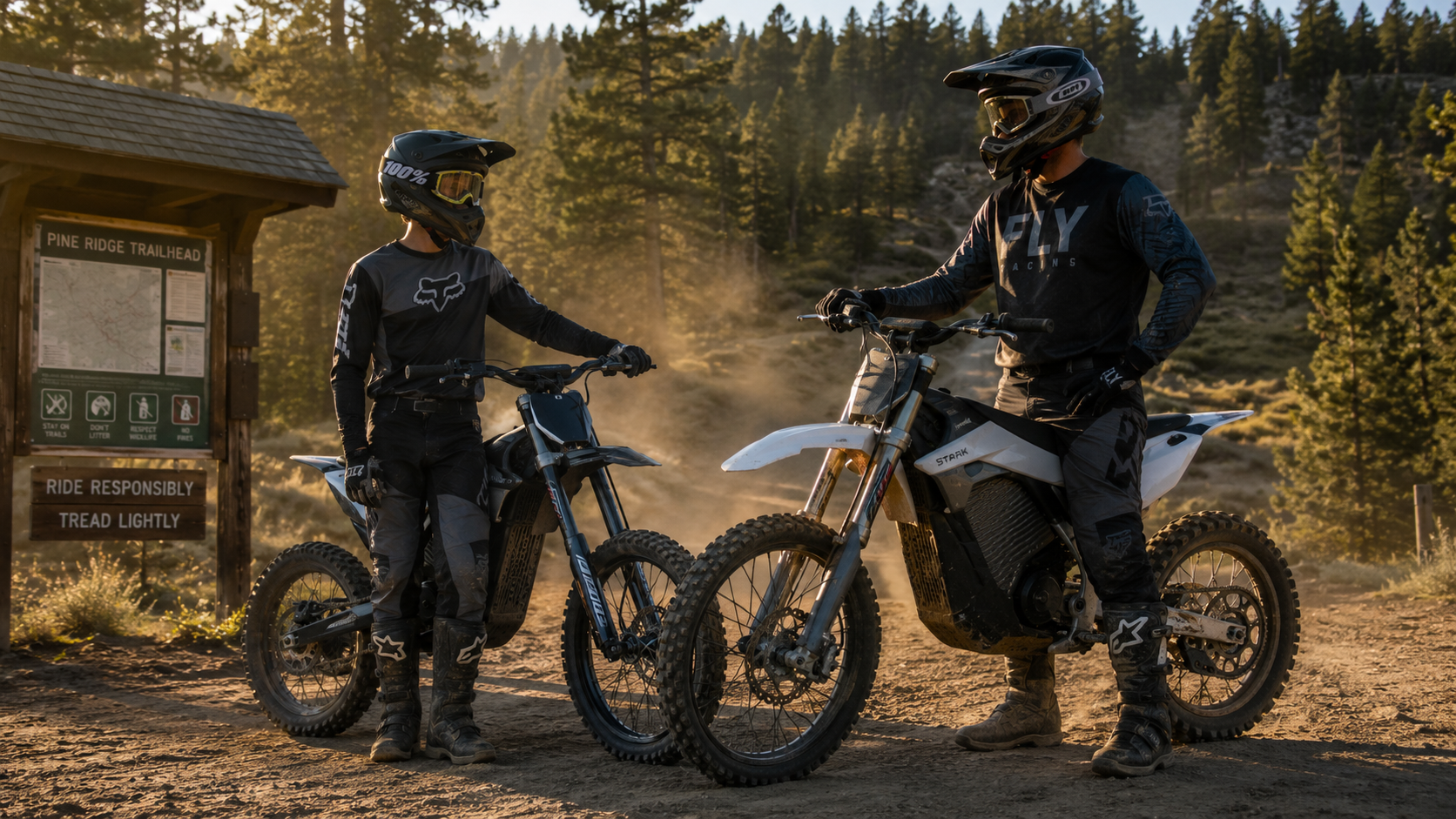
per U.S. CPSC guidanceGear is simple once the priorities line up. Protection over looks. Fit over price. A full-face helmet covers the chin and jaw a bicycle helmet leaves open in a forward fall, and the CPSC tells riders to pick a helmet built for the activity, not a generic lid. Teen or adult, the core kit is the same.
- Full-face helmet, fitted level and snug
- Gloves and goggles
- Knee and elbow pads with hard shells
- Off-road or motocross boots that cover the ankle
- Long sleeves and riding pants; body armor for faster riding
Stock up before the first ride, not after the first fall. Browse off-road safety gear and parts and fit everything in the driveway first.

California State Parks OHV division and U.S. Forest Service MVUM guidance
Terrain should steer the final pick. A backyard bike, a trail bike, and an open-ground adult bike do not need the same motor, tires, or suspension. Buy for the riding you actually do and you skip most of the regret.

Backyard and flat dirt want low speed and easy control, a natural fit for a teen bike with adjustable modes. Grass and beginner trails ask for better tires and steady throttle. Hills, rocks, and forest need more torque, stronger brakes, real suspension, and a rider who built up to them slowly. Open terrain gives adults room to use speed on a full-size frame, as long as braking and turning still feel composed.
Rules matter as much as dirt. These are off-highway vehicles, not street-legal bikes, so they belong on private land, dirt tracks, and designated OHV areas, never public roads. Age limits and where a young rider can legally ride change by state, county, and park. Check your local rules before you buy. The legal answer can change which bike you pick.
Want the numbers lined up? You can compare the full lineup by motor, speed, seat height, and load, then match a model to your rider and your ground.
How to Choose: Teen or Adult
The right bike matches the rider's body, skill, terrain, and goals. Age is where you start, not where you land. Match it well and a teen gets safer practice while an adult gets a bike that actually leaves the garage.
- Age and maturity first. The rider has to follow rules, wear gear, and stop when it feels wrong, whatever the birthday says.
- Then height and weight. Test it seated and standing; if it is hard to hold upright, it is too big.
- Then experience. Beginners want smooth throttle, lower speed, a manageable size; experienced riders can take more.
- Then terrain. Flat grass asks less than hills and rock; tight trails reward a lighter bike, open ground a larger one.
- Then the long game. Adjustable modes let a bike grow with the rider, but never trade away fit today to get there.
The common mistakes cluster in the same spots. Buying an adult bike too early. Chasing peak watts over control. Ignoring seat height. Skimping on brakes. Forgetting that range drops hard on a climb. Start with the rider every time. The spec sheet comes second.
The Short Version
Teens usually want a lighter frame, lower speed, smooth throttle, strong brakes. Adults can take more motor and a taller frame, but control still beats top speed. Pick the bike that fits, stops clean, and adjusts as the rider gets better. That gives a teen confidence and gives an adult a bike worth pulling out on a Saturday. Fit first. Every time.
Frequently Asked Questions
Are electric dirt bikes good for teens?
Yes, if the bike fits the rider. Quiet, easy to start, no gears to fumble, so a teen can focus on balance and throttle. The trap is too much bike. What to look for:
- Adjustable speed and a smooth throttle, not a jumpy one
- Brakes that bite without a hard squeeze
- A seat low enough to plant a foot
- Full gear, set rules, flat open ground for the first rides
Control first. Speed later, once they can start, stop, turn, and brake clean.
Should a 14 year old have an electric bike?
Depends on the kid, not the number. Some 14-year-olds are tall and careful and ready. Some are not. Before you buy, check three things:
- Can they touch the ground, reach the brakes, walk the bike under control
- Are they mature enough to follow rules and wear gear
- What your state, county, and park actually allow
Age alone should not decide it.
What is the best electric dirt bike for a 15 year old?
The one that fits their height, weight, skill, and terrain. Not the fastest one. A newer rider wants:
- Smooth power and adjustable speed modes
- Strong brakes and stable tires
- A frame they can manage slow, not just at speed
Experienced teen? More motor is fine. Sharing it with an adult? Check the teen can still handle the seat and weight.
How fast can a 13 year old go on an e-bike?
Slow, until the basics are solid. Start, stop, turn, brake. The safe number depends on bike, terrain, rider size, and local rules, and a flat field is nothing like a rocky trail. Build it up:
- Use the speed limiter, raise it a step at a time
- Smooth throttle drills before any real speed
- A small practice course with turns and a stopping zone
Instant torque surprises young riders. Practice beats chasing mph.
Can a 16 year old have a dirt bike?
Sometimes. Turning 16 does not make an adult-rated bike the right call. Weigh experience, terrain, braking skill, physical control. The age ratings, straight:
- EM-5, 13+
- EM23, 16+
- EM-5 Pro, 18+, not for under-18 riders
Test at low speed first. Move up only once control is steady.
What is the main difference between a teen and adult electric dirt bike?
Fit and intent. Teen bikes and adult bikes pull in different directions:
- Teen: lower seat, lighter frame, smoother power, speed caps to learn on
- Adult: stronger motor, higher top speed, taller frame, heavier build for rough ground
The real line is not the spec sheet. It is whether the rider can plant a foot, control the throttle, and stop without strain.
Sources
- U.S. Consumer Product Safety Commission, OHV & ATV Safety Information Center (2026)
- U.S. Consumer Product Safety Commission, Which Helmet for Which Activity? (2026)
- California State Parks OHV Division, Off-Highway Vehicle Safety (2026)
- U.S. Forest Service, Motor Vehicle Use Map (MVUM) FAQ (2026)
- Commonwealth of Massachusetts, Summary of Off-Highway Vehicle Safety Laws (2026)


Looking for something else?
Electric Dirt Bike Replacement Parts Availability: What Buyers Should Verify Before Ordering
LEARN MORE
How to Check an Electric Dirt Bike for Safety Recalls by Model and Serial Number
LEARN MORE
How to Choose an Electric Dirt Bike Repair Shop: Questions to Ask Before Service
LEARN MORE
How to Lift a Fallen Electric Dirt Bike Without Hurting Yourself or the Bike
LEARN MORELooking for something else?
Electric Dirt Bike Fall Riding on Wet Leaves: Grip, Hidden Obstacles and Braking
LEARN MORE
Electric Dirt Bike Trailside Power Loss: Recovery Plan When the Battery Is Dead
LEARN MORE