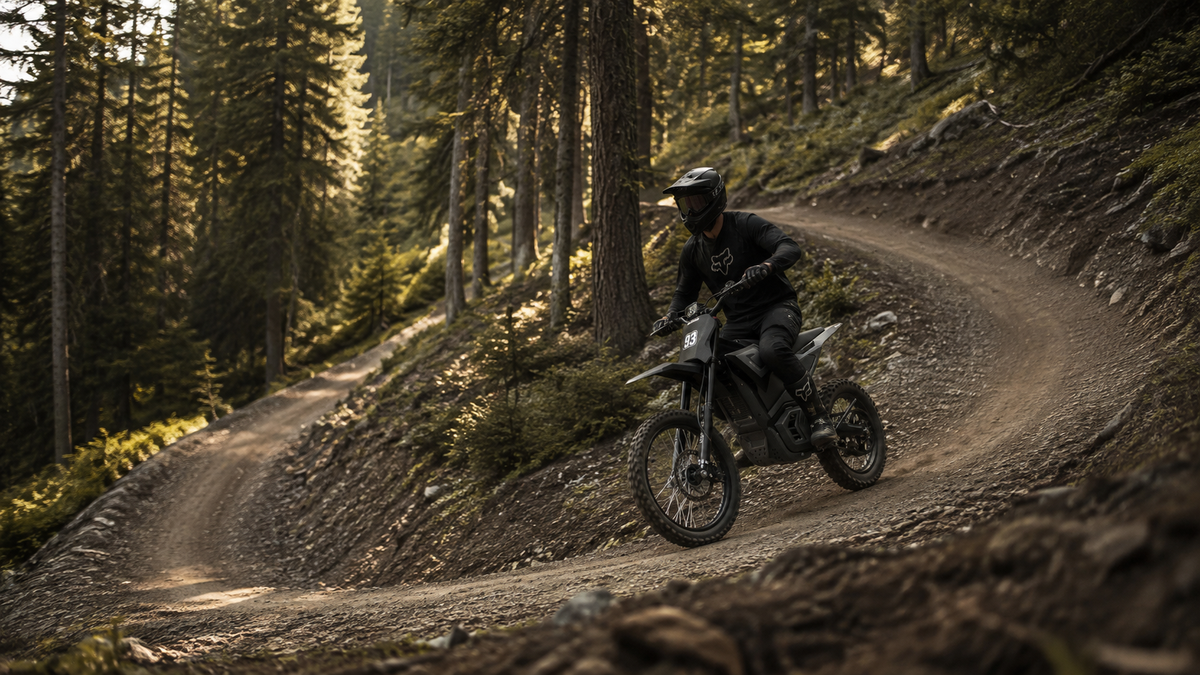
Electric Dirt Bike Tight Switchbacks: Build Low-Speed Turning Control
Slow down before the corner, not inside it. That one habit fixes more switchbacks than any body-position tip.
Tight turns want balance, timing, traction and throttle discipline in the same two seconds. An adult electric off-road motorcycle adds a wrinkle. No clutch to slip. Torque lands the moment your wrist moves. On an electric dirt bike the ride-mode selector is the closest thing you get to a slip zone.
Below: the sequence, the geometry that caps it, and the point where repositioning beats forcing the turn. Plus what we refuse to publish.
The Sequence, In Order

Four stages. Out of order, the corner runs you.
|
Stage |
What you do |
What ruins it |
|
1. Read |
Grade, surface, apex, exit, bailout point |
Deciding at the apex |
|
2. Slow |
Finish hard braking while upright |
Braking at full lock |
|
3. Steer |
Outside entry, later apex, eyes through the exit |
Staring at the outside edge |
|
4. Drive |
Small steady throttle as the bars unwind |
Power before the front wheel points out |
Every failure below is one of those four, done in the wrong order.
Why Electric Changes the Low-Speed Problem
No clutch, no slip zone
A gas rider meters drive three ways. Throttle, clutch, brakes. Feather the clutch and you pick exactly how much reaches the rear tire.
Take that away, and the middle tool goes with it. Drive now comes from wrist position through the controller, so small movements do more than they used to. Copying clutch technique from a gas bike is why strong riders struggle on their first electric trail day.
Torque arrives before wheel speed

Electric motors pull hard from almost nothing. Useful on a climb. Less useful with the bars turned and the rear tire sitting on gravel.
Keep the wrist neutral. Small amounts. A lower mode spreads the same wrist travel across a narrower speed band, which is exactly what a tight corner wants.
A closed throttle is not a neutral input
Some bikes settle when you shut off. Others slow hard from motor drag or regenerative braking. Some let you dial the effect.
Test it on flat open ground first. Learn whether closing the throttle steadies the bike or unsettles the rear on loose soil. That answer changes your entry plan.
Turning Radius Is Geometry Before It Is Skill

Tire size, wheelbase, steering stops, fork angle, footpeg position. Together they draw a circle the bike cannot turn inside. Practice buys more of the range that exists. Not more range. Read your own numbers before blaming technique, and take a minute to compare wheelbase and wheel sizes across the lineup.
Read your own numbers first
Three bikes we build, three low-speed characters. The EM-5 has the longest wheelbase and the smallest wheels, plus by far the lowest seat. That last figure is why beginners find it least intimidating at a standstill. Inseam matters more than riders expect, so our fit guide by height and weight beats a spec sheet.
|
Model |
Wheels front / rear |
Wheelbase |
Seat height |
Handlebar width |
Max load |
|
EM-5 |
14 in / 12 in |
43.3 in |
28.3 in |
27.2 in |
243 lb |
|
EM-5 Pro |
17 in / 14 in |
41.7 in |
31.5 in |
27.2 in |
287 lb |
|
EM23 |
19 in / 17 in |
41.7 in |
31.9 in |
30.7 in |
265 lb |
Live Valtinsu collection page, August 10, 2026. Age ratings are not interchangeable: EM-5 is 13+, EM23 is 16+, and EM-5 Pro is 18+ (adults only).
When the corner is smaller than the bike
A ride-through turn needs room for the front wheel to enter, cross the apex and point out. Ruts, rocks, banks and drop-offs steal it. Bigger wheels roll over trail junk more calmly and steer more steadily. That is the trade the EM23 makes with a 19-inch front. On real singletrack that stability reads as a wider arc.
Stop before you enter when the line looks wrong. Firm ground and a reposition beat reaching the apex at full lock with nothing left.
Set the Bike Up, Then Leave It Alone
Pick the mode with the widest control band

The three models compared here use different three-mode ladders. The EM-5 Pro runs 26, 40 and 52 mph. The EM-5 runs 22, 32 and 40. The EM23 opens at 16 mph, the lowest first-mode ceiling among these three and a useful option in technical corners.
Lower ceiling, more resolution between no drive and too much. Stay in one mode until the response is familiar.
The numbers we will not publish
|
An editorial position, not an oversight Plenty of blogs hand out a universal tire pressure, a sag percentage, a chain slack figure and a regen setting for "electric dirt bikes." We will not. Those are model-specific safety inputs. A pressure that suits a 12-inch rear rated to 243 lb is wrong on a 17-inch rear rated to 287 lb. In a switchback, that shows up as a front tire washing out. Every figure of that kind lives in your model-specific user manual. Same answer for the brake cutoff. Some guides walk you through bypassing it to hold drive while dragging the rear brake. We will not publish that. It is a safety input. If the cutoff behaves oddly, stop riding and check the manual. |
One change per session
Entry speed. Line. Mode. Regen. Body position. One at a time, or you will not know what helped. Write the baseline down first.
Read the Switchback Before the Front Wheel Arrives
Evaluate on the approach. Grade, surface, usable width, exit direction, consequence.
Uphill and downhill are different corners
Uphill needs drive to hold balance and climb out. Downhill loads the brakes, because gravity keeps shoving you at the outside edge.
Same turn ridden the other way wants a different line. Slow early enough to notice which one you are in.
Widest legal line, later apex
Use the full width of the built trail where rules and conditions allow. An outside entry grows the radius and buys the front wheel time.
Do not create width. No vegetation, no drainage structures, nothing past the markers.
Pick the bailout point on the way in
Your bailout is the last stable spot to stop before the turn gets hard to reverse. Firm footing. Room to hold the bike.
Choose it before you commit. Riders go too far because they wait until balance is already gone.
Body Position That Lets the Bike Turn Under You
Lean the bike, keep the torso calmer
On slow flat turns, the bike leans while your upper body stays more upright. That separation shortens the turning path without asking the tire for a big lean angle.
Steep and off-camber ground changes the answer. Adjust for grip and grade rather than repeating the same position everywhere.
Outside peg, loose elbows, planned dabs

Steady pressure on the outside footpeg keeps the lower body working instead of hanging off the bars. Firm, not stamped. Bent elbows let the bar move without dragging your torso off balance, and a locked inside arm pushes the front tire wide.
A planned dab saves a low-speed fall. Ground you can see, leg clear of the rear wheel, foot back on the peg once it settles. Dragging a boot through the whole corner is not technique.
Light rear-brake drag
A little rear brake with a small throttle opening smooths out the on-off feel of running a whole corner on throttle alone. Light is the word. Too much builds heat, and on models with brake-activated cutoff it reduces drive right where you need it.
Uphill and Downhill, Handled Differently
Uphill without spinning the rear
Carry enough momentum to reach the apex without a burst. Too little and you stop. Too much and you run out of time to turn.
Hold a small continuous opening through the apex where traction allows. Shutting off removes the drive balance depends on. Point the front tire at the exit before real power.
If the bike stops, hold the brakes and plant a foot only on stable ground. Reposition toward a workable line. Steep or exposed, get off and move it the way the manual says.
Downhill without washing the front
Start slowing on the straight above, then bleed pressure off as the turn tightens. Front brake stops hardest and loses grip first on loose ground. Rear settles the bike and skids sooner on a steep pitch. Use both, smoothly.
Do not slide so far back that the front goes light. Centred and active shares the traction. Soft arms let the front wheel self-correct on a rock. Throttle again only once the exit is clear.
Surface by Surface: What Actually Changes

Grip caps braking, lean, steering and power. Decide before you enter.
|
Surface |
Line and speed |
Power |
Avoid |
|
Loose gravel |
Slower entry, stay upright, hunt the swept strip |
Very small changes |
Trusting the polished centre |
|
Wet soil, mud |
Limit lean, skip deep water where legal |
Gentle, no spin |
Wheelspin walking the bike sideways |
|
Rock and roots |
Cross edges at the strongest angle |
Steady, light hands |
Running the front along a wet root |
|
Deep ruts |
Look through it first to confirm the exit |
Steady, centred |
Abrupt steering inside the rut |
|
Off-camber |
Less speed, less lean, smoother inputs |
Wait for flatter ground |
Driving hard across the slope |
|
Narrow or exposed |
Stop and inspect. Walk it if the cost is high |
None until committed |
Assuming flat-ground technique transfers |
Mud carries a maintenance tail. Follow the manual on wet operation, cleaning and post-ride inspection. IPX6 on our off-road models covers heavy spray, not submersion. The EM23 sits at IPX4.
Reposition Instead of Forcing It
Some switchbacks are narrower than any practical ride-through line. Repositioning is a trail decision.
- Foot-assisted turn. Slow to a stable pace, check the ground, place the inside foot, guide the bike through part of the arc on gentle power.
- A multi-point turn needs firm footing and real width. Short movements, a full stop between each, both wheels on the trail, never backing toward a soft edge.
- Pivot and hop turns work. They also need timing, strength and a controlled practice area. Learn them from a qualified off-road instructor, not for the first time beside a drop-off.
Diagnose the Failure, Then Change One Thing
Where the turn broke tells you which input needs work. Note speed, line, mode, braking and terrain before you adjust anything.
|
What happened |
Most likely cause |
The one fix |
|
Ran wide at the exit |
Too much entry speed, an early apex, or throttle before the front pointed out |
Slow earlier, apex later |
|
Stopped dead at the apex |
Entered too slow, shut the throttle fully, or dragged too much brake |
Hold a small steady drive |
|
Spun the rear tire |
More torque than the surface takes, often a high mode or an unloaded rear |
Drop a mode, straighten first |
|
Front tire washed out |
Braking hard while leaned, a rut wall, or a locked inside arm |
Finish braking upright |
|
Fixated on the edge |
Eyes on the hazard, hands following the eyes |
Look back at the exit line |
|
Foot down too early |
Habit. Costs peg control and weight distribution |
Both feet up while stable |
A Practice Progression That Transfers
Short controlled sessions. This order.
- Full-lock circles on flat firm ground, both directions, in a manageable mode.
- Figure eights. Big loops first, tighter only once the pace holds steady.
- Add light rear brake with a small throttle opening, if the manual permits it.
- Cone switchbacks. Three soft markers for entry, apex, exit. Move one marker at a time.
- A mild open slope. Uphill and downhill entries separately, safe runoff, no exposure.
- Both directions equally. Most riders hide a weak side by only practising the good one.
Never add loose terrain and steep grade in the same session. Riders learn faster when they change one variable, record the result, and repeat the same feature under controlled conditions.
Access, Etiquette and the Legal Trap
Your bike is almost certainly not an e-bike
This one catches people. Under 43 CFR 8340.0-5, an e-bike means a two- or three-wheeled cycle with fully operable pedals and a motor of not more than 750 watts. Our lightest model makes 3,840 watts and has footpegs. So e-bike trail permissions are not your permissions.
An electric dirt bike is generally treated as an off-highway motorcycle. Forest Service, BLM and Park Service e-bike pages are all built on that pedal-and-wattage line. Read them for contrast, not for access. Our guide on where you can legally ride goes further. Check the current land manager map, route designations, permits, and seasonal closures. When the classification is unclear, call the office that manages that trail system.
Quiet is not a warning device
Nobody hears you coming. Slow at blind turns, crossings, stopped groups and narrow passing spots, and speak up early enough that you do not startle a horse.
Do not cut the inside bank to straighten a switchback. It kills plants, loosens the soil, and opens a fall-line channel that carries water down the trail. Reposition instead. Keep the wheelspin down.
How We Built This Guide
- Manufacturer figures came from the live Valtinsu collection and product pages on August 10, 2026, not an internal deck.
- Turning, braking and hill guidance follows Motorcycle Safety Foundation off-highway material, cited below.
- Withheld on purpose: universal pressures, sag settings, chain slack, service intervals, clearance figures, and any brake-cutoff bypass.
Bottom Line

Read the surface and the exit. Slow while upright. Enter wide. Look through the corner and meter the throttle as the bars unwind.
Flat ground first, then grade, mud, rock and exposure. Start from the documented baseline for your model, learn what your regen and cutoff actually do, and change one thing at a time.
When the trail is narrower than the bike can turn, stop and reposition. That is the skilled answer.
FAQs
How do you ride a tight switchback on an electric dirt bike?
Slow while upright, turn from the widest legal entry, and add drive only as the front wheel points toward the exit.
- Choose a manageable ride mode before the corner.
- Look through the exit, not at the outside edge.
- Keep the wrist neutral and use a small, steady opening.
- Let the bike lean under a calmer upper body.
- Unwind the bars before adding meaningful power.
Practical tip: Practice the sequence on flat ground in both directions before adding grade or loose soil.
What are the most common tight-switchback mistakes?
Most failures start with too much entry speed or an early apex, not with a lack of motor power.
- Braking hard after the bike is already leaned.
- Staring at the outside edge instead of the exit.
- Abrupt throttle at full steering lock.
- Dragging a foot through the whole corner.
- Cutting the inside bank and damaging the trail.
Practical tip: If the exit keeps running wide, move the braking point earlier before changing body position.
Why does the rear tire spin in slow electric dirt bike turns?
The tire is receiving more torque than the surface can hold, often while it is also carrying cornering load.
Use a lower mode, reduce wrist movement, and wait until the bike is straighter before asking for more drive. If the problem repeats on familiar terrain, inspect tire condition and return to the model-specific pressure baseline rather than copying a forum number.
Practical tip: Change one input per attempt—mode, line, or throttle—not all three.
Can you drag the rear brake and use the throttle at the same time?
Yes, lightly, if the manufacturer permits it and the brake-cutoff system behaves predictably.
A small amount of rear brake can settle an on-off power delivery, but excess drag builds heat. A brake-cutoff sensor may also reduce or remove motor drive. Test the interaction on flat, open ground; never bypass the cutoff to make the technique work.
Practical tip: An inconsistent cutoff is a stop-and-inspect signal, not a reason to ride around the sensor.
How should uphill and downhill switchbacks be handled differently?
Uphill turns need controlled momentum and continuous traction; downhill turns need earlier braking and a clear runoff.
- Uphill: enter with enough momentum to reach the apex without a throttle burst.
- Downhill: do most braking on the straight approach and release pressure as steering increases.
- Both: choose firm ground for a bailout and add power only after the exit opens.
Practical tip: If the bike stalls on a steep uphill, hold the brakes and reposition instead of rescuing it with sudden power.
When should you stop and reposition instead of riding through?
Stop when the turn is tighter than the bike's available arc or when you cannot identify a safe entry, exit, and recovery point.
- Do not force full steering lock beside a drop-off.
- Do not make a first pivot-turn attempt on exposed terrain.
- Do not back toward a soft edge or stand on ground you cannot see.
Practical tip: Choose the last stable stopping point before the corner; that is your bailout, not a failure.
Sources
- Motorcycle Safety Foundation, Tips and Practice Guide for the Off-Highway Motorcyclist (2024).
- Motorcycle Safety Foundation, Rider Education Library and Motorcycle Operator Manual (2026).
- Electronic Code of Federal Regulations, 43 CFR 8340.0-5, Definitions (current).
- Bureau of Land Management, E-Bikes on BLM-Managed Public Lands (2026).
- USDA Forest Service, Electric Bicycle Use (2026).
- National Park Service, Policy for Electric Bicycle Use in National Parks (2026).
- Valtinsu, Electric Dirt Bike collection specifications (accessed August 10, 2026).


Looking for something else?
Electric Dirt Bike Loses Power Under Load: Causes and How to Fix It
LEARN MORE
Electric Dirt Bike Bolt Torque Checklist: What to Check and Where the Numbers Come From
LEARN MORE
How to Bleed Electric Dirt Bike Brakes Safely
LEARN MORE
Electric Dirt Bike Throttle Not Working: What to Check First
LEARN MORELooking for something else?
Electric Bike Battery Not Charging? Work Through This Before You Buy a New One
LEARN MORE
Electric Dirt Bike Error Codes: What They Mean and What to Check First
LEARN MORE
Electric Dirt Bike Brake Rotor Rubbing: Diagnose the Cause Before Adjusting
LEARN MOREYou may also like
VALTINSU EM-5 Off-Road Electric Dirt Bike
VALTINSU EM-5 Pro Off-Road Black Electric Dirt Bike
VALTINSU EM-5 Pro Green Electric Dirt Bike
VALTINSU EM-5 Ultra Electric Dirt Bike
VALTINSU EM-5 & EM-5 Pro Combo
Further reading
Electric Dirt Bike Trailside Power Loss: Recovery Plan When the Battery Is Dead
Electric Dirt Bike Fall Riding on Wet Leaves: Grip, Hidden Obstacles and Braking
How to Lift a Fallen Electric Dirt Bike Without Hurting Yourself or the Bike