Electric Dirt Bikes at OHV Parks: Rules and Checklist
Before loading the bike, contact the OHV park and verify the current rules for the exact make and model. Forum posts and prior visits cannot confirm today's registration, zone, charging or closure requirements.
An OHV park that permits motorcycles may still classify a high-power electric off-road motorcycle differently. The park may accept the bike throughout the facility, restrict it to certain zones or decline admission based on state documentation or venue policy.
The answer depends on how the machine is classified, which state OHV documents are required, which trails or zones permit that vehicle class and whether charging or spare-battery storage is allowed on site.
What follows is the workflow we use before a first visit. A call-ahead script that produces something in writing, the paperwork to pack, a zone check, a charging plan, and a first lap treated as reconnaissance instead of a warm-up.
The Short Version: Five Things to Confirm Before You Load
Confirm these five items with the venue and relevant authority before travel:
- Is this exact make and model accepted? Not "electric dirt bikes" in general. Yours.
- Which documents come with you? Registration or decal, nonresident permit, day pass, waiver, proof of ownership, photo ID.
- What zones is it cleared for? Admission and trail access are two different permissions.
- Charging and battery storage. Outlets, generators, cords, spare packs, supervision rules.
- And the incident procedure. Who to call, how trails are numbered, what happens after a crash or a battery warning.
Ask for written guidance and save it for check-in, but treat it as advisory. Posted rules, current permits, closure orders and on-site staff instructions remain controlling.
Know Which Authority Actually Decides

Park staff do not control every rule they enforce. Registration usually comes from the state. Route designations on federal land come from the land manager. Zone rules and charging policy come from the operator. When an answer sounds uncertain, it is often because you asked the wrong desk.
|
Authority |
What it decides |
Where to check |
|
Park operator (private or state) |
Vehicle acceptance, admission, zones, waivers, charging policy, pit rules |
Direct contact, in writing |
|
State OHV program or DMV |
Registration, decals, nonresident permits, reciprocity, equipment code |
The state OHV or DMV site |
|
U.S. Forest Service |
Which roads and trails are open, by vehicle class and season |
That unit’s Motor Vehicle Use Map |
|
BLM field office |
Open, limited or closed area status, plus local closures |
The area page and the field office |
|
County or local agency |
Access roads, staging, hours, noise complaints |
County parks or the sheriff’s office |
The federal side is the strictest about paper. Under 36 CFR 261.13, once a national forest unit has published its designations, operating a motor vehicle outside them is prohibited whether or not a sign is standing there.
The Motor Vehicle Use Map is the document that settles it, and routes it does not show are not open. On BLM ground, the frame is different again: areas are open, limited or closed, and every off-highway vehicle still has to satisfy state rules on top of that.
Why "Electric" Is the Wrong Question at the Gate
Nobody is turning you away for the motor. The problem is the word riders reach for when they describe the bike.
Do not lean on the e-bike label
Class 1, 2 and 3 definitions hang on functional pedals, assisted speed and motor output. A throttle-controlled machine with no pedals and four figures of peak wattage sits outside all three. Say "e-bike" on the phone, and you may get a cheerful yes that means nothing when you arrive.
Forest Service guidance treats electric motorcycles as OHVs rather than low-speed e-bikes for its trail-registration framework. California eligibility and documentation depend on the current state program and the exact machine; do not assume another brand or model receives identical treatment.
Describe the vehicle, not the category
Give staff the model and model year, rated and peak output, top speed capability, wheel sizes, weight, and the fact that it has no pedals and is built for off-road use. State the rider age. Say whether you are a resident.
If staff are unsure, send the manufacturer specification page and ask for the person responsible for vehicle eligibility. Uncertainty is not permission; wait for an answer that cites the applicable policy or requirement.
Park access is not street legality
Being welcome inside the fence changes nothing about the road outside it. Registration, plates, insurance, licensing, lighting and inspection are a separate stack of requirements, and what a street-legal conversion actually involves is its own project. Plan to trailer the bike to the approved unloading point. A quarter-mile of public road between the hotel lot and the gate is still a quarter-mile of public road.
The Call-Ahead Script That Gets a Usable Answer

Email beats a phone call for one reason. You can show it to somebody at the window.
Open with the exact machine and the exact date
|
Subject: Vehicle eligibility check, [date] visit I plan to visit on [date] with a [model, model year]. It is a no-pedal electric off-road motorcycle, [peak output] peak, [top speed] capability, [weight] with a [seat height] seat. The rider is [age] and is a [resident / nonresident]. Specification page: [link]. Is this exact motorcycle permitted at your park on the planned visit date? Please send the current policy or written guidance covering required documents, permitted trails and zones, and charging. |
Short, specific, answerable. Vague questions get vague answers, and a vague answer is what leaves you at a gate with a loaded trailer.
Then work the checklist
- Which registration, permit, decal, waiver or insurance do I bring?
- Are there power, wheel-size, weight, age or equipment limits?
- Which trails, tracks, pits and practice areas may this bike enter?
- How do you handle spark-arrestor wording and sound testing for an electric motorcycle?
- Charging or battery swaps on site, yes or no?
- Generators, chargers and extension cords, and where they may be used?
- Where do I park, unload, and start powered riding?
- What is the procedure after a breakdown, a crash, or a battery warning?
One more, and riders skip it: ask whether any of those answers change for weather, an event weekend, a seasonal schedule, or your arrival time.
Get it in writing
Save the reply. Save the name of whoever sent it, the date, the policy links, and every condition attached to the yes. Given a phone answer, send a two-line summary back and ask them to confirm. An undated park post or a comment thread from last year is not proof of anything current.
Documents and Rider Rules to Nail Down
Missing or unacceptable documentation can end a first visit at check-in, before the bike reaches a trail.
Registration, decals and reciprocity
Ask whether the governing authority wants OHV registration, a displayed decal, a nonresident permit, a day pass, or some combination.
California is a useful example of how specific this gets: the state OHMVR program requires a highway licence or a DMV identification sticker on any land open and accessible to the public for OHV recreation, private property excepted, and reciprocity for out-of-state riders depends on whether your home state honours California’s sticker in return. Registration runs through the DMV’s off-highway vehicle process.
Ask whether the machine’s VIN or serial format and ownership documents satisfy both the state registration process and the venue’s admission policy. Do not assume a bill of sale, title or manufacturer certificate is interchangeable.
Ownership and identity paperwork
Ask for the exact document list and whether originals, digital records or copies are accepted. Common examples include registration, proof of ownership, identification, membership and a signed waiver, but the venue’s current list controls.
Helmet, age and supervision
Helmet standards, protective equipment, minimum age, adult supervision, safety-course requirements, passenger rules. All of it varies by venue, and some of it varies by zone inside a single venue. Youth areas and tracks often carry stricter rules than the trail system.
Park helmet rules can be stricter than general state requirements. Check the current venue policy and wear a properly certified helmet regardless of the legal minimum.
Equipment language written for gas bikes
Equipment policies may address spark arresters, sound testing, mufflers, flags, number plates, mirrors and other items. Some provisions are written around combustion vehicles, but the park or governing authority must confirm how each rule applies to an electric motorcycle.
Ask the venue how exhaust-related rules are applied to a machine with no combustion exhaust and request the answer in writing when possible. Do not assume that an electric motorcycle is exempt from the facility's broader inspection, registration, fire-season or equipment policies.
|
From our own venue calls Venue answers can vary by staff role and by how clearly the machine is described. Ask the person responsible for vehicle eligibility and request a link or citation to the current policy. Save the written reply, but recheck it against posted rules and check-in instructions on the visit date. |
Verify the Zones the Bike May Actually Use
Get the current official map
Download the latest one before you leave, then take a fresh copy at check-in. Mark the entrance, the office, staging and unloading, beginner loops, motorcycle-only trails, shared OHV routes, tracks, closed zones, emergency exits and recovery access.
Match vehicle type to zone
Admission is not access. Motorcycles get excluded from ATV-only and side-by-side routes, from bicycle and pedestrian trails, from youth areas, from racecourses and skills zones. Ask specifically whether electric motorcycles carry any extra route restrictions beyond the motorcycle class.
Check same-day closures
Check alerts before you leave. Ask again at the window. Wet weather, maintenance, fire danger, an event, capacity limits, a seasonal schedule, storm damage, any of it closes part or all of a facility on the day.
Ask about temporary one-way routes too. Where a sign contradicts your saved map, the sign wins.
Dirt Bike Park Checklist: Transport and Load-Out

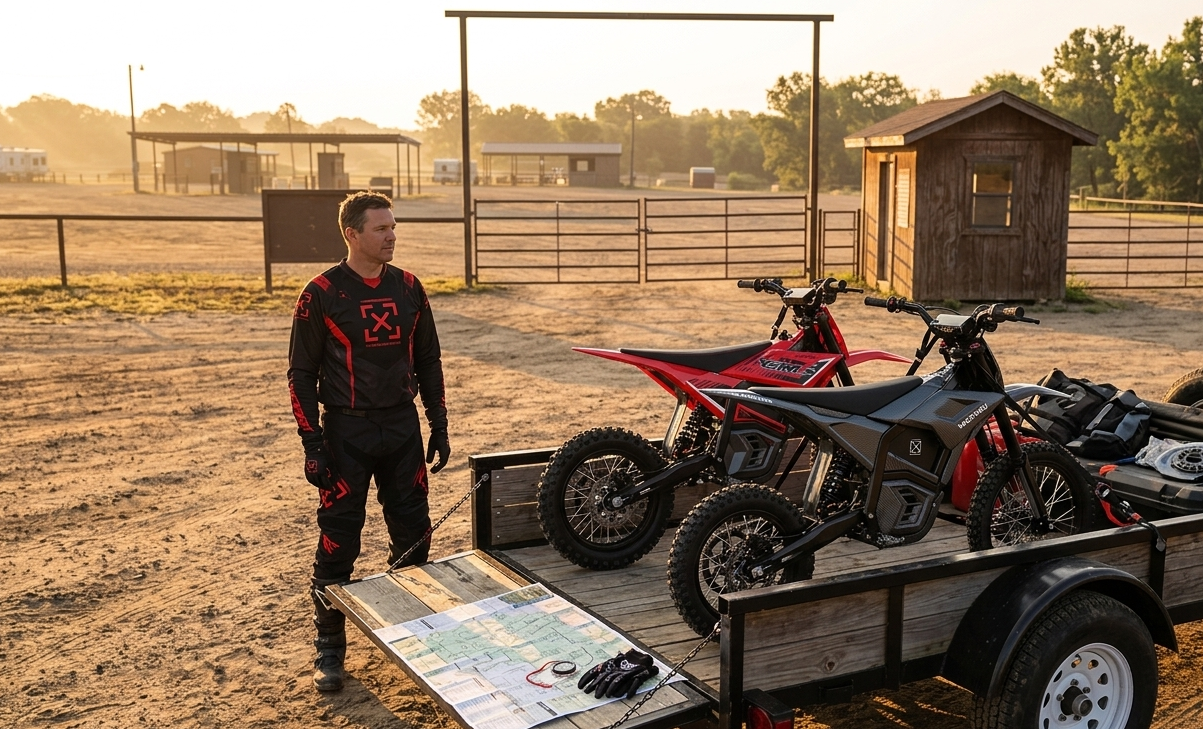
Weight is the spec that catches people out. Adult electric off-road motorcycles are heavier than the mini bikes riders picture, and a rack rated for a bicycle is not rated for this.
|
Category |
Bring or verify |
Why it matters |
|
Paperwork |
Registration or decal, permit, waiver, photo ID, proof of ownership |
Check-in stops here without it |
|
Carrier |
Trailer or rack rated well above the bike’s gross weight, tow vehicle payload checked |
An EM-5 Pro is 143 lb net, 161 lb crated |
|
Tie-downs |
Manufacturer tie-down points, soft loops, nothing strapped across the pack |
Frame and pack damage is not a warranty claim |
|
Charging |
Manufacturer-approved charger; current venue policy confirmed |
Improvised adapters are the fastest route to a refusal |
|
Recovery |
Model tools, tube or plug kit, tire irons, chain tool, zip ties |
A trailside fix beats a two-mile push |
|
Gear |
Helmet to the park’s standard, goggles, boots, gloves, armour |
Standards differ between trails, tracks and youth zones |
|
Navigation |
Offline map, park number saved, marker system understood |
Coverage drops fast past the staging area |
|
Water and first aid |
Per rider, not per trailer |
Heat, odour, smoke or charging faults require an immediate stop |
One more line for the trailer: protective gear and spares are cheaper to carry than to improvise. Do not assume you may ride from a campground, a hotel lot, a friend’s driveway or a roadside verge to the gate. A short public-road connection creates an illegal gap even when the destination is perfectly legal.
Charging at an OHV Park Is Not a Given
Here is the gap in every location guide we have read. They tell you the park allows motorcycles. None of them tell you whether you can put electrons back in.
Ask before you count on it
Verify outlet type, voltage, access fees, reservation rules and hours on the venue’s current page or with staff. Public vehicle-charging infrastructure may not provide a compatible household outlet for a bike charger.
If plugging into park power is prohibited, ask what is allowed instead. Owner-supplied generators, heavy-duty cords, a designated charging area, continuous supervision. Some parks permit generators in the pits and nowhere else.
Charge by the book
Use the charger that came with the bike. Nothing improvised, nothing unattended. Do not charge a pack that is hot from riding, wet, swollen, impacted or deformed.
These controls address documented charging hazards. CPSC’s 2026 proposal is not yet a final standard; its incident review covers 227 micromobility battery incidents from 2019–2023, including 120 while products were plugged in and charging. Follow current manufacturer and venue rules rather than treating the proposal as law.
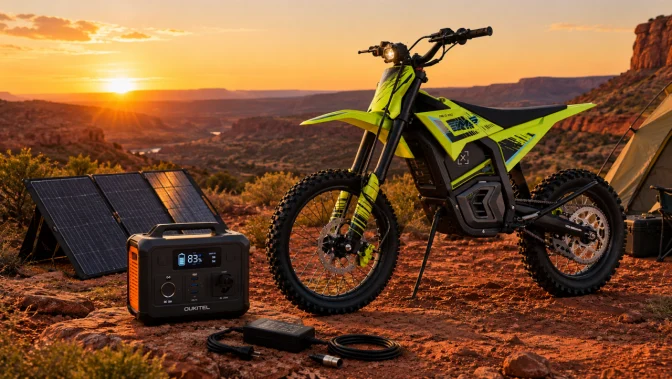
Charge times are long enough that this needs planning rather than improvising. Seven to eight hours on the EM-5 and EM-5 Pro, six to seven on the EM23, from a standard household outlet. Follow your model’s user manual on sequence and storage.
Protect the return reserve
Rated range does not predict a park day. Surface, elevation, temperature, load, mode, starts and wheelspin all change energy use. Build a turnaround reserve from comparable rides rather than applying a fixed percentage.
So set the reserve as a number, not a feeling. Enough charge to get back to staging with margin, decided before you leave the trailer.
Spare packs and swaps
Ask where spares may be stored and where a swap may happen. Terminals stay clean, dry and shielded from dust, moisture and impact through transport and staging. A pack rattling loose in a truck bed is a problem waiting for a pothole.
Check-In and the Pre-Ride Inspection
At check-in, present the current documents and identify the bike as electric. Confirm that the written guidance still matches today’s zones, closures and charging rules. Take the current map and ask about traffic direction, emergency contacts and unusual conditions.
Then inspect, off the trailer, before anything is switched on.
- Tire pressure and spoke tension
- Brakes, levers, lines
- Chain tension and alignment
- Suspension seals, fastener torque, guards
- Battery retention latches and charging-port seals
- Cable routing and any warning indicator on the display
Record starting charge, mode and a conservative turnaround reserve based on comparable use. Recheck consumption after a short first loop and leave margin for delays and recovery.
The First Lap Is Reconnaissance, Not a Warm-Up

Ride the easiest approved loop first. Even with years of experience elsewhere. Trail ratings are set by each venue against its own terrain, and a green loop at one park bites harder than a blue at another.
- Pick the shortest green-rated loop inside your confirmed access zone.
- Locate one-way markers, blind crests, jump landings, bypasses, merges, and any intersection where a side-by-side can arrive faster than you expect.
- Test throttle response, braking, traction, and regenerative drag at controlled speed, using approved settings only.
- Log the charge drop against distance, climbing, and mode. That is your real consumption rate for the day.
- Set turnaround triggers off that number: charge remaining, clock time, weather, fatigue. Any one of them ends the loop.
Recalculate before committing to anything remote. Either the lap confirms your plan, or it corrects it. Both are worth twenty minutes.
Off-Road Park Trail Etiquette for a Quiet Bike
Silence is the feature that gets electric riders in trouble.
Assume you have not been heard
Other users track approaching traffic by engine note. You do not have one. Slow where sight distance is short, pass only with room and clear acknowledgement, and treat every blind corner as occupied. Never assume the rider ahead knows you are there.
Quiet unlocks nothing, either. It is not permission to use a bicycle path, a pedestrian trail or a closed zone.
Yield, and slow down early
Follow posted direction and staff instruction. Slow before intersections, blind turns, stopped riders, children, horses, pedestrians, and routes shared with larger machines. The BLM’s own best-practice list is short and worth reading once: helmets, obey posted signs and fencing, register with the state agency where required, respect private property.
Protect the surface
No unnecessary wheelspin. No shortcutting, no roosting other users, no riding around a closure barrier, no saturated trails. Rutted trails are what close trail systems, and electric machines are already carrying more scrutiny than they deserve on that front.
Keep the pits calm
Observe the posted pit speed. Do not test acceleration anywhere near people, animals, trailers, parked vehicles, or charging equipment. Instant torque is fun in exactly one place, and the staging area is not it.
Breakdowns, Crashes and Battery Incidents
Learn the recovery procedure first
Ask whether the park runs patrols, offers towing, maintains recovery points, or has emergency vehicle access. Save the number. Learn how trails and intersections are marked, because "somewhere past the second creek" is not a location anybody can drive to.
Stop after a hard impact or a warning
Pull over somewhere safe and shut down per the manual. Do not keep riding with pack deformation, damaged cabling, unusual heat, odour, smoke, leaking fluid, abnormal noise, or an electrical fault light. Follow the manufacturer procedure rather than improvising a fix on a trailside rock.
Report it
Tell staff promptly after an injury, a collision, a blocked trail, damaged facilities or a suspected battery event. Keep others clear where that is sensible. Do not move, open, charge or transport a suspect pack until the manufacturer, emergency personnel or another qualified authority confirms the safe procedure.
Matching an EM5-Series Bike to a Confirmed Venue

Confirm access first. Then compare the EM-5, the EM-5 Pro and the EM23 against the venue’s written vehicle-class, document, zone and charging requirements. A park’s acceptance of one model does not prove it accepts another.
Use current product pages to compare dimensions, weight, riding modes, charging time and control layout; do not infer legal classification or trail permission from marketing names. Start in the lowest mode and use a short familiarization loop.
Compare the EM5-series lineup side by side, then verify the exact model page and your model’s user manual before purchase or travel. The right bike is the one the rider can stop, turn, recover and load safely at the confirmed venue—not the one with the largest peak number.
How We Built This Checklist
Three inputs, in this order.
Reader questions, not location lists
The workflow is built around the questions a venue must answer before a rider loads the bike: exact vehicle eligibility, documents, zones, charging and the on-site sequence. A location list cannot replace those current, venue-specific answers.
Primary regulatory sources only
The legal framework below uses regulations and land-management or state-agency sources. Venue policy, registration steps and closures still require a fresh check before each visit.
Product pages used only for comparison
Product pages support specification comparisons, but they do not prove venue eligibility. Recheck the exact model page and manual at publication; if any figure conflicts with the approved workbook, resolve the mismatch before publishing.
Get It in Writing, Then Ride the First Lap Slow
Identify the exact motorcycle and visit date. Contact the park, save its guidance, pack the current documents, verify zones, and settle charging, swaps and recovery. At check-in, confirm that the guidance still matches posted rules, then use a short first loop to read traffic, surface and real consumption.
A quiet powertrain does not waive registration, equipment, access or operating rules. The applicable agency and venue decide which requirements apply.
Once a park has said yes in writing, compare the EM5-series lineup side by side against what it actually told you. Terrain first, paperwork second, spec sheet third.
FAQs
Do OHV Parks Require Registration for Electric Dirt Bikes?
Some do. Registration is set by the state program and venue, not by the motor type alone.
- Confirm how the park classifies your exact machine.
- Check the required state decal, OHV permit or nonresident credential.
- Verify proof-of-ownership, VIN or manufacturer-document requirements before travel.
- Check whether the park also charges a separate entry or day-use fee.
Can You Charge an Electric Dirt Bike at an OHV Park?
It depends entirely on the venue. Do not assume that an outlet in a campground or paddock is approved for vehicle charging.
- Ask whether compatible outlets or designated charging areas exist.
- Confirm whether generators, extension cords or unattended charging are prohibited.
- Arrive with a planned battery reserve and follow the manufacturer’s charging instructions.
Can I Ride an Electric Dirt Bike on the Road to Reach the Park?
Not automatically. Park admission does not make an off-road machine street legal. The public-road segment may require accepted title or VIN status, registration, a plate, approved equipment, a licence and insurance. Trailer the bike unless the responsible motor-vehicle agency confirms both the route and machine are compliant.
Do Electric Dirt Bikes Need a Spark Arrester?
A spark arrester is designed for combustion exhaust, but the park and state determine how their equipment rule applies at check-in. Confirm before travel; registration, fire-season, speed, sound and zone restrictions can still apply.
Is a Helmet Required at an OHV Park?
Many parks require helmets, and venue rules may be stricter than general state law. Confirm the required certification standard and any age- or zone-specific rule. Regardless of the minimum, wear a properly certified helmet, eye protection, gloves, boots and protective clothing.
Does a Quiet Motor Give an Electric Bike Extra Trail Access?
No. Quiet operation does not create access where the official map, land order or venue policy excludes the vehicle. It does improve trail interaction: slow at blind corners, expect other users not to hear you and pass only after they acknowledge you.
Sources
- USDA Forest Service, Register vehicles and e-motorcycles for use on OHV trails (2025)
- eCFR, 36 CFR 261.13 Motor vehicle use (2026)
- USDA Forest Service, Motorized Vehicle Use Maps (MVUM) (2026)
- Bureau of Land Management, Off-Highway Vehicles on Public Lands (2026)
- California State Parks OHMVR Division, OHMVR Frequently Asked Questions (2026)
- California DMV, Register an Off-Highway Vehicle (OHV) (2026)
- California State Parks, Electric Vehicle Chargers in State Parks (2026)
- Federal Register (CPSC), Safety Standard for Lithium-Ion Batteries Used in Micromobility Products (2026)


Looking for something else?
Electric Dirt Bike Replacement Parts Availability: What Buyers Should Verify Before Ordering
LEARN MORE
How to Check an Electric Dirt Bike for Safety Recalls by Model and Serial Number
LEARN MORE
How to Choose an Electric Dirt Bike Repair Shop: Questions to Ask Before Service
LEARN MORE
How to Lift a Fallen Electric Dirt Bike Without Hurting Yourself or the Bike
LEARN MORELooking for something else?
Electric Dirt Bike Fall Riding on Wet Leaves: Grip, Hidden Obstacles and Braking
LEARN MORE
Electric Dirt Bike Trailside Power Loss: Recovery Plan When the Battery Is Dead
LEARN MORE