High-Altitude Electric Dirt Bike Performance Guide
High altitude does not reduce electric-motor output through oxygen starvation as it does in a combustion engine. However, lower air density can affect cooling, while steep climbing, cold, loose surfaces, limited charging and rider acclimatization can reduce usable performance and range.
There is no universal electric-dirt-bike power or range loss per thousand feet. Separate elevation itself from grade, temperature, surface, load and speed, then measure consumption on a short representative loop before committing to a remote route.
Quick Answer: Does Altitude Cut Electric Dirt Bike Power?
Not through the combustion-engine mechanism. A battery-electric drivetrain does not burn oxygen, so gasoline-engine altitude-loss formulas do not apply. Output can still be limited by battery state of charge, temperature, controller protection, sustained load and cooling.
Most articles stop there. The planning starts there, because the motor is one component in a system that also holds a pack, a controller, protection software, tires, a charger and a rider.
|
Factor |
What altitude alone does |
What still needs planning |
|
Motor torque |
No oxygen dependence, so no combustion-style loss |
Sustained output is set by thermal limits and software, not elevation |
|
Usable range |
No direct oxygen-starvation loss; route and thermal effects remain |
Climbing, load, cold, surface and wheelspin all raise consumption |
|
Cooling |
Lower air density can change convective heat rejection |
Slow steep climbing means high current and weak airflow together |
|
Tire pressure |
Gauge readings shift with temperature and ambient pressure |
Set cold pressure inside tire and bike limits, every ride |
|
Charging |
Supply and charger compatibility still require verification |
Verify the source, the temperature window and the hours you have |
|
Rider capability |
Oxygen availability drops with elevation |
Acclimatization, symptoms, turnaround gates, recovery plan |
Because the motor does not require combustion air, electric motorcycles can retain their basic torque-production mechanism at elevation. That advantage does not remove limits imposed by the battery, controller, cooling system, traction, route and rider.
Long grades, low climbing speeds, loose or wet surfaces, cold conditions, extra load, low starting charge and limited access to approved charging can all reduce the usable margin. Record these factors separately from elevation.
Separate Altitude From Everything That Travels With It
Elevation often changes alongside temperature, gradient, surface, support access, and recovery distance. Log these factors separately instead of attributing the whole result to altitude. Log the factors separately. Otherwise your own ride data will mislead you.
Elevation and Elevation Gain Are Different Numbers
Absolute elevation is height above sea level. Elevation gain is how much climbing the bike actually does. Trailering to an 8,000 ft trailhead costs the battery nothing. Riding from 4,000 ft to 8,000 ft costs real energy, because lifting bike, rider, gear, and water against gravity has a price that lands on the charge indicator.
Same summit. Very different bill.
There Is No Altitude Range Calculator
A fixed range-loss percentage per thousand feet is not reliable. Consumption depends on pack capacity and condition, system efficiency, total mass, temperature, cumulative climbing, speed, surface, tire setup and throttle use. Measure a representative route and record the conditions.
Records Are Not Consumer Range Tests
In November 2025, Swiss rider Jiri Zak reportedly took a stock Stark Varg EX to 6,721 m on Ojos del Salado, on the Chile and Argentina border. GPS units were sealed and calibrated three days ahead. At last check, the figure was still moving through Guinness verification, against a listed mark of 6,639 m set on the same mountain days earlier.
A real milestone. Not a range test.
The reported high-altitude ride involved a support team, acclimatization, route planning, weather windows, and thermal management. Those conditions should not be used as evidence that an unsupported rider-and-motorcycle combination can repeat the route safely.
What Actually Changes Inside the Electric System
Pack, controller, software, cooling path. All four have limits, and mountain conditions push on all four. A motor that does not breathe air is not the same thing as a system that does not care where it is.
Battery Output Tracks Temperature and Load, Not Elevation

Cold-temperature research on road electric vehicles shows that battery and drivetrain efficiency can change with temperature, but cabin-heating percentages do not transfer to an electric dirt bike. Use model-specific battery limits and measured trail consumption rather than applying a passenger-vehicle percentage.
State of charge counts too. A pack at 30 percent behaves differently under a long high-current climb than the same pack at 90 percent, and protection thresholds live in software, not in your route plan. Use the display and the manufacturer instructions instead of estimating capacity from a topo map. Several everyday habits quietly cut range before altitude gets any say in it.
Thinner Air Can Change Heat Rejection
Air carries heat away from the motor, controller, wiring and charger. Lower air density can reduce convective cooling, especially during sustained high-load operation, but the effect depends on the specific cooling design. No universal altitude correction factor applies across electric dirt bikes.
Protection Software May Trim Output Before You Notice
A controller or battery-management system may reduce output when temperature, voltage or state of charge reaches a protection threshold. The rider may perceive this as altitude-related power loss, but the correct diagnosis requires the model's warning information and operating limits. Peak output also should not be treated as sustained climbing output.
Warning lights, error codes, intermittent delivery, unexplained power loss. Any of those means stop. Do not bypass a sensor, do not change protection settings, and do not keep climbing to see whether the warning clears.
Electronics Still Need Published Limits
Read the documentation before the trip, not at the trailhead. Operating, charging, transport, and storage boundaries, plus any temperature or ventilation limit for specific components. Valtinsu publishes user manuals and spec sheets per model and, like the rest of the category, publishes no maximum operating altitude.
Absence of a figure is not permission. It means the limit is unknown and should be clarified with the manufacturer before the route plan depends on it.
Why Mountain Routes Drain More Energy Than Flat Miles
You pay for vertical, then you pay again for the surface it sits on. A bike can keep every bit of its motor principle at 9,000 ft and still give back far less usable range than the same pack manages on flat singletrack. How much less is a measurement, not a percentage.
Count Cumulative Gain, Not Summit Height
Record total climbing, not the difference between trailhead and high point. A rolling forest road sheds and regains elevation a dozen times and can stack up more gain than one steady ascent to the same endpoint. Compare distance, gain, surface, pace and exit options together. Mapping data carries errors, so leave reserve instead of planning against the full number on the display.
Weigh the Whole Moving Mass

The motor moves more than the bike. Rider, helmet, armor, water, tools, luggage, comms, spares, plus any approved accessory bolted on. Added mass raises climbing energy and changes braking, tire, and suspension demand on the way down. Load ratings exist for a reason. The EM-5 Ultra lists a 287 lb maximum, and a rider in full gear with a loaded pack sits closer to that ceiling than most people expect.
Add Surface, Traction and the Regen You Will Not Get
- Firm gravel is cheap. Sand, mud, snow, loose rock and deep ruts are not.
- Wheelspin burns charge and produces no forward progress, which is how a 200 ft technical pitch costs more than a mile of road.
- Very low pressure raises rolling resistance and adds tire and rim risk, so it is not a free range trick.
- Regen is model-specific. Strong on some bikes, token on others, absent on a few, and capped by pack temperature, state of charge, traction, and descent speed.
- Do not base the return budget on energy recovery during the descent. Budget the route on measured consumption plus a return reserve, using a repeatable range-testing method that logs charge, distance, gain, temperature, load and surface together.
Test Cooling and Power Delivery Under Sustained Climbing

Evaluate sustained load rather than top speed. Long or technical climbs can demand high current while providing limited cooling airflow; actual temperature response depends on the model, load, pace, surface, and ambient conditions. Use documented limits and observed warnings rather than a generic safe speed.
Log the same fields every run:
- Start and finish state of charge.
- Distance, moving time, cumulative gain.
- Ambient temperature at the start, then again at the high point.
- Ride mode, and whether you changed it mid-route.
- Surface in plain words. Dry gravel. Wet clay. Loose pumice.
- Any warning, any derate, anything that felt different from last time.
Never ride through abnormal feedback. Warnings, unusual heat or odor, intermittent power, odd mechanical noise, damaged cabling, unexplained derating. Shut it down. Follow the manual, get qualified service before the next ride.
Our hill-climbing guide covers throttle and body position for steep pitches, and it does not replace a service decision.
Tire Pressure at Elevation: What to Change and What Not To
Set cold pressure inside the manufacturer range and stop there. Search for a high-altitude e-bike tire pressure rule, and you will find advice to add or drop a fixed amount per thousand feet of gain. Skip it. What genuinely moves your gauge reading is temperature, and the fix for temperature is measurement, not arithmetic.
Measure Cold, Before the Ride
Michelin is direct about this. Check pressure cold, before every ride, because a tire that has been running reads high. Never bleed air from a hot tire to hit a cold-pressure number. Compare against the range approved by both the tire and the motorcycle manufacturer, and use a gauge you trust rather than the one chained to the compressor at the gas station.
No Per-Thousand-Feet PSI Rule, But Recheck After a Temperature Swing
Air contracts as it cools, so pressure falls. A tire set correctly in a warm staging area can read low at a cold trailhead two hours up the road, and DOE lists that same effect, cold-weather pressure drop raising rolling resistance, among the reasons winter mileage falls. Temperature story, not an elevation story.
Check again at the trailhead, reset to the approved pressure for the conditions you are riding in, and do not exceed tire, rim, or structural limits chasing temporary traction. A rim strike at 10,000 ft with no cell service is a recovery problem.
Treat Mountain Charging as a Go or No-Go Decision
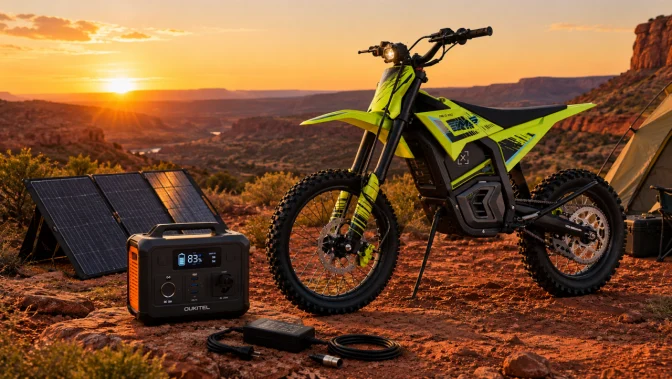
Assume there is no charging until you have verified there is. Trailhead outlets, cabin outlets and campground pedestals are not amenities to plan around on faith, and the arithmetic gets unforgiving once you look at real charge windows.
Read the Charger Numbers Before You Leave

Charge time decides what a mountain day looks like. The EM-5 Ultra ships with an 84V / 5A charger and lists a 7 to 8 hour charge, so a mid-route top-up is not a thing on that platform. You get the pack you left with. Check approved input power, operating temperature range, siting requirements, and any stated altitude boundary for your exact charger and battery pairing.
Do Not Charge Outside the Allowed Temperature Window
UL Standards & Engagement guidance is blunt: do not charge in extremely hot or cold conditions, keep packs away from heat sources, and use only batteries and chargers the manufacturer approved for that device. No improvised warming, no cooling tricks, no custom adapters, no unverified generator. Follow the manual and the onboard indicators.
Confirm the Power Source, Then Confirm It Again
Outlet availability, voltage, grounding, generator compatibility where it is expressly approved, access hours, and the hours you will genuinely be parked. An unverified source is an unavailable source. Plan the ride so it still works when the outlet is dead, because eventually one will be.
Rider Acclimatization and Decision-Making Matter
High elevation can affect rider judgment, coordination, and recovery capacity even when the electric motor is not oxygen-limited. Include acclimatization and symptom checks in the route plan.
Build an Acclimatization Plan, Not a Fitness Argument
CDC guidance puts inspired oxygen pressure at roughly 69 percent of the sea-level value at about 10,000 ft, and acute exposure there can pull arterial oxygen saturation into the high 80s. Gradual ascent is the recommended pattern.
Avoid jumping straight to a sleeping elevation above 9,000 ft in one day, move sleeping elevation no more than about 1,600 ft per day once above that, and add a rest day for every 3,300 ft of sleeping gain. Day trips with a return to lower ground are less stressful than sleeping high.
Physical fitness does not prevent acute mountain sickness. Headache, nausea, dizziness, fatigue, or impaired judgment are reasons to stop ascending and follow current medical guidance; severe or worsening symptoms require descent and medical help.
Confirm Motorized Access in Writing
Check the Motor Vehicle Use Map for the forest you are entering, plus trailhead notices, seasonal closures and vehicle-class rules. The Forest Service position is unambiguous: routes not shown on the MVUM are not open to public motor vehicle travel, and designated routes are not always signed on the ground. Quiet operation earns no exemption. Our forest-road access guide covers route legality in depth.
Set Turnaround Gates, and Plan for a Bike You Cannot Ride
Pick the numbers at the truck, in daylight, before anyone is tired. State of charge, clock time, weather, temperature, rider condition. Then honor them. Share the route and your return time with someone who is not riding, carry navigation and communication backups, and mark vehicle access points along the route rather than only at the ends.
Do not assume a partner can tow or recharge the motorcycle on a loose grade. Compare the exact ready-to-ride mass with slope, footing, available recovery equipment, access points, and communication coverage before committing.
Expert View: What Repeats in Real Mountain Rides
High-altitude ride analysis should separate three questions: whether climbing consumption exceeds the flat-route baseline, whether a warning or output reduction matches a documented thermal or state-of-charge limit, and whether the route plan included a clear turnaround gate and recovery option.
Build a Measured Short-Loop Altitude Baseline

Start with a short loop of known distance and cumulative gain on a legal, recoverable route. Use the motorcycle you actually own, hold key conditions as consistent as practical, and extend only after the baseline repeats without abnormal operation.
- Choose a permitted motorized route with known distance and cumulative gain. Predictable surface, clear junctions, reliable comms, an easy turnaround, vehicle access nearby.
- Skip cliff exposure, deep water, and technical features that could turn a measurement into a rescue.
- Hold conditions steady: same rider, gear, cargo, ride mode, starting charge band and pace, as close as you can manage.
- Log the fields listed earlier, every run, in the same order. Note heat, noise, intermittent delivery or a change in throttle response.
- If the bike operates abnormally, the test is over for the day.
- Once a baseline repeats, add one demand. Distance, or gain, or load, or a harder surface, or colder air. Then measure again.
Avoid combining an unfamiliar motorcycle, extreme elevation, remote terrain, and maximum route length in one test. Increase one demand at a time while preserving a return reserve and workable recovery plan.
Where the EM-5 Ultra Fits, and Where It Does Not
Judge the EM-5 Ultra against measured route demand, not a general mountain-climbing claim. Use the current official product page for published figures, and separate peak output from rated output, battery energy, listed charge time, load, and the model’s documented operating limits.
|
Published figure (official page) |
Value |
Why it matters at elevation |
|
Motor peak power |
72V 8000W |
Peak, not sustained. Climbing is a duty-cycle question |
|
Rated power |
60V 3000W |
Closer to what a long grade actually asks for |
|
Maximum torque |
203 lb-ft |
Helps on low-speed pitches where a gas bike would stall |
|
Battery |
72V / 25Ah Samsung |
A fixed energy budget. Cold and climbing both spend it faster |
|
Charger, charge time |
84V / 5A, 7 to 8 hours |
The listed charge time may make a mid-route top-up impractical; verify power, temperature, access, and dwell time |
|
Listed range, conditions not specified |
75 miles |
A flat-ground ceiling, not a mountain figure |
|
Maximum load |
287 lb |
Rider plus gear plus water plus tools counts toward this |
|
Maximum climb |
45 degrees |
A gradeability figure, not a sustained-climb endurance rating |
Figures as listed on the official EM-5 Ultra page in August 2026. The range is published as up to 75 miles with no test conditions stated, so treat it as a manufacturer maximum rather than a route budget. Confirm current specifications and documentation on the product page before buying, or before planning a route around any number here.
Compare Route Demand With Published Figures
Put measured route data next to the published figures. For example, if a repeatable short loop uses a large share of the pack, do not scale distance and climbing linearly without preserving a substantial return reserve and accounting for changed surface, temperature, load, and pace.
Use a Decision Matrix
|
Decision factor |
Evidence to collect |
Favorable sign |
Stop or verify |
|
Route energy |
Charge used against distance and cumulative gain |
Large return reserve, repeatable |
Reserve keeps vanishing before the exit |
|
Sustained climbing |
Warnings and output behavior on long grades |
Stable delivery inside published limits |
Derating, abnormal heat, power changing on its own |
|
Temperature |
Pack, ambient and charging conditions |
Inside the manual window |
Outside operating or charging limits |
|
Access |
MVUM status and vehicle class rules |
Route designated for your vehicle |
Ambiguous designation or seasonal closure |
|
Recovery |
Comms coverage and a retrieval plan |
Known exit points, help reachable |
No practical way to retrieve the bike |
|
Rider readiness |
Acclimatization profile and symptoms |
Rider clear-headed and capable |
Symptoms present or judgment slipping |
Treat the Ultra as a model to qualify for a measured route. Extend the plan only when repeatable tests show adequate reserve, normal operation, legal access, a workable recovery plan, and a rider without altitude symptoms.
How We Assessed This
Approved Specifications Only
Valtinsu figures in this guide should be treated as a snapshot of the cited official page or documentation. Confirm current specifications and resolve any disagreement with the manufacturer before using a number for route planning or purchase decisions.
Public Agency and Manufacturer Guidance
Altitude physiology, CDC. Cold-weather energy figures, DOE testing on electric vehicles, with the cabin-heating component excluded because a dirt bike has no cabin. Access rules, the Forest Service. Charging safety, UL Standards & Engagement. Tire practice, Michelin.
What We Deliberately Did Not Publish
This guide does not provide a universal power-loss percentage, cooling correction factor, tire-pressure adjustment, mountain charge-time estimate or operating-altitude ceiling. Use the exact motorcycle, tire, battery and charger documentation and treat an unpublished limit as unknown rather than unrestricted.
The Short Version Before You Ride
The electric motor is not oxygen-limited like a combustion engine, but the complete ride still depends on cumulative climbing, temperature, surface, total mass, thermal headroom, verified charging, legal access and rider acclimatization. Measure these factors on a short, recoverable route before extending the plan.
Build a measured baseline and an acclimatization plan before committing to a longer mountain route. Repeat the baseline under comparable conditions, preserve a conservative return reserve, and stop if rider symptoms or abnormal motorcycle behavior appears.
High-Altitude Electric Dirt Bike FAQ
Does altitude reduce electric dirt bike motor power?
Not through oxygen starvation as it does in a combustion engine. Output can still change if the battery, controller, or motor reaches a documented temperature, voltage, or state-of-charge limit, so diagnose warnings and derating from the model manual rather than from elevation alone.
Why can electric dirt bike range fall in the mountains?
Elevation by itself is not a reliable range-loss formula. Mountain routes often combine several energy demands:
- Cumulative climbing and repeated acceleration
- Cold battery and tire conditions
- Loose, wet, rocky, or high-resistance surfaces
- Higher rider, gear, water, and recovery-equipment mass
- Wheelspin, pace, wind, and limited return-route options
Is there a maximum altitude for an electric dirt bike?
Use only a limit published for the exact motorcycle, battery, charger, and components. If the documentation does not state an operating or charging altitude, treat the limit as unknown and ask the manufacturer; absence of a number is not approval for unrestricted use.
How should I test range for a high-altitude route?
Build a measured baseline on a short, legal, recoverable route before extending distance or climbing.
- Record starting charge, distance, cumulative gain, temperature, surface, load, pace, and ride mode.
- Repeat the same loop under similar conditions and compare charge used and any warnings.
- Keep a conservative return reserve based on measured consumption, not the listed maximum range.
- Change only one demand at a time—distance, gain, load, surface, or temperature.
- Stop the test if power delivery, temperature, noise, braking, or electrical behavior changes.
Should I lower tire pressure at high elevation?
Do not use a per-thousand-feet adjustment. Set cold pressure within the ranges approved by both the motorcycle and tire manufacturers, then account for temperature, load, surface, speed, and impact risk. Recheck after a major temperature change using the manual’s cold-pressure procedure.
Can I charge an electric dirt bike at a mountain trailhead?
Only if the charger, power source, temperature, grounding, access hours, and required dwell time all meet the manufacturer’s instructions. Treat an outlet as unavailable until verified, and plan the route so the motorcycle can return without depending on an unconfirmed mid-route charge.
Sources
- CDC, High-Altitude Travel and Altitude Illness (2026)
- U.S. Department of Energy, Fuel Economy in Cold Weather (2026)
- USDA Forest Service, Motor Vehicle Use Map Information and FAQ (2026)
- UL Standards & Engagement, E-mobility Devices (2026)
- Michelin, Check Your Motorcycle Tire Pressure (2026)
- Motorcycle News, Swiss Rider Reaches 6721 Metres on Electric Stark Varg EX (2025)
- Enduro21, Stark Varg Scales 6,721 Metres, Is It a Guinness World Record? (2025)
- Valtinsu, EM-5 Ultra Electric Dirt Bike Product Page (2026)


Looking for something else?
Electric Dirt Bike Replacement Parts Availability: What Buyers Should Verify Before Ordering
LEARN MORE
How to Check an Electric Dirt Bike for Safety Recalls by Model and Serial Number
LEARN MORE
How to Choose an Electric Dirt Bike Repair Shop: Questions to Ask Before Service
LEARN MORE
How to Lift a Fallen Electric Dirt Bike Without Hurting Yourself or the Bike
LEARN MORELooking for something else?
Electric Dirt Bike Fall Riding on Wet Leaves: Grip, Hidden Obstacles and Braking
LEARN MORE
Electric Dirt Bike Trailside Power Loss: Recovery Plan When the Battery Is Dead
LEARN MORE