Hot-Weather Electric Dirt Bike Guide: Battery, Rider and Range
Yes, an electric dirt bike can be ridden in hot weather when the rider, forecast, route, motorcycle and charging plan remain within their respective limits. If any one of those conditions is not met, shorten, modify or postpone the ride.
Desert conditions combine direct sun, radiant ground heat, soft terrain, sustained electrical load and long recovery distances. Protective gear adds to the rider's heat load, while sand and low-speed climbing can increase energy use and component heat.
No single air-temperature threshold makes every ride safe. Direct sun, humidity, wind, protective gear, exertion, terrain, pack temperature and manufacturer limits all affect the decision.
Assess the rider first, then the motorcycle and the route home. Use current public-health guidance for heat illness and the exact motorcycle, battery and charger manuals for operating and charging limits.
Advice for pedal-assist bicycles may not transfer to a heavier, throttle-controlled electric off-road motorcycle. Use guidance that accounts for the machine's weight, speed, energy use and recovery difficulty.
Quick Answer: Can You Ride an Electric Dirt Bike in Hot Weather?
Possibly. Only when all five factors clear their own bar, and only while they keep clearing it. The bike pulling cleanly out of the staging area proves nothing about hour three.
Why One Universal Temperature Cutoff Fails
A shaded air reading leaves out direct sun, ground radiation, humidity, wind, your clothing, and how hard you are working. Pack temperature, too. It says nothing about that.
Heat index exists for this reason. NIOSH and OSHA publish a joint Heat Safety Tool that scores how hot it actually feels by hour and location, which beats a forecast high as a planning input.
Treat the Lowest Limit as the Real Limit
Line the weather guidance up against the motorcycle, battery, and charger manuals. Then add your own condition, the land-use rules where you ride, route exposure, and whatever recovery you actually have.
Take the strictest. If one factor says postpone, shorten, or shut down, that is the answer. Even when the other four look fine.
Make the Rider Decision Before the Battery Decision
Range and motor performance are second-order problems. They matter only if the rider can handle the exposure. And do not build the day around a fixed water volume or a break schedule you read somewhere.
Read the Forecast for the Route, Not the Town
Check the hours you will be out, for the ground you will cover. Temperature and humidity. Cloud cover, wind, heat alerts, dust, storms, flood watches.

A daily high from the nearest town does not describe an exposed south-facing climb or the inside of a wash. Washes earn their own line. During the North American monsoon, roughly June 15 through September 30, terrain funnels water into places that never saw rain, and the National Weather Service warns your margin of safety in a flash flood can come down to seconds.
Clear sky overhead tells you nothing about the storm twenty miles upstream.
Gear and Exertion Change the Math
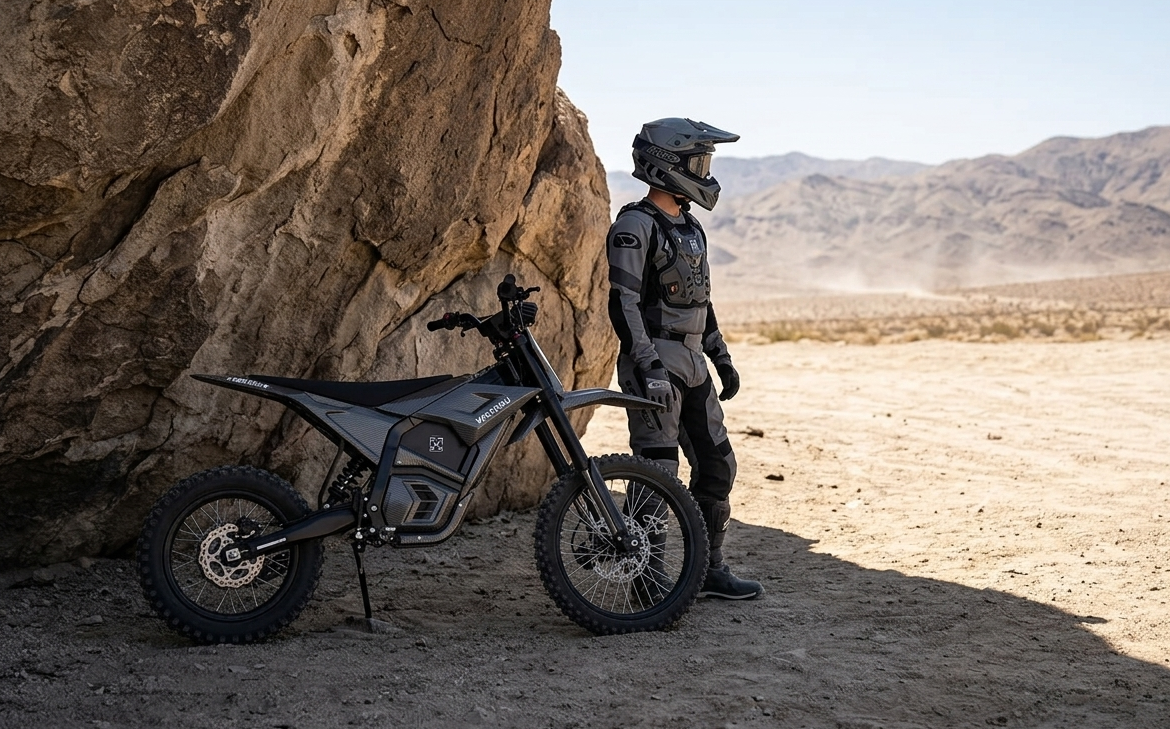
Helmet, armor, boots, gloves. All of it protects you, and all of it slows heat loss. CDC guidance is explicit that protective equipment adds to the body’s heat load rather than being neutral.
Then add the work. Picking a heavy bike out of soft sand. Digging a buried rear wheel free. Walking a mile in boots after a failure, done by someone already heat-loaded.
Know the Signs, and Who Should Not Start
Heat exhaustion looks like headache, nausea, dizziness, weakness, heavy sweating, thirst, and reduced urine output. Stop. Shade, cooling, and current medical guidance.
Confusion, slurred speech, fainting, seizures, or skin gone hot and dry is a different category. Possible heat stroke. Call 911 and cool aggressively while help comes.
Ride with someone, too. The buddy system sits in the NIOSH workplace recommendations because the person losing judgment to heat is usually the last to notice.
- Ill, hungover, short on sleep, or recovering from anything: not today.
- Poorly acclimatized riders carry more risk on the same loop than a local who has been out all summer.
- No way to call for help, no shade, or not enough water for the round trip plus a delay. Same answer.
- Ask a healthcare professional how your medications, past heat illness, or existing conditions change your risk. Before the trip, not in a wash at noon.
Use a Hot-Weather Go, Modify, or Stop Matrix
Run it before you load the truck, then again at every planned stop. "Modify" might mean an earlier start, a shorter loop, firmer ground, a second vehicle, or a different weekend. A stop condition beats the plan you drove out with.
Numeric limits belong to your health guidance and your documentation. Not this table.
|
Factor |
Proceed only when |
Modify or delay when |
Stop or do not start when |
|
Rider |
Fit, alert, equipped, acclimatized |
Tolerance or exposure is uncertain |
Any heat-illness sign appears |
|
Weather |
Conditions match the written plan |
Forecast worsens, shade disappears |
An official warning or hazard exceeds the plan |
|
Battery and motorcycle |
Both inside documented operating limits |
A temperature warning or power cut appears |
The manual says shut down, or a fault repeats |
|
Route |
Return distance and recovery still realistic |
Sand, climbing, heat, or distance raise the draw |
No safe exit and no workable recovery |
|
Charging |
Location, equipment, and pack temperature meet the instructions |
The pack has not reached permitted charging conditions |
Damage, swelling, odor, abnormal heat, charger fault |
Reassess when the terrain, the weather, your condition, the energy burn, or the bike’s behavior changes.
Find Your Motorcycle’s Actual Thermal Limits
A temperature quoted for another electric motorcycle, another cell chemistry, or a generic e-bike charger is not a limit for your machine. Pull the current manuals for the complete bike and its approved charging system. Valtinsu posts them on its user manuals and spec sheets page, and most serious manufacturers do the same.
Four Separate Limits, Not One
Find all four:
- Motorcycle operating range
- Battery discharge range
- Storage range for the pack
- Permitted charging range
They are usually different, and the charging window is often narrowest. Check what each value refers to before applying it. Ambient air, pack temperature, cell temperature. Not interchangeable.
Thermal Protection Is Not Permission
Learn what your display tells you before you are somewhere remote. Temperature icons, error codes, refusal to charge, reduced power, automatic shutdown.

Derating is the system protecting itself from you. Power returning after a cooldown does not mean the last hour was harmless. So never bypass a warning, and never restart into the load that triggered it.
Then inspect, using the manufacturer’s procedure: enclosure, cables, charging port, tires, brakes, drivetrain, guards, cooling surfaces. Impact damage. Swelling, leakage, odd smell, loose hardware. Any of those and the bike stays off remote routes until somebody qualified has looked.
Why Desert Terrain Pulls More Current
Ambient heat and self-generated heat compound. The terrain that makes desert riding fun is the terrain that asks for sustained current, and sustained current is heat inside the controller, motor, and pack. No motor layout fixes that. No voltage architecture either, not when the ground fights back.
|
Load factor |
What it does |
What you control |
|
Soft sand |
Tires sink, the wheel spins, current spikes and stays high |
Line choice, momentum, tire setup, how much sand is in the route |
|
Low-speed technical |
High demand, almost no airflow across cooling surfaces |
Route selection, pace, shaded stops |
|
Payload |
More mass to accelerate and hold on climbs, less range |
Gear discipline, staying inside the documented load limit |
|
Ground radiation |
Heats tires and low enclosures past the air reading |
Where you park, and for how long |
Sand and Slow Technical Riding Are the Expensive Parts
Sinking tires and constant wheelspin cost far more than firm dirt. Deep sand needs steady power just to hold momentum, so draw climbs and stays there.
Rocky washes and steep low-speed climbs are worse. Maximum demand, minimum airflow. Temperatures rise fast when nothing is moving air across the surfaces meant to shed heat. So fast often runs cooler than slow. Not always safer, though.
Payload and Ground Heat
Rider, armor, water, tools, recovery gear. Adds up quicker than people expect, and every pound raises strain and cuts range. Stay inside the documented load limit, which on the EM-5 Pro is 287 lbs including everything you carry.
Dark sand and rock under direct sun also run far hotter than the air above them. Tires, low-mounted enclosures, anything parked. Your forecast high does not describe that.
Manage Traction Without Inventing a Tire Pressure
Flotation and component protection pull in opposite directions, and the acceptable range depends on the fitted tire, rim, load, and motorcycle documentation. A pressure copied from another rider or a generic desert guide cannot account for those variables and may increase the risk of bead movement, rim impact, or a pinch flat.

Deep sand, hardpack, gravel, sharp rock, mixed ground. Each wants something different, and a pressure that floats beautifully in sand becomes a pinch flat the moment you hit fast rock. So check casing type, load rating, the manufacturer’s pressure range, rim compatibility, and tube versus tubeless. Never below the stated minimum.
Set it cold. Heat inflates readings, and a hot check will lie to you. Bring a real gauge. And a pump that works. Our electric dirt bike tire guide covers tread and pressure by terrain in detail.
Build a Range and Return Plan That Survives the Heat
Published range depends on the test method and assumptions stated by the manufacturer. Sand, climbing, payload, speed, wheelspin, wind, temperature and battery condition can reduce usable trail range. Our electric dirt bike range guide explains the relevant energy and terrain factors.
Find the High-Draw Sections First
Map the deep sand, the elevation, the technical climbs, the exposed stretches with no shade, and anywhere you will be carrying a full load. That is where the energy goes. A route that looks symmetrical on a map rarely is.
Write the Turnaround Rule Down
Before you leave. A real number, picked while you are calm and hydrated, based on your consumption so far, distance covered, terrain ahead, temperature trend, and where the exits are.
A generic reserve percentage is not a complete return plan. Set the turnaround point before departure using measured consumption from comparable rides, distance covered, terrain ahead, temperature trend, and confirmed exits. Do not rely on an unridden shortcut, an unconfirmed outlet, regenerative braking, or the dashboard estimate as the only evidence that the return leg is achievable.
Plan Recovery Before You Need It

Here is what the product roundups skip. Riders on r/motorcycles have been blunt about this for years: the worry with electric off-road is not the motor, it is being stranded somewhere nobody can hand you a gallon of fuel and a spark plug.
They are right that the failure mode differs. A dead pack is not a roadside fix. So treat it as a load-out problem:
- Tell someone the route and your return time, then actually check in.
- Satellite messenger or PLB, because coverage in the places worth riding is a coin flip.
- Two machines on remote routes. One bike breaking is an inconvenience. One bike breaking alone is the whole problem.
- Know the truck access point, and who is coming, before you need either.
- Deployable shade, water for the delay and not just the ride, first aid stocked for heat illness.
Then decide honestly whether your route has an exit that works. If it does not, it is a different route.
Follow a Documentation-Controlled Charging Workflow
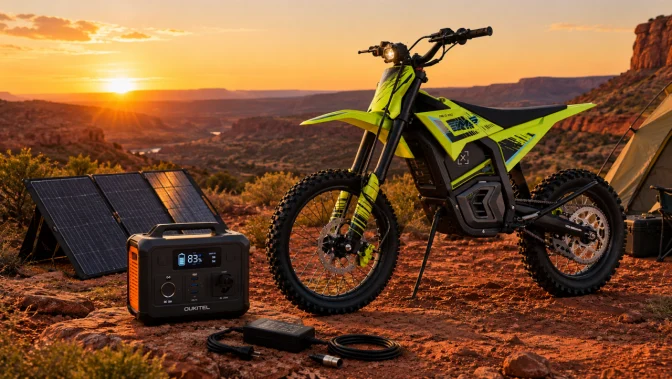
Charging in high ambient heat is where a good day goes wrong fast. Two rules from NFPA’s lithium-ion guidance matter here: follow the manufacturer’s instructions, and use only the charging equipment designed for the device.
Park in shade ➔ Inspect pack and cables ➔ Verify permitted temperature ➔ Connect approved charger ➔ Monitor
Park, Then Inspect Before Connecting

Flat, stable ground. Shaded and ventilated, clear of direct sun, flammable material, traffic, and blowing sand.
Then look at the enclosure, wiring, leads, connector, and the port. Impact damage, swelling, fluid, odor, excessive warmth, sand in the contacts. Anything abnormal and you stop there.
Confirm the Permitted Charging Temperature
Do not begin charging until the pack is within the charging-temperature conditions specified for the exact battery and charger. A fixed waiting period cannot confirm that condition, especially after a high-load ride in direct sun.
Use the model's available temperature indicator or warning system and compare the condition with the charging instructions in the manual. If the bike does not expose pack temperature, wait and inspect as directed by the manufacturer rather than estimating from touch or time alone.
Approved Equipment, and What to Do on a Fault
The charger specified for your model. Nothing else. Check its rated output against the manual rather than against a figure from a listing. Charge times move with the starting state of charge, ambient temperature and the supply, so treat any single quoted duration as an estimate that needs its assumptions stated.
Confirm the source meets the voltage requirement, skip unrated extension cords and improvised adapters, and stay with the bike while it charges.
Two different situations here, and they get opposite responses. Smoke, flame, rapid swelling, venting, hissing, or heat that keeps climbing: do not touch the motorcycle and do not try to move it. Get away from it, keep everyone else back, and call emergency services.
A pack in thermal runaway can reignite after it appears to have stopped, and moving it puts you next to the vent path. An ordinary charger fault is a different thing.
Error code, unusual noise, or a charge that stops early. Disconnect at the source if it is safe to reach, following your manual’s sequence, then follow the manufacturer’s procedure for that code rather than retrying the charge.
Where the Machine Fits Into the Plan
Battery size does not make heat safe. What it buys is margin, and margin is what a hot remote route consumes.
The pattern holds across the market. Lightweight 60V machines, the Sur-Ron Light Bee X and Talaria models among them, handle a normal trail day comfortably. Push into long exposed loops where the next charge is hours off and the machine matters more.
Compare the things that actually decide it: usable energy rather than nominal capacity, the documented cell specification, the thermal limits in the manual, whatever sustained-output data the manufacturer publishes, and your own measured consumption on terrain like the route you have in mind. Nominal pack voltage on its own tells you very little about how a bike holds up in heat.
|
Model |
Battery |
Rated range |
Top speed |
Suited to |
|
EM-5 |
48V 23.4Ah |
50 miles |
40 mph |
Beginners, short trail rides, 13+ |
|
EM-5 Pro |
60V 27Ah |
59 miles |
52 mph |
Adult trail riding, mixed terrain, 18+ |
|
EM-5 Ultra |
72V 25Ah Samsung |
75 miles |
56 mph |
Long or remote loops, 18+ |
|
EM23 |
60V 27Ah |
43–50 miles |
43.5 mph |
Cruiser geometry, 16+ |
These are manufacturer-rated figures from the current specification source. The EM23 range is accompanied by a stated average test speed; the other listed ranges do not state equivalent test conditions here. Ask for the test method before using any published range in route planning, and compare it with consumption measured on similar terrain.
High ambient temperature, soft terrain, climbing, payload, speed, and battery condition can all change usable range. Plan from measured consumption on comparable rides and retain a return reserve instead of assuming the printed rating will apply to a desert route.
Evidence and Limits Behind This Guide
Rider Safety Sets the Order
Rider heat risk is addressed before battery performance because it can become urgent and requires different decisions. Health guidance comes from CDC, NIOSH, and the National Weather Service; motorcycle limits come from the exact manufacturer documentation.
Documentation Beats Round Numbers
This guide does not invent universal capacity-loss percentages, charging temperatures, sand pressures, hydration volumes or cooldown times. Health limits come from current public guidance, while motorcycle and charging limits come from the exact product documentation.
What Thermal Protection Is Actually For
Thermal protection may reduce power, display a warning, or shut the system down when monitored conditions exceed model-specific limits. It is a protective response, not evidence that the route remains appropriate after a cooldown. Follow the manual for the exact warning or fault, and revise the route, load, timing, or ambient conditions before riding again.
Ride the Plan You Wrote
Use the current forecast for the exact route and riding hours, confirm operating and charging limits in the manuals, define the turnaround rule and recovery plan, and estimate the round trip from measured consumption on comparable terrain before departure.
After the route, turnaround point, and recovery requirements are defined, compare the current EM-5 Pro and EM-5 Ultra specifications for battery capacity, published range conditions, complete-bike mass, load limit, and charging documentation. Those figures can help screen options, but they cannot determine suitability without comparable real-world consumption data and a recoverable return plan.
FAQs
Can you ride an electric dirt bike in the desert in summer?
Sometimes. Five things have to clear their limits at once:
- Your condition, acclimatization, and supplies
- The forecast for your route and hours, not the nearest town
- Documented operating limits for your bike and pack
- A return distance you can actually make in the heat
- A recovery option if the bike stops
One of those failing is enough to postpone.
What temperature is too hot for an electric dirt bike battery?
Use the limit in the exact motorcycle, battery and charger documentation. No universal figure applies to all packs. Check whether the published value refers to motorcycle operation, battery discharge, storage or charging, because these ranges may differ.
Does heat reduce electric dirt bike range?
Yes. Heat can affect battery performance and thermal protection, while sand, climbing, payload, speed and throttle use also raise energy demand. Plan from measured consumption on comparable rides and keep a conservative return reserve.
Can I charge the battery right after riding in hot weather?
Not straight off the trail. Use whatever temperature indicator or warning the model gives you, and compare it against the charging window in your manual. If the bike does not show pack temperature, wait and inspect as the manufacturer directs. Skip the arbitrary countdown. Use the approved charger, and stay with it.
What happens if an electric dirt bike dies in the desert?
Treat a no-power event as a recovery problem, not a trailside battery repair. Make the motorcycle safe according to the manual, move to shade if you can do so without handling a damaged or overheating pack, share your location, and use the recovery plan prepared before departure:
- Share the route and a return time
- Carry a satellite messenger where coverage is thin
- Ride remote routes with a second machine
- Know the truck access point before you go
Do electric dirt bikes overheat?
Some electric dirt bikes can reduce power or shut down when monitored temperatures exceed system limits, but the behavior varies by model. Treat any warning, power reduction, fault code, or shutdown as a reason to stop, consult the manual, and change the route or conditions before riding again.
Sources
- CDC, Heat Stress and Workers (2026)
- CDC, Heat Stress Workplace Recommendations (2026)
- CDC, OSHA-NIOSH Heat Safety Tool App (2026)
- National Weather Service, Heat Related Illnesses (2026)
- National Weather Service, North American Monsoon Flash Floods (2026)
- NFPA, Lithium-Ion Battery Safety Tip Sheet (2025)


Looking for something else?
Electric Dirt Bike Replacement Parts Availability: What Buyers Should Verify Before Ordering
LEARN MORE
How to Check an Electric Dirt Bike for Safety Recalls by Model and Serial Number
LEARN MORE
How to Choose an Electric Dirt Bike Repair Shop: Questions to Ask Before Service
LEARN MORE
How to Lift a Fallen Electric Dirt Bike Without Hurting Yourself or the Bike
LEARN MORELooking for something else?
Electric Dirt Bike Fall Riding on Wet Leaves: Grip, Hidden Obstacles and Braking
LEARN MORE
Electric Dirt Bike Trailside Power Loss: Recovery Plan When the Battery Is Dead
LEARN MORE