

Street Legal Electric Dirt Bike for Adults: Models You Can Actually Ride
Dave had a two-block plan. Roll down his Sacramento street, hop the curb where the pavement ends, and vanish onto the levee trail behind the house. The salesman pointed at the headlight and said the word “street-ready.” The DMV, when Dave finally called, said a different word. A few of them, actually.
That two-block plan is where most adult riders get tripped up. A Valtinsu adult electric off-road motorcycle — or honestly any high-power electric dirt bike — can look every bit road-ready and still be flat illegal on a public street. A headlight doesn't make it a motorcycle. A fast motor doesn't earn it a plate. Three different things have to line up: the bike's parts, the bike's paperwork, and the law where you live. Miss one and what you've got is a great trail machine sitting in the wrong place — the road.
So this guide does three things. Splits the genuinely street-legal models from the off-road-only ones. Spells out what actually makes a bike road legal, part by part. And hands you a checklist to run before you spend a dollar. Let's start with the part nobody at the dealership wants to lead with: how the law sees the thing in the first place.
|
Quick answer: Most electric dirt bikes are off-highway vehicles (OHVs) — not street legal by default. A handful of ship factory street-legal dual-sport e-motos. Everything else needs DOT equipment, a road-recognized VIN, registration, insurance, and a license before it touches pavement. Buy the street version, or haul the off-road one to the trail.
|
How the Law Sees Your Electric Dirt Bike

Speed is the trigger — that's the short version. The NHTSA figures any motor vehicle that can clear 20 mph and is meant for the road is road-regulated: a motorcycle, or a motor-driven cycle, with federal safety standards attached. Then your state DMV files the bike into a category based on how it was built. Not what you bolt on in the garage afterward. How it left the factory. That one detail ends up deciding almost everything that follows.
|
Classification
|
Public Roads?
|
Where It Applies
|
|
Off-Highway Vehicle (OHV)
|
No
|
Most electric dirt bikes, including the Valtinsu EM-5 and EM-5 Pro
|
|
Street-Legal / Dual-Sport
|
Yes — if registered
|
Factory dual-sport e-motos with DOT gear, road VIN, insurance, Class M license
|
|
Moped / Low-Speed Cycle
|
Sometimes
|
Lower-power pedal models only; does not apply to high-watt dirt bikes
|
And here's the thing people keep getting wrong: electric dirt bikes are not e-bikes. A Class 1 or 2 e-bike quits assisting around 20 mph. Class 3 around 28. Every one of them has working pedals you're legally supposed to use. A high-power electric dirt bike has no pedals and runs at motorcycle speed. Ride one on a public road like it's an e-bike and the law reads you as a rider on an unregistered motorcycle. Because that's exactly what you are.
Street-Legal Models Adults Can Actually Ride
According to this discription mention type of all lens with actuall image make it like infographics but dont write too much words on the image make it professional and clean

“Actually rideable” isn't about the biggest number in the listing. It's about your state, your license, the roads you'll really use, and the dirt you'll really ride. Chase watts and you'll buy the wrong bike. So instead of a spec race, here are three buckets to shop from.
Factory Dual-Sport E-Motos
These come street legal straight from the factory in the markets that support them — road VIN, DOT lighting, mirrors, the whole moped-or-motorcycle title path baked in. The NIU XQi3 Street is the one people name most: automatic turn signals, an LCD display, usually registered as a moped class. One catch, and it's a real one. You have to buy the street trim, not the off-road-only version that looks nearly identical — then confirm your state actually accepts it before you ride.
Higher-Speed Electric Motorcycles
This bucket leans closer to a road motorcycle than a dirt bike. The Zero FXE and, where you can find it, the Stark VARG EX ship with road-legal gear and dealer-backed titling — and that titling is the part that makes them registerable, not the horsepower. Skip the spec-sheet arms race here. Ask the only question that matters first: can I register it, insure it, and get it serviced where I live?
Off-Road Models You Haul, Then Ride
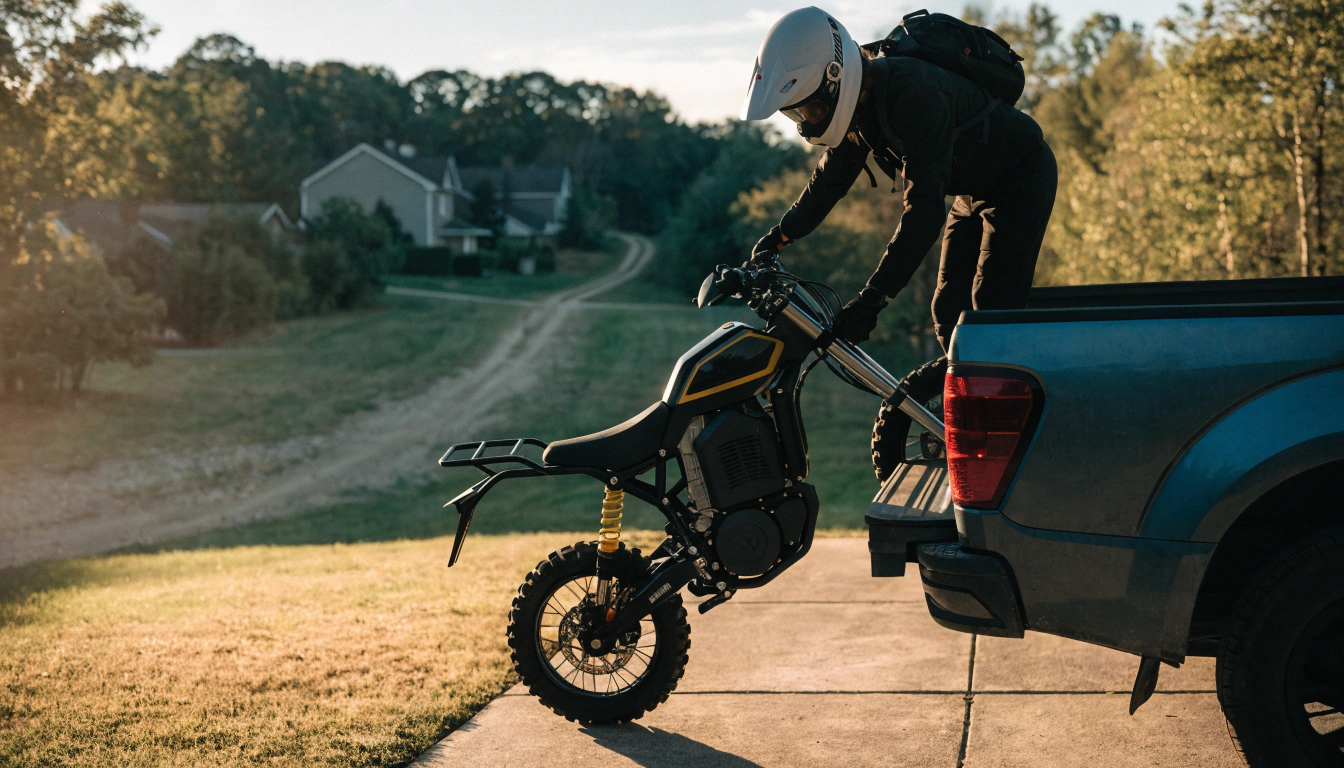
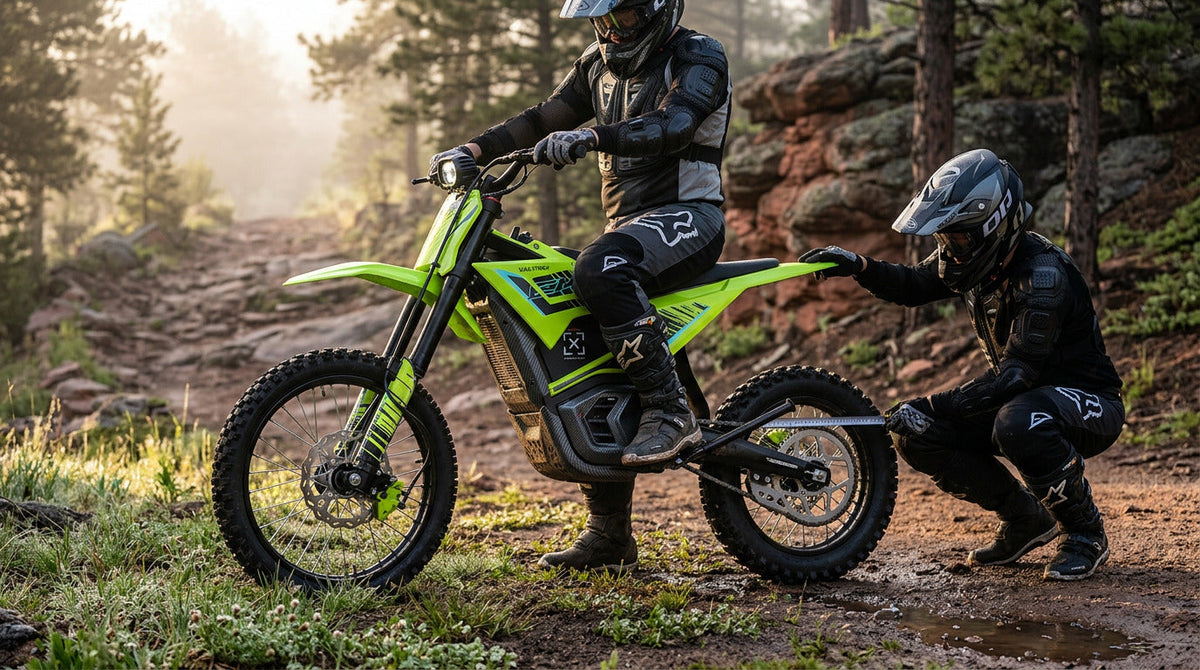
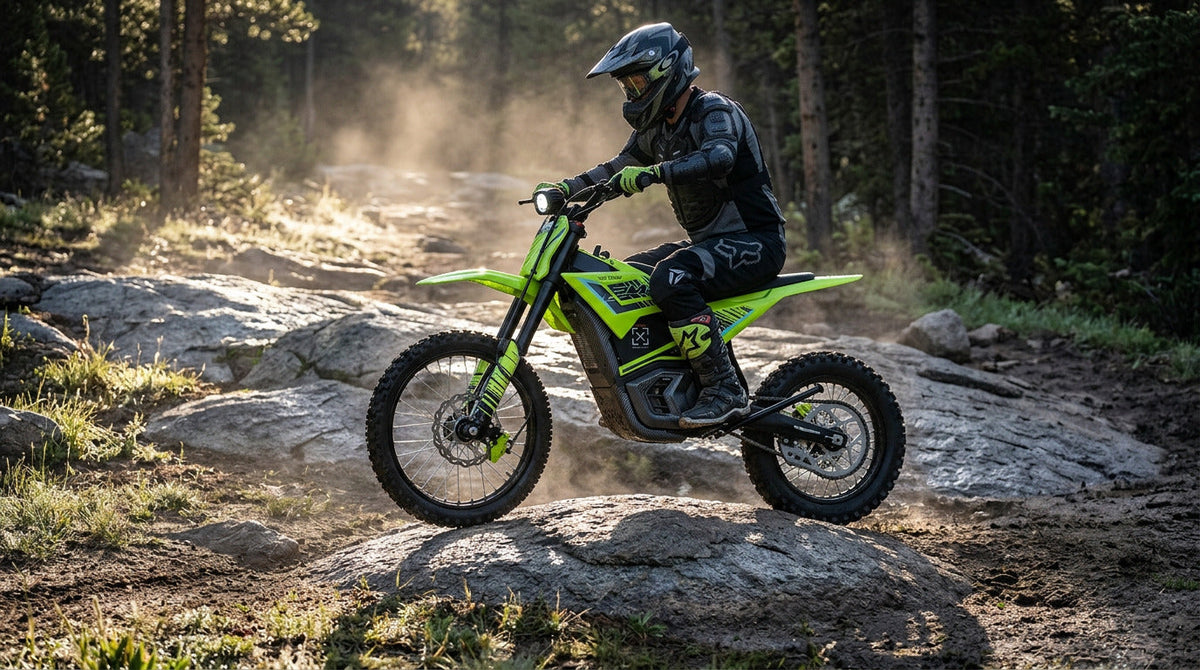
This is where most of the good adult bikes land, Valtinsu included. Built for dirt — trails, fire roads, private land, OHV parks. And they ride better off-road precisely because nothing got watered down to please a DMV. The honest game plan is unglamorous: load it in the truck, drive to where motorized off-road riding is allowed, drop the gate, ride. The EM-5 is an adult off-road motorcycle built for trail riding, and Valtinsu sells it as exactly that — not a commuter pretending to be one.
Three buckets, side by side, before you go deeper:
|
Dual-Sport E-Moto
|
Electric Motorcycle
|
Off-Road (Haul It)
|
|
Street legal from factory
|
Street legal, road-first
|
Off-road / OHV only
|
|
Light road + light dirt
|
Faster traffic, longer road
|
Trails, fire roads, private land
|
|
Buy the street trim
|
Confirm titling first
|
No road plate needed
|
|
NIU XQi3 Street
|
Zero FXE, Stark VARG EX
|
Valtinsu EM-5 / EM-5 Pro
|
|
Valtinsu EM-5 — Adult Electric Off-Road Motorcycle
48V geared motor | 3,840W peak | 190 N·m torque | 37 mph | IPX6 | Three ride modes | Age 13+
Built for trail riding on private land, OHV parks, and designated off-road areas — not public roads. The reduction-gearbox motor puts torque low in the rev range, where a new rider needs it on a tight climb.
From $1,259 USD | Free U.S. shipping | 3–7 day delivery
View EM-5 → valtinsusport.com
|

What Actually Makes an Electric Dirt Bike Street Legal
Street legal isn't one upgrade. It's a package, and every state checks roughly the same core list before a DMV will hand a plate to a converted off-road bike. Here's what's on it.
-
DOT-compliant lighting — headlight with high/low beam, taillight, brake light, front and rear turn signals. Trail lights don't qualify.
-
Mirrors — one minimum, two in many states.
-
Audible horn — heard from a set distance; usually missing on off-road models.
-
DOT-approved tires — knobby off-road tread won't pass inspection; a full tire swap is common.
-
Speedometer reading in MPH, plus a license-plate mount with plate light.
-
A road-recognized VIN — if the title says “off-road use only,” the DMV can refuse registration no matter what you've installed.
-
Registration, title, liability insurance, and a Class M motorcycle license or endorsement.

|
The VIN wall: Parts are the cheap, easy side — a conversion kit runs roughly $300 to $700. Paperwork is the wall. If the manufacturer's title or owner's manual reads “off-road use only,” several DMVs refuse road registration outright. Call your state DMV with the exact VIN before buying a single part.
|
Can You Convert an Off-Road Electric Dirt Bike?
Maybe. That's the honest answer, and anyone who gives you a flat yes is selling something.
Valtinsu doesn't sell or support street-legal conversion kits — the bikes are dirt machines and the brand says so straight. Whether a specific model can ever wear a plate comes down to two things, in this order: what your state allows, and what the VIN paperwork says it is.
California makes the rule painfully clear. The CA DMV is specific: a motorcycle originally built and registered for off-highway use can't be converted for on-highway use unless it was manufactured for dual purpose in the first place. That “dual purpose” stamp comes from the factory. You can't earn it with a box of parts and a weekend. If the title reads off-road only, the road is closed — in California, and in a fair number of other states too.
Some riders pull it off. Texas, Colorado, a handful of others — people have registered converted bikes legally. It takes a VIN the DMV will accept, a full inspection, the title work, and insurance. So start with the phone call, not the parts list. One call to the DMV either opens the door or saves you a thousand dollars you were about to spend on hardware that was never going to matter.
Speed, Watts, and the Legal Limits Adults Ask About
Watts give you a hint. They don't settle legality on their own — voltage, the controller, gearing, your weight, the terrain, all of it shifts the real number. Here's the back-of-napkin math riders search for most, with the legal read sitting right next to it.
|
Setup
|
Rough Top Speed
|
Legal Read
|
|
48V 1000W
|
20–28 mph
|
Above the common 750W e-bike cap in many states — may not qualify as a standard e-bike.
|
|
2000W
|
30–40 mph
|
Past most e-bike limits; often treated as a moped or motorcycle on public roads.
|
|
3000W
|
35–50 mph
|
Motorcycle/OHV territory — different license, registration, and paperwork.
|
|
5000W
|
45–60 mph
|
Treat as an e-moto: motorcycle-grade brakes, registration, insurance, and gear.
|

Read that table as a ladder. Every rung up in wattage, the law gets less likely to call your bike a bicycle and more likely to call it a motorcycle. A 5000W machine sold with no clear road paperwork? For all practical purposes it's an off-road bike — so ride it on private land or a designated area, and don't kid yourself about the street.
Where You Can Legally Ride
Figure out the location type before you load the truck. The rules don't bend — they flip, completely, depending on where the tires actually land.
|
Location
|
Status
|
What You Need
|
|
Public roads & neighborhood streets
|
Not legal by default
|
Full motorcycle registration, DOT equipment, insurance, Class M license
|
|
Bike lanes & sidewalks
|
No
|
Dirt bikes aren't e-bikes under any state's law
|
|
Designated OHV parks
|
Yes
|
OHV sticker or trail permit; varies by state and land manager
|
|
Public OHV land (green sticker)
|
Yes — with ID
|
California issues a green-sticker eMoto ID for off-highway use
|
|
Private land
|
Yes
|
Owner's permission; safety gear still applies
|
|
Crossing a road to reach a trail
|
State-dependent
|
Some states allow a perpendicular crossing only — no riding along the road
|

|
Haul it, don't ride it there. Loading the bike in a truck and driving to an OHV park is legal. Riding it there on public roads is not. That two-mile stretch between your garage and the trailhead gate is a public road. It counts.
|
The Street-Legal Buyer Checklist
Run this before you pay — not after. A real street-legal electric dirt bike for adults clears three checks: legal, spec, and support. Drop any one and you risk a bike that photographs great and fails in your driveway. Get the seller's answers in writing where you can. And only start browsing the full electric dirt bike lineup once you actually know which bucket you're in.
-
Confirm the legal category. Is it sold as an e-bike, moped, motorcycle, OHV, or off-road only? “Many riders use it on roads” is not proof it can be registered.
-
Check the documents before the spec sheet. Ask about the VIN, title, and registration path first. Paperwork decides road access, not watts.
-
Compare real range, not claimed range. Rider weight, hills, and throttle use all cut the number on the page. Plan for less.
-
Ask about warranty, parts, and service. Tires, pads, chargers, batteries, and controllers all need support after the sale.
Which Valtinsu Fits Your Riding?
|
EM-5 — Ages 13+ — Trail Starter
48V | 3,840W peak | 190 N·m | 37 mph | IPX6. Three modes (25/40/60 km/h). The only Valtinsu model rated under 18 — the default pick for a parent shopping for a teen.
View EM-5 — $1,259 → valtinsusport.com
|
|
EM-5 Pro — Adults 18+ only — Performance Trail
60V | 4,800W peak | 240 N·m | 43 mph | IPX6. Black or Volt Green. The geared motor delivers 240 N·m low in the rev range — the kind of torque that matters on a 30° fire-road climb, available as the performance trail model for adult riders.
View EM-5 Pro — $1,699 → valtinsusport.com
|

|
Age rule — no exceptions: EM-5 = 13+ | EM-5 Pro = 18+ adults only. A parent shopping for a rider under 18 must choose the EM-5.
|
The Bottom Line
The best street-legal electric dirt bike for adults isn't the fastest one on the page. It's the one that fits your state's rules, your license, the roads you ride, and the way you actually ride them. Want it on public roads? Then start with the boring stuff — category, VIN, title, registration, insurance, equipment — and only then compare power, range, brakes, and fit.
Want off-road fun instead? An off-road electric dirt bike is the better value, and it'll ride better in the dirt because nobody softened it for the pavement. Just keep it where it belongs: private land, OHV parks, closed tracks, approved motorized trails. Dave worked this out before he spent a cent on a conversion kit. Turns out the question was never “can I add lights to this?” It was “can I register and insure this exact bike?” Ask that one first, and the rest gets a lot simpler.
|
Key takeaways
Most electric dirt bikes are off-highway vehicles — not street legal until they're registered as motorcycles.
A factory dual-sport e-moto is the clean path to road use; converting an off-road bike depends entirely on the VIN and your state.
Wattage is a clue, not a permission slip — the higher it climbs, the more the law treats your bike as a motorcycle.
If you ride off-road, haul the bike to the trail. The stretch of public road to the gate still counts.
|
FAQs
What electric dirt bike is street legal?
Factory dual-sport e-motos like the NIU XQi3 Street are sold road-ready in supported markets, with DOT lights, mirrors, a road VIN, and a moped or motorcycle title path. Most other electric dirt bikes — including the EM-5 and EM-5 Pro — are off-road only. A headlight alone never makes a bike street legal. Ask the seller for the title and registration path before you ask about top speed.
Can I make an electric dirt bike street legal?
Sometimes, depending on your state and the VIN. Conversion usually needs DOT lights, brake light, turn signals, mirrors, horn, DOT tires, a speedometer, plate mount, insurance, and inspection. The hard part isn't the parts — it's whether the DMV accepts the paperwork. If the bike was built and sold as off-road only, added equipment may not be enough. Call your DMV with the exact VIN first.
Are electric dirt bikes legal to drive on the street?
Only when registered as a motorcycle in that state. A high-power off-road model isn't legal on public roads — neighborhood streets and short pavement links to a trail included — unless it's plated, insured, and equipped for road use. The quiet motor doesn't change the classification. No plate, no insurance, no registration means stay off the street.
How fast is 3000W in mph?
Roughly 35–50 mph, depending on voltage, controller, gearing, tire size, rider weight, and terrain. That's well past standard e-bike limits, so a 3000W machine usually falls into motorcycle or OHV classification — different license, different paperwork. Treat the wattage as a legal warning sign, not just a performance perk.
How fast will a 2000W electric bike go?
About 30–40 mph in most real-world builds, faster with higher voltage and road tires. That's beyond many legal e-bike limits, so it may be treated as a moped or motor-driven cycle on public roads. At those speeds, brakes, tires, and protective gear matter more than the spec sheet suggests.
How fast will a 5000W eBike go?
Often 45–60 mph depending on the build, which puts it in e-moto territory, not bicycle. Expect to need motorcycle-grade brakes, lighting, registration, insurance, and a license before any public-road use. A bicycle helmet isn't enough at that speed — plan for real riding gear.
Is 48V 1000W legal?
Not automatically. In many U.S. e-bike class systems, 1000W is above the common 750W limit, so a 48V 1000W bike may not qualify as a standard e-bike even though it looks like one. It might still be fine on private land or certain off-road areas. Check wattage, speed, pedals, and your state rules together before riding on roads or paths.
How fast can you legally ride an e-bike?
In many states, Class 1 and Class 2 e-bikes assist up to 20 mph and Class 3 up to 28 mph — and all have working pedals within the legal power cap. Once a machine is faster or more powerful than the e-bike category, it needs motorcycle-style registration, insurance, and licensing. Check your state's class law before riding bike lanes or paths.
Sources
-
California DMV, “Register an Off-Highway Vehicle (OHV).”
-
California DMV, “Conversion From OHV to On-Highway (Non-Complying OHVs).”
-
California State Parks, “Off-Highway Motor Vehicle Recreation — OHV Registration.”


Looking for something else?
Electric Dirt Bike Setup for Hardpack Trails
LEARN MORE
Electric Dirt Bike Mud Riding: Setup, Technique and Cleanup
LEARN MORE
Can You Ride an Electric Dirt Bike on Forest Service Roads?
LEARN MORE
Electric Dirt Bikes at OHV Parks: Rules and Checklist
LEARN MORELooking for something else?
Hot-Weather Electric Dirt Bike Guide: Battery, Rider and Range
LEARN MORE
How to Ride an Electric Dirt Bike Over Wet Roots
LEARN MORE
Electric Dirt Bike Ruts and Washouts: Line Choice and Recovery
LEARN MOREYou may also like
VALTINSU EM-5 Off-Road Electric Dirt Bike
$969.00
$1,559.00
VALTINSU EM-5 Pro Off-Road Black Electric Dirt Bike
$1,699.00
$1,899.00
VALTINSU EM-5 Pro Green Electric Dirt Bike
$1,699.00
$1,899.00
VALTINSU EM-5 Ultra Electric Dirt Bike
$2,199.00
$2,499.00
VALTINSU EM-5 & EM-5 Pro Combo
$2,658.00
$3,458.00
Further reading
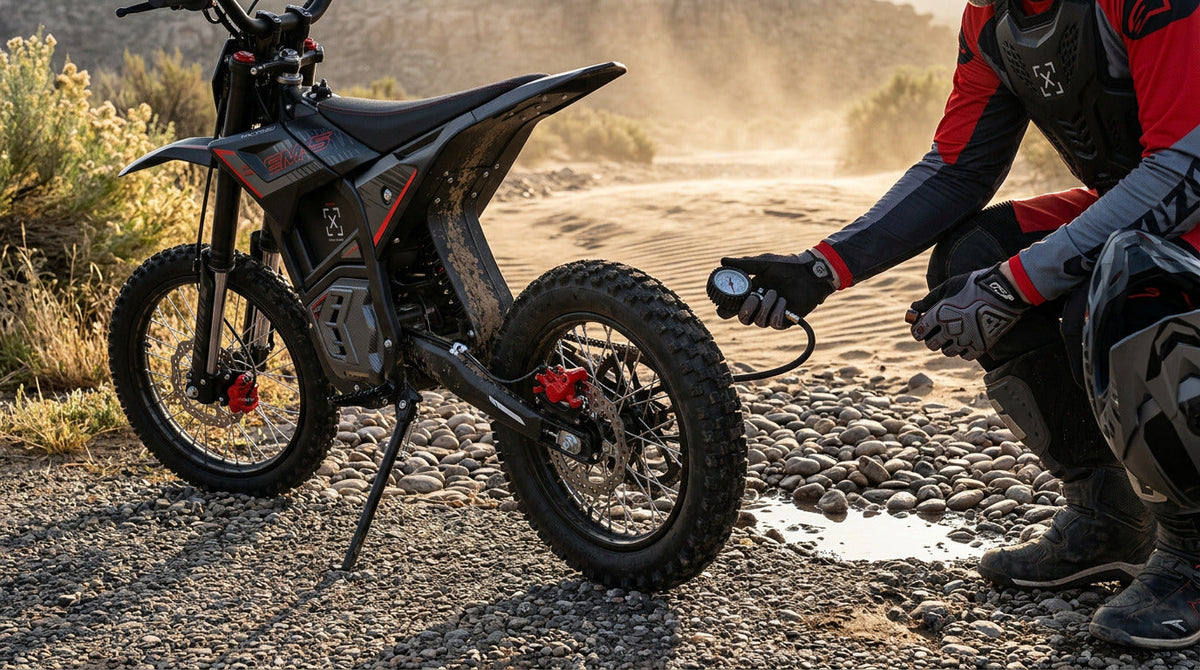
Electric Dirt Bike Tire Pressure by Terrain: PSI Starting Points
Electric dirt bike tire pressure should start with the exact tire and motorcycle limits, then change with terrain, rider load, tire construction and impact risk. Softer ground usually favors a lowe...
Electric Dirt Bike Suspension Sag Setup: A Rider-Weight Method
Electric dirt bike suspension sag setup starts by measuring the rear suspension fully extended, then measuring it again with the bike alone and with you in full riding gear. Use those readings to e...

Your First 100 Miles on an Electric Dirt Bike: Break-In and Service Checklist
The first 100 miles on an electric dirt bike are an inspection period rather than a gas-engine-style mechanical break-in. Check the motorcycle at 0, 25, 50 and 100 miles for hardware settling, chai...
Electric Dirt Bike Ground Clearance vs Suspension Travel: What Each Number Means
Electric dirt bike ground clearance is the vertical space between the ground and the motorcycle’s lowest relevant chassis point, while suspension travel is how far the wheel and suspension can move...