Watts and Torque Electric Dirt Bike Guide: Choose Your Perfect Ride
Carlos texted me at 11:47 on a Tuesday night.
"Bro. These spec sheets are lying to me."
He had five tabs open. EM-5 Pro. Two Sur Ron variants. A Talaria. And some bike from a brand I'd never heard of promised "8,000W of trail-crushing power" for $1,400. (Which should've been a red flag. But Carlos was three hours into research at that point and his judgment was getting soft.)
Carlos is 44. Machinist. Lives outside Reno. Used to ride a KTM 250 back when he was the kind of guy who'd spend a Saturday taking it apart and putting it back together for fun. Then his back filed paperwork. Then a daughter happened. Then fifteen years went by without much off-road in them.
This spring he started shopping.
By the time he texted me he'd been at it six weeks. He had a spreadsheet. The spreadsheet had eighteen columns. I'm not joking about that.
"They're all using different numbers," he typed. "One says four thousand peak. Another says two thousand continuous. A third has both. A fourth one just says 'powerful adult motor.' How do I tell which one of these is gonna feel like my old KTM and which one's gonna feel like a moped?"
That's what this guide answers. Buckle in.
Here's the part nobody tells you up front. Watts and torque are the two numbers every brand wants you to obsess over. They're also the two most weaponized numbers in the entire electric off-road category. A 4,000W bike isn't a 4,000W bike. A 240 N·m number on Brand A reads completely differently from a 240 N·m number on Brand B. Before you pull the trigger on any adult electric off-road bike built for real terrain, you need a framework that cuts through the marketing.
This is the framework Carlos eventually used. He ended up on the EM-5 Pro Volt Green. Four months from now. We'll come back to him.
Quick Answer: Watts and Torque for an Electric Dirt Bike
Look. You want the short version? Fine.
For most adult riders coming back to off-road, or stepping up from light trail use, the right power band lives somewhere between 3,500W and 5,500W peak. Continuous power between 1,200W and 2,500W. Torque in the 190 to 250 N·m range. Geared brushless motor, not direct-drive hub. 60V battery if you ride hills (48V is fine if you don't). Three ride modes minimum so you can dial the bike's personality up or down depending on whether you're feeling brave or feeling tired.
From Valtinsu's lineup: EM-5 Pro ($1,699) for adults 18 and up. EM-5 ($1,259) for riders 13 to 17 with adult supervision. EM-23 ($1,799) for older teens or mature riders who want cruiser geometry instead of singletrack aggression.
Now read the rest. Because I just gave you the answer without showing my work, and that's exactly how Carlos almost bought the wrong bike.
Peak Watts Lie to You. Continuous Watts Tell the Truth.

Brands lead with peak watts. Always. Because peak is the bigger number and the bigger number sells. Simple.
Here's what peak actually is. Peak is what the motor can produce for ten to thirty seconds before the controller pulls the power back so the system doesn't cook itself. It's the burst when you launch from a stop. The punch up a short rise. The surge out of a tight corner.
Continuous is the boring number. Continuous is what the motor delivers all day, no matter how hot the desert gets, no matter how long the climb. Twenty minutes of climbing. Cruising at speed. Long sand pulls.
The bike that hits 6,500W peak but only sustains 1,000W continuous? Feels electric on the launch. Feels tired four minutes into a real climb. Carlos almost bought one of those. Then he saw the continuous spec buried at the bottom of a PDF and the math stopped making sense.
Both numbers matter. Asking which one matters more is the wrong question. You need to know both before you can read any spec sheet honestly.
The rule of thumb that actually works
|
Type of Riding |
What to Prioritize |
|
Short rides, flat trails, lots of corners |
Peak watts matter more than continuous. You're sprinting between corners. |
|
Sustained climbs or longer rides |
Continuous matters more. The motor's working for minutes at a time. |
|
Mixed weekend riding |
Aim for roughly a 2:1 peak-to-continuous ratio. A 4,800W / 1,500W bike fits the band. A 6,500W / 1,000W bike doesn't. |
(Quick aside. Carlos's old KTM 250 made around 18 kW continuous at peak power. Gas bikes don't have the peak-vs-continuous problem because the engine is just the engine. Electrics do. Took me a minute to wrap my head around that the first time someone explained it to me.)
|
Spec Sheet BS Translator Things you'll see in marketing copy. And what they actually mean once you look closer. "Powerful adult motor" → No published continuous rating. They're hoping you only look at peak. "Up to 8,000W" → Peak only. Continuous is probably under 1,500W. The 'up to' is doing all the work. "Race-tuned controller" → Sometimes legit, sometimes just a sticker. Ask the amperage. If they can't tell you, that's the answer. "Mountain-grade torque" → Means nothing. Ask for the N·m number. If it's missing from the spec sheet entirely, walk away. "Battery: lithium-ion" → Tells you almost nothing. Need voltage, amp-hours, and ideally cell chemistry (NMC, LFP). Ask. "Designed for adult riders" → Could mean 16+. Could mean 18+. Could mean nothing. Find the actual manufacturer age rating, not the marketing line. |
What Torque Actually Does (in Plain English)

Torque is the force that turns the wheel. Watts is the rate at which that work happens. Two different things, often confused. Took me embarrassingly long to internalize the difference.
Plain version: torque gets you moving from a stop. It climbs the hill. It pulls you out of soft sand without bogging. Watts holds your speed once you're rolling and gives you the top end.
A geared electric motor produces all of its torque instantly, from zero RPM. Gas bikes have to rev to find their torque peak. Electrics don't. This is the thing that surprises every gas-to-electric convert in the first five seconds of throttle. You crack it open. The bike just goes. No clutch dance. No gear hunt. Just immediate force.
Torque numbers on adult electric dirt bikes range from about 150 N·m at the entry end to 330 N·m on top-tier race bikes. The honest middle, the band where most weekend riders should be shopping, sits between 190 N·m and 260 N·m.
|
Field note from Dana Dana's a motor engineer. Used to work on traction systems for an EV startup outside Phoenix. I asked her once what number she actually looks at first on a spec sheet. "Not peak watts. Continuous, then torque, then voltage. In that order. Peak is the easiest number to game. Continuous is what the motor will actually do at the bottom of August in Arizona. Torque tells me what the gearing is doing. Voltage tells me whether the system holds up under load. Get those three honest and the peak number will be honest too." Dana drives a 2019 minivan. The fastest thing she owns is the table saw in her garage. She also knows more about traction control than anyone I've met. I trust her. |
The Math That Matters: Power = Torque × RPM

Two bikes both claiming 4,000W can feel completely different on the trail. Here's the why.
Power equals torque times motor RPM. That's it. That's the formula. Which means the same wattage can come from high torque at low RPM (a torquey bike that climbs hard from a standing start) or low torque at high RPM (a top-end bike that doesn't really pull until it's already moving fast).
A geared motor with an internal reduction gearbox concentrates torque at the low end. A direct-drive hub motor spreads it across the rev range. Same wattage on paper. Completely different ride. Sur Ron and Talaria use direct-drive hubs because their adult enduro riders want consistent power high in the rev range. The EM-5 Pro's geared brushless motor with reduction gearing puts the torque down low, where slow corners and short climbs actually happen. Different design goal. Different ride.
This is why the spec sheet alone never tells you the story. Numbers without motor architecture context are meaningless. (I keep saying that. I'll stop. But it's true.)
Geared vs direct-drive at a glance
|
Architecture |
Strength |
Weakness |
|
Geared brushless |
Strong low-RPM torque. Climbs without complaint. Trail-friendly. |
Slightly more mechanical complexity. Internal gearing wants occasional service. |
|
Direct-drive hub |
Consistent power across the rev range. Higher top-end. Fewer moving parts. |
Weaker from a dead stop. Heavier. Race-tuned, not beginner-friendly. |
Spec Bands by Rider Type

Look. The honest version of "what specs do I need" depends on who you are and where you ride. Here's how the bands actually shake out. (These aren't industry standard. These are what I've seen work over a couple hundred conversations like Carlos's.)
|
Rider Type |
Peak Watts |
Continuous |
Torque |
Architecture |
|
Teen beginner (13–17) |
2,500–4,000W |
1,000–1,500W |
150–200 N·m |
Geared |
|
Adult weekend trail rider |
4,000–5,500W |
1,500–2,500W |
200–260 N·m |
Geared |
|
Adult intermediate / fast trail |
5,000–7,000W |
2,500–3,500W |
250–300 N·m |
Geared or hub |
|
Adult enduro / race-leaning |
6,000W+ |
3,500W+ |
280 N·m+ |
Direct-drive hub |
Where Valtinsu fits on this map: EM-5 sits in the teen-to-light-adult band. EM-5 Pro and EM-5 Pro Volt Green sit in the adult weekend trail band. EM-23 hits the same band as the Pro but with cruiser geometry. Longer wheelbase. 19-inch front wheel. Built for older teens or taller adults who'd rather cruise than carve.
|
Pull quote "Almost every adult I fit gets impatient and asks me about top speed first. Top speed is the dumbest spec to shop on. It's the spec you'll use for maybe four seconds out of a two-hour ride. Torque is the spec you'll feel every single time you crack the throttle." — Trevor, shop tech, Asheville NC |
The Specs Watts and Torque Can't Save You From

Honestly? The motor numbers are maybe half the story. Maybe.
You can buy a bike with stunning peak watts and respectable torque and still have a miserable ride. Because the battery is undersized. Or the controller is choked. Or the suspension can't handle the speed the motor produces. Or the brakes fade on the second downhill of the day.
Worth knowing before you click Buy Now on the bike with the biggest poster numbers.
Battery voltage and amp-hours
Higher voltage (60V vs 48V) holds voltage under load better, which means the motor doesn't sag mid-climb. Higher amp-hours means longer ride time but also more weight. A 60V 27Ah pack on the EM-5 Pro hits the practical sweet spot for adult weekend riding. The EM-5's 48V 20.8Ah pack is sized for lighter teen riders and shorter sessions. Different bikes for different riders. Pretty obvious once you say it out loud.
Controller current
The controller is the bouncer between the battery and the motor. A 70A or 80A controller can deliver short bursts cleanly. A 100A controller (like the EM-23's) sustains harder runs without flinching. Underrated controllers throttle the peak watts before the motor itself reaches its actual limit. This is a really common reason a bike's quoted peak watts never show up in real riding. The motor would do it. The controller won't let it.
Thermal management
The motor and battery generate heat under load. Heat shortens battery life and triggers power reductions. Look for finned motor housings. A published thermal protection threshold. A battery management system (BMS) with cell-level monitoring. Without those, the bike will quietly give you less power on hot days and you'll never know why. You'll just think the bike feels slow today. That's not a feeling. That's thermal protection kicking in.
Suspension and brakes
A 4,800W peak motor without proper suspension is a way to launch yourself into a bush at 35 mph. The EM-5 Pro's 150mm front hydraulic fork and rear adjustable air shock are sized to match the power. Same logic on brakes. Hydraulic discs front and rear are non-negotiable on anything making more than about 2,500W continuous. Mechanical discs feel fine at toy-grade speeds. Past that, no.
|
The cheap-bike trap Big watts on a $700 bike usually means the motor number is real but everything around it isn't. Plastic forks. Mechanical brakes. A controller that can't deliver the watts the motor is rated for. The motor number on the box is the number the marketing team agreed on. The number you'll actually feel on the trail is whatever the weakest part of the system allows. |
|
Trevor's three questions to ask any dealer Trevor's the shop tech I quoted earlier. He told me he asks customers three questions before he lets them ride out the door on a new bike. Steal these. 1. "What's your continuous wattage, and where's the thermal protection threshold?" If they don't know either number, the bike isn't ready for adult off-road use. 2. "What's the controller's peak amperage, and can the battery sustain it?" This catches the spec-sheet vs reality gap. Underrated controllers and undersized batteries are why peak watts never show up. 3. "What's the actual age rating from the manufacturer?" Not the marketing line. Not the salesperson's opinion. The manufacturer's official rating. If they hedge, that's the answer. |
Which Valtinsu Matches the Watts You Need
Once you understand watts and torque on an electric dirt bike, the Vatinsu lineup becomes easier to compare by rider size, terrain, speed needs, and how much power you actually want to manage.

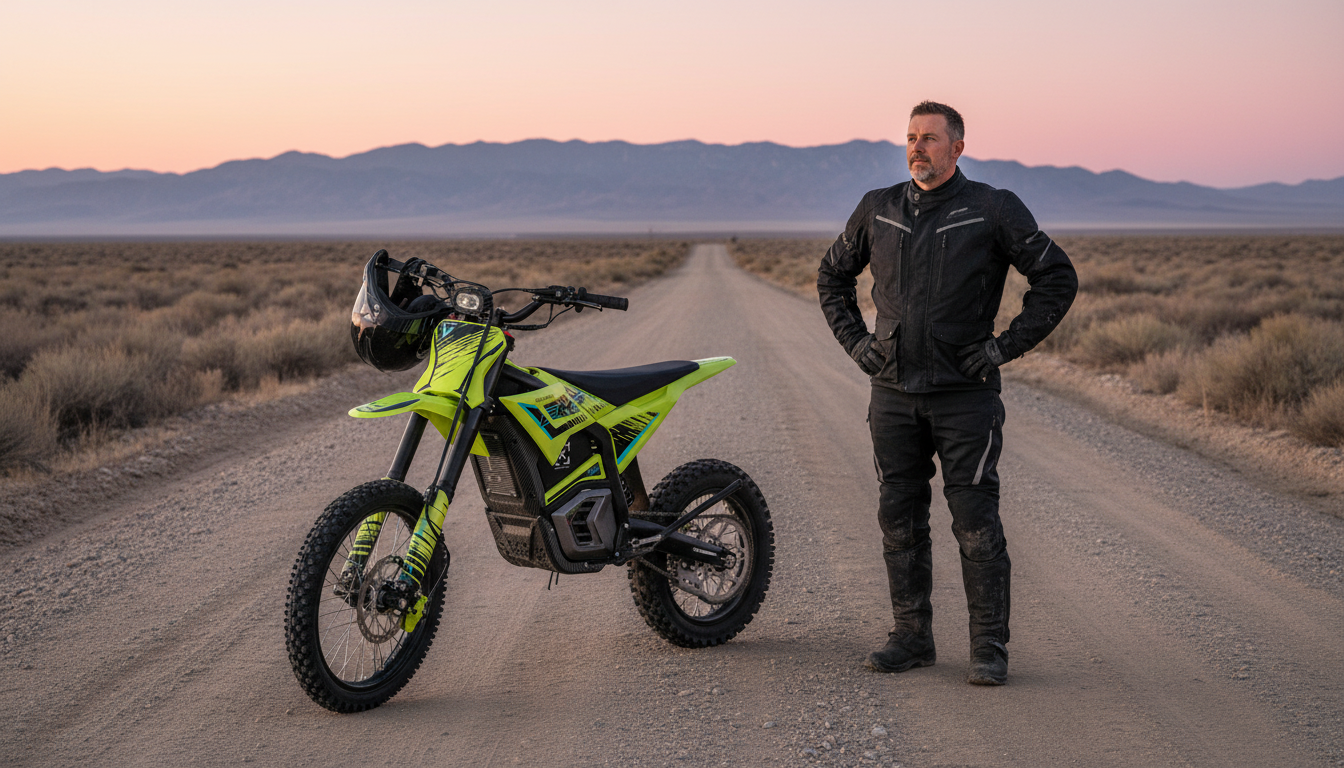
Carlos ended up on the EM-5 Pro Volt Green. He's 5'10", 185 pounds. Rides fire roads and singletrack on BLM land outside Reno. Spent the first three weeks in mode two (around 31 mph). Moved to mode three (43 mph) once he trusted the brakes. Hasn't asked about peak watts since June. The bike just works for him. Worth pulling up the full electric dirt bike lineup alongside the table below for a side-by-side.
|
Bike |
Peak |
Continuous |
Torque |
Top Speed |
Age |
|
Valtinsu EM-5 |
3,840W |
1,200W |
190 N·m |
37 mph |
13+ |
|
Valtinsu EM-5 Pro |
4,800W |
1,500W |
240 N·m |
43 mph |
18+ |
|
EM-5 Pro Volt Green |
4,800W |
1,500W |
240 N·m |
43 mph |
18+ |
|
Valtinsu EM-23 |
4,000W |
2,500W |
250 N·m |
43 mph |
16+ |
The EM-5 Pro and EM-5 Pro Volt Green are mechanically identical. Only the colorway differs. The Volt Green has a 0% return rate at the time of writing. No, really. Zero. Carlos checked. He likes data.
The EM-23 carries the highest continuous power and the highest torque in the lineup. Cruiser wheels (19-inch front, 17-inch rear) make it the choice for taller riders or riders prioritizing all-day comfort over aggressive singletrack. It's not my favorite of the lineup but it's the right answer for the right rider. (For me, that's a 50-something dad who wants to ride twice a month and not feel like he's in a Red Bull video.)
|
Valtinsu EM-5 Pro — Adult Electric Off-Road Motorcycle (18+) 60V geared brushless motor | 4,800W peak | 1,500W continuous | 240 N·m torque | 43 mph top mode | IPX6 | Three ride modes | Age 18+ Heavy-duty steel frame. 150mm hydraulic front fork. Adjustable air rear suspension. Hydraulic disc brakes front and rear. Removable 60V 27Ah lithium battery. One-year battery warranty. Two-year motor and controller warranty. CE, UL, and GCC certified. |
|
Age rule. No exceptions. EM-5 = 13+ (with adult supervision under 16). EM-23 = 16+. EM-5 Pro and EM-5 Pro Volt Green = 18+ adults only. The Pro models aren't options for minors. Don't let a sales pitch tell you otherwise. Don't let a forum thread tell you otherwise either. |
What it actually costs you, year one
Buying the bike is the first line item, not the whole bill. Build the rest into the budget on day one. The bike that arrives without gear is the bike that gets ridden without gear. Don't be that owner.
|
Item |
Cost |
Notes |
|
EM-5 Pro |
$1,699 |
Free U.S. shipping |
|
DOT-rated helmet (adult full-face off-road) |
$120–$280 |
Don't cheap out on this one |
|
Gear set (gloves, boots, knee, elbow, chest) |
$280–$520 |
Goggles included |
|
Tools & maintenance starter kit |
$80–$180 |
Torque wrench, chain lube, tire gauge |
|
OHV permit / trail pass (first year, varies) |
$25–$80 |
State and federal land |
|
Total year one |
$2,204–$2,759 |
Plus gas to the trailhead |
|
Carlos's three near-mistakes (don't make them) Carlos almost bought the wrong bike three times before he got it right. He sent me a screenshot of each near-miss. With his permission, here they are. 1. Almost bought the $1,400 "8,000W" no-name bike. Peak watts huge. Continuous unpublished. Battery voltage unspecified. Warranty 90 days. He paused because he couldn't find one independent review. Good instinct. 2. Almost bought a used Sur Ron Light Bee X from Facebook Marketplace. Listing was a real bike at a fair price. But Sur Ron is 18+ adult-rated and Carlos's nephew was going to ride it sometimes. Wrong rider, wrong bike. He realized in the parking lot. 3. Almost bought the EM-5 (not the Pro). Spec-wise great for trails. Wrong for him personally because he's an adult rider returning from gas and wanted the 4,800W peak / 240 N·m feel rather than the EM-5's 3,840W / 190 N·m. He pivoted to the Pro. No regrets. |
Conclusion

Carlos rode out to Pyramid Lake last weekend. First time in fifteen years.
He said the EM-5 Pro felt like coming home. Not like the KTM exactly. Different in some ways, better in others. Quieter. Lighter. No clutch to nurse. The torque arrives faster than he remembered, torque being allowed to arrive. He laughed about that part.
The math was right. The ride followed.
Here's the version I want you to walk away with. Watts and torque are useful numbers if you read them in context. Read them in isolation and you'll buy the wrong bike (too much top end, not enough climb, or the other way around). The right adult electric off-road motorcycle for you is the one whose peak watts, continuous watts, torque, motor architecture, and supporting systems all match the way you actually ride. Not the way you imagine you'll ride. The way you actually will.
If you're somewhere between the spec sheet and the credit card right now, here's what I'd tell you. Decide where you ride first. Pick the peak-to-continuous ratio that fits that kind of riding. Check the torque against the motor architecture (geared or hub — which question matters more for your terrain). Then look at the bike around the motor. Battery. Controller. Suspension. Brakes. The bike that survives all four filters is the one you should buy.
For most adult riders in the 35-to-55 mph range, watts and torque on an electric dirt bike should guide the final choice more than peak speed alone. The EM-5 Pro fits riders stepping up from light use, while the EM-5 Pro Volt Green makes more sense for heavier riders, rougher terrain, or stronger hill-climbing needs.
Compare the EM-5 Pro and EM-5 Pro Volt Green side by side using this same framework: rider weight, terrain, ride style, battery size, and the amount of power you actually want to control..
If you've got a teen in the family, the EM-5 ($1,259) is the only youth-rated option in the lineup. The Pro models are 18+ adults only. That isn't a marketing line. It's the manufacturer's rating. And it doesn't move.
Carlos's spreadsheet is closed now. He hasn't opened it since June.
FAQs
What's the difference between peak watts and continuous watts?
Peak watts vs continuous watts is the difference between short burst power and steady riding power. Peak watts support quick launches, hill starts, and brief acceleration, while continuous watts show the power a motor can hold during normal riding without overheating.Continuous is the climb you're going to be on for fifteen minutes. The healthy ratio is about 2:1 peak-to-continuous. A 6,500W peak / 1,000W continuous bike is built to look good on a poster. A 4,800W / 1,500W bike is built to actually work.
How many watts is enough for an adult electric dirt bike?
For weekend trail riders? 4,000 to 5,500W peak with 1,500 to 2,500W continuous. That's the sweet spot. Less than 3,000W peak and most adults will feel underpowered on real terrain (especially anyone over about 200 pounds). More than 7,000W peak is race-tier and most beginners can't safely use that much power. Honestly, I'd tell most adults shopping right now to look at bikes in the 4,500–5,000W peak range and stop there. The EM-5 Pro lands inside that window.
Does more torque mean more speed?
Nope. Different properties entirely. Torque is rotational force (the wheel-turning part). Top speed is how fast the motor can spin combined with the gearing. A torquey low-RPM motor will out-pull a high-RPM motor at the bottom of the throttle but lose to it at the top. Match the spec to your riding, not the other way around.
Is 4,000W enough for an adult electric dirt bike?
Yes. For most adult weekend riders, 4,000W peak handles acceleration, short climbs, and trail cruising without complaint. The asterisk: if you're over 220 pounds, or you ride steep sustained climbs, or you're carrying gear, 4,800W (like the EM-5 Pro) gives you more cushion. The number alone doesn't tell you the whole story though. You also need the continuous rating and the torque figure. A 4,000W peak with 800W continuous is not the same bike as a 4,000W peak with 2,500W continuous.
How important is torque on an electric dirt bike?
More important than top speed for almost everyone except racers. Torque is what moves the bike from zero. What climbs the hill. What gets you through soft sand without losing your nerve. Top speed only matters on open ground, and most actual trail riding happens at speeds where torque is doing the work. A bike with strong torque at low RPM (geared motor with reduction gearing) will feel more capable off-road than a higher-horsepower bike with lazy low-end pull. Every. Single. Time.
Do watts matter more than torque?
Honestly, I kinda hate this question because the framing is wrong. Watts and torque measure different things. They're linked by motor RPM. Asking which matters more is like asking whether the gas pedal or the engine matters more in a car. They're the same system, expressed differently. What actually matters: do you need power delivered at low RPM (geared motor, torquey) or across the rev range (hub motor, top-end)? Weekend off-road? Geared wins. Race-tier enduro? Hub wins. That's the real question.
What's the difference between watts and horsepower?
Same thing in different units. 746 watts equals about one horsepower. A 4,800W peak motor makes roughly 6.4 hp at peak. Watts is more useful for electric motors because watts is literally what the battery delivers. Horsepower is a gas-engine convention that gets recycled into electric marketing because it sounds bigger to people raised on gas bikes. When you're comparing electric to electric, stay in watts. When you're translating to your old KTM, divide by 746.
Why do two bikes with the same wattage feel different?
Motor architecture. That's the headline answer. A geared brushless motor with reduction gearing concentrates torque at low RPM. A direct-drive hub motor spreads it across the range. Same watts on paper. Totally different ride. There's more underneath that, though. Controller amperage. Battery voltage. Final gearing ratio. Wheel diameter. Bike weight. Two 4,000W bikes can feel completely different because everything around the motor is doing different work. The motor is one part of a system, not the whole system. (I really do need to stop saying that. But.)
Sources
- U.S. Department of Energy — Electric Vehicles overview, motor and battery efficiency primers.
- U.S. Environmental Protection Agency — Green Vehicles, drivetrain comparison resources.
- U.S. National Highway Traffic Safety Administration (NHTSA) — Motorcycle safety, DOT helmet standards
- U.S. Bureau of Land Management — E-bike classification on BLM-administered public lands.
- USDA Forest Service — Motor Vehicle Use Maps for National Forest land.
- SAE International — Standards for electric motor classification and testing.
- Valtinsu — Electric Dirt Bike Collection.
- Valtinsu — EM-5 Pro product specifications.


Looking for something else?
Electric Dirt Bike Replacement Parts Availability: What Buyers Should Verify Before Ordering
LEARN MORE
How to Check an Electric Dirt Bike for Safety Recalls by Model and Serial Number
LEARN MORE
How to Choose an Electric Dirt Bike Repair Shop: Questions to Ask Before Service
LEARN MORE
How to Lift a Fallen Electric Dirt Bike Without Hurting Yourself or the Bike
LEARN MORELooking for something else?
Electric Dirt Bike Fall Riding on Wet Leaves: Grip, Hidden Obstacles and Braking
LEARN MORE
Electric Dirt Bike Trailside Power Loss: Recovery Plan When the Battery Is Dead
LEARN MORE