Electric Dirt Bike Tire Guide: Knobby vs Street Tires by Terrain
Match the tire to the ground you ride most.electric dirt bike tire guide Knobby for dirt, mud, sand, and rocks. Street for pavement. And if you ride a bit of both, which most people do, semi-knobby splits the difference without much drama. That is the guide. The rest is detail.
Why it matters more here than on a pedal bike comes down to two things, and an adult electric off-road motorcycle has both in spades: instant torque and weight. Touch the throttle and the motor sends power to the rear wheel with no build-up, no clutch, nothing to ease it in. The battery adds mass a bicycle never carries. Wrong tread on that combination and the rear spins, the front washes wide in corners, and your range quietly bleeds off. Right tread and the bike just hooks up. Below we cover the tire types, how to read a size, tread by terrain, pressure, tubes versus tubeless, and when a tire is done.
Quick Tire Pick by Surface
Short on time? Name the surface you ride most and take the tread built for it. This table does the whole job.
|
Your surface |
Best tire |
Why |
|
Dirt trails, singletrack |
Knobby |
Deep, spaced lugs bite loose ground and hold under braking. |
|
Mud, wet trails |
Aggressive knobby |
Wide gaps clear mud so the tread does not pack and go slick. |
|
Sand, soft ground |
Wide knobby / paddle |
Width floats the bike; open tread pushes it forward. |
|
Rocky trails |
Knobby, hard compound |
Reinforced sidewalls and tougher rubber resist cuts. |
|
Hard-packed dirt |
Semi-knobby |
Enough grip, less drag, faster rolling. |
|
Pavement, neighborhood |
Street |
Smooth tread rolls quiet and protects range. |
|
Dirt + road mix |
Semi-knobby |
Road-friendly center, grippy shoulder knobs. |
Not sure what your bike even rolls on? Wheel size is part of the picture, and it varies more than people expect across a single lineup. You can compare electric dirt bike wheel sizes before you shop tread. The EM-5 runs a 14-inch front and 12-inch rear. The EM-5 Pro steps up to 17/14. The EM23 goes bigger still with a 19-inch front for open ground. A taller front wheel rolls over square-edged hits more smoothly, while a smaller one turns in quicker. Neither is better. They are built for different riding.
Why Tire Choice Matters More on Electric Dirt Bikes

A gas engine builds power as it revs, so grip has a half-second to catch up. Electric skips that grace period. Peak torque sits right there at zero rpm, which means the rear tire has to turn a hard shove into forward motion the instant you ask, not a beat later.
Some numbers make it real. The EM-5 Pro lays down 177 lb-ft from a 5,600W geared motor, and the EM23 carries the most twist in the range at 184 lb-ft. All of it arrives at once. Put smooth street tread under that on loose dirt and the wheel just spins in place, throwing rooster tails and going nowhere. Put a knobby under it and the lugs hook, and the same throttle input drives you forward instead.
Then there is weight. A battery, a motor, and a steel frame press on the tires far harder than any bicycle. That load rewards a reinforced sidewall. Thin bicycle casings go vague in corners and cut on rocks the first time you clip one wrong. So the decision really rests on three things working together. Torque. Weight. Terrain.
|
Field note In our experience, the rear tire wears out first on these bikes, and it is not close. Instant torque rounds off the center knobs faster than most riders expect, especially anyone logging pavement miles between trailheads. |
The Four Tire Types, Plainly
Every tread is a trade between grip and how easily it rolls. Four families cover almost everything a rider needs.

Knobby Tires
This is the off-road default, and for good reason. Tall, widely spaced lugs press down into soft ground and shed mud as the wheel spins, which is exactly what you want on dirt, mud, sand, and rocky trail. The cost shows up on pavement, where they get loud, roll harder, and wear faster if you spend real time on roads.
Semi-Knobby Tires
Call it the middle ground. A smoother center strip keeps things rolling on hardpack and short road links, while raised side knobs still bite when you lean the bike into a dirt corner. It gives up ground in deep mud and loose sand. For most riders who mix surfaces, it is the smart pick anyway.
Street Tires
Street tires run a smooth or lightly grooved tread meant for pavement and clean, hard surfaces. More rubber on the road buys you quieter rolling, steadier braking, and better range. Take them onto gravel, sand, or wet grass, though, and they let go with almost no warning, so keep them to riders who stay on hard ground.
Sand and Specialty Tires
Deep, loose sand is its own problem, and a paddle-style tread solves it by scooping and floating where a normal knobby just digs a hole. This is a niche tool. If sand only turns up now and then on your rides, a wide knobby dropped to lower pressure usually gets you through.
How to Read a Tire Size
Sidewall codes look cryptic until you split them into three parts. And the rim size is the part you check first, every time.

|
Code example |
What it means |
|
90/90-19 |
90 mm wide, sidewall height 90% of width, fits a 19-inch rim. |
|
80/100-21 |
80 mm wide, sidewall 100% of width, 21-inch rim. |
|
3.25-19 |
Inch-based: about 3.25 in wide, 19-inch rim. |
|
80/90-14 |
80 mm wide, sidewall 90% of width, 14-inch rim (common on smaller bikes). |
Read it left to right. First number, width in millimeters. Middle number, the aspect ratio, which is the sidewall height as a percentage of that width. Last number, rim diameter. A 19-inch tire only goes on a 19-inch rim, full stop. Metric and inch sizes sometimes land close to each other but are not guaranteed matches, so hold a new size up against your current tire before you commit. If you want the marking-by-marking version, Michelin's sidewall guide lays it all out.
|
Watch clearance Right rim size, wrong tire. It happens. Width still has to clear the fork, swingarm, chain, and fender, with room left over for mud to pass through. Check the narrowest points before you buy. A bigger tire is not an upgrade if it rubs the frame. |
Match Tread to Terrain
Let terrain drive the tread, not the way it looks in a photo. A tire that feels planted on pavement can feel downright sketchy the moment it hits loose gravel.

Loose Dirt and Gravel
Here you want open tread spacing and strong shoulder knobs. Those shoulder knobs earn their keep when the bike leans into a corner and the edge of the tire is doing the work. Keep the throttle steady. Loose ground punishes a sudden snap of torque more than almost any surface.
Mud and Wet Trails
Mud wants deep, widely spaced knobs that fling the muck out as they roll. Let it pack between the lugs and the tire turns into a slick, and grip disappears in an instant. Street tread cannot clean itself at all here, so it slides under braking. Dropping pressure can help the tire spread and grab, but only within the sidewall's safe range.
Sand and Soft Ground
Width and float are what win in sand. A wider knobby spreads the bike's weight across more surface so it rides on top of the soft stuff instead of tunneling into it. Momentum is your friend, abrupt throttle is not, and any pressure drop stays inside the safe window.
Rocky Terrain
Rock rewards reinforced sidewalls and a medium-to-hard compound. Soft rubber grips beautifully but wears down fast against stone, and a thin casing pinches and cuts the first time you land hard on an edge. Pressure is a balancing act. Too low and the rim strikes rock, too high and the bike skates off the tops.
Hard-Packed Dirt
Firm ground does not need giant mud lugs, which only add drag with nothing to bite into. A semi-knobby or a closer-spaced hard-terrain knobby rolls faster while still holding a line through corners. This is the surface where a lot of mixed-use riders quietly settle.
Pavement and Neighborhood Roads
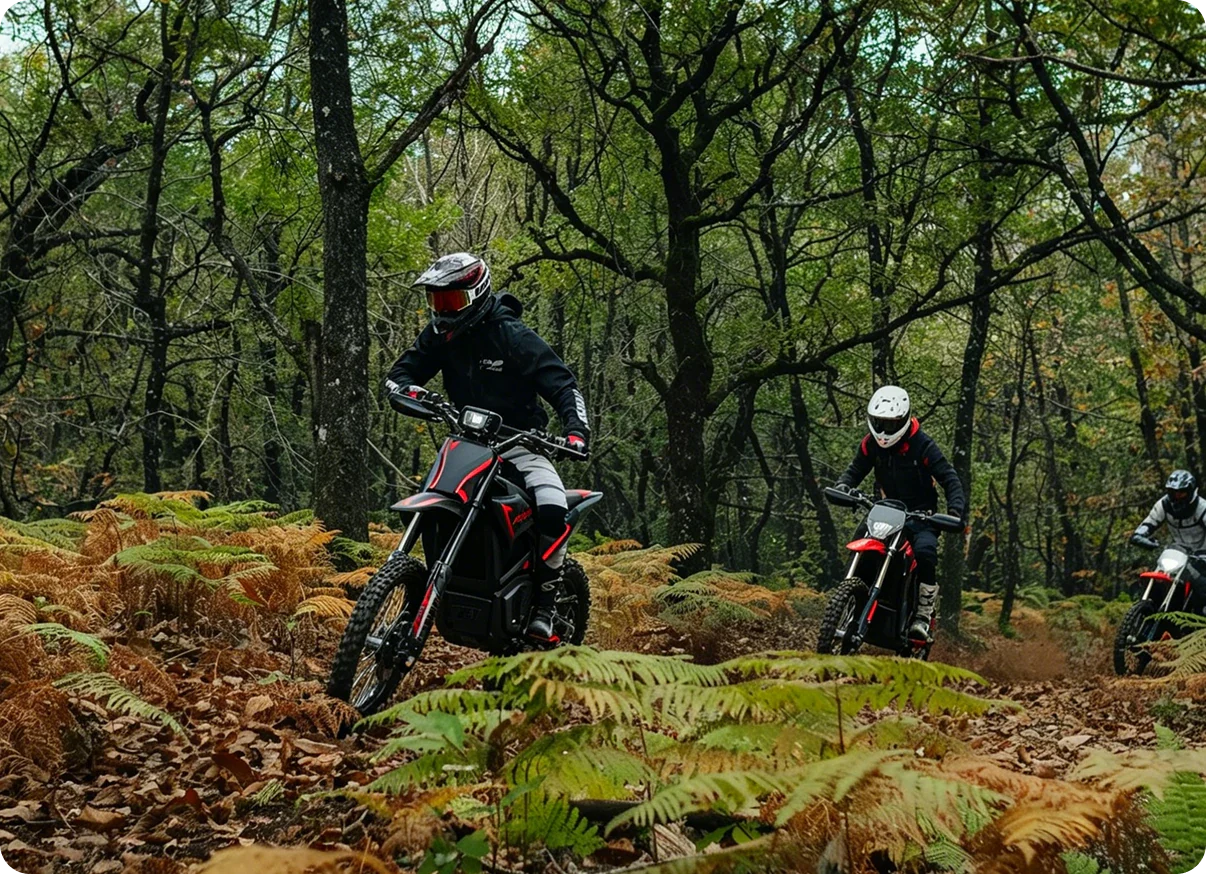
On tarmac, run street tires or road-friendly semi-knobbies. Knobbies flex and scrub against the hard surface, and all that movement turns into heat, noise, and quicker wear. One thing before you ride any public route, though: most of these machines are off-road only, so check the local rules first. Our trail etiquette guide covers where riding is allowed and who yields to whom.
Set the Right Tire Pressure
Pressure might be the most powerful setting most riders never touch. It changes grip, it changes comfort, it changes how the tire rolls, and it drifts on its own with rider weight, terrain, and the temperature outside.

|
Condition |
Direction |
Why |
|
Loose / muddy / sand |
Lower (within safe range) |
Bigger contact patch grips soft ground. |
|
Pavement / hardpack |
Higher (within safe range) |
Less squirm, smoother rolling, less wear. |
|
Heavier rider or cargo |
Add a little |
Keeps the tire from folding or hitting the rim. |
|
Cold weather |
Recheck before riding |
Pressure drops roughly 1 PSI per 10 F cooler. |
One rule matters more than the rest: check pressure cold, before the wheels have turned. Michelin's guidance spells out why. Riding warms the tire and pushes the reading up, so a warm check quietly lies to you. Use a real gauge instead of a thumb press, and move in small 1 to 2 PSI steps rather than big jumps. A lot of riders keep the rear a touch higher than the front, since the rear takes the drive force and the weight shift under acceleration.
|
Do not guess from the sidewall max That number molded into the sidewall is a ceiling, not a goal. Start in the middle of the tire maker's range for your terrain and fine-tune from there. Chasing a feeling past the safe range is how tires and rims get hurt. |
Rubber Compounds and Tread Depth
Tread shape is the part you can see. Compound is the part everyone forgets, and it matters just as much. Soft rubber grips harder and wears out sooner. Hard rubber lasts and lasts but trades away some bite.
|
Compound |
Strength |
Trade-off |
Best for |
|
Soft |
Grip on rock and roots |
Wears faster, worse on pavement |
Technical, low-mileage trail days |
|
Hard |
Long life on hardpack/road |
Less grip on wet or loose |
High-mileage, road-heavy riding |
|
Balanced |
Mixed grip and wear |
Master of none |
Riders who split trail and road |
Depth is your read on how much grip is left in the tire. On a knobby, look for lugs that have gone rounded, cracked, or torn, because once those sharp edges are gone the tire stops biting. Street tires tell the story differently, with flat spots worn into the center and fine cracks in the rubber. See cords or casing through the surface and you are done. Replace it.
Tube vs Tubeless
Neither setup is wrong. Which one suits you comes down to your rim, the way you ride, and how you would rather deal with a flat when it happens.
Tube Setups
Pros
- Simple and common on dirt bikes.
- Easy field repair: patch or swap the tube.
- Heavy-duty tubes handle rough riding well.
Cons
- Pinch flats if pressure runs too low.
- Sharp rock and root hits can squeeze the tube.
Tubeless Setups
Pros
- Small punctures can seal while you ride.
- Lower pressure is possible on the right rim.
- Fewer stops from thorns and small nails.
Cons
- Not every wheel is tubeless-ready; check first.
- A sloppy setup leaks; it must be done correctly.
Either way, sealant helps seal the small stuff, and liners add a thorn barrier that will rub the tube if you place it sloppily. What matters most is that you carry the basics no matter which setup you run: spare tube, levers, a pump, a patch kit. Nothing stops every flat. Grab your tubes, sealant, and maintenance parts ahead of a big ride, not standing over a flat on the trail.
Common Tire Mistakes
Most tire trouble is baked in before the wheels ever turn, either at checkout or during setup. These are the ones we see over and over.
- Buying tires that do not fit. The rim size matches but the width fouls the frame, or the tire sits poorly on a too-narrow rim. Check every clearance point.
- Running street tires on loose trails. Fine at low speed, then the front pushes wide the moment gravel sits over hardpack.
- Knobbies on daily pavement. Noise, buzz, faster wear, and more battery drain for grip you are not using.
- Ignoring pressure. Too low pinches and lets the rim strike; too high goes harsh and skittish. Check it cold, every ride.
- Riding worn or cracked rubber. Rounded lugs, thin tread, cuts, and exposed casing all mean grip is gone. Replace before a hard day.
Maintenance for Longer Tire Life
A few small habits add real miles, and none of them take long.
- Check pressure cold before each trail day; tires lose air just sitting.
- Rinse off mud after wet rides so cuts and thorns are easy to spot. Keep water off seals and electrics.
- Spin each wheel slowly and inspect the tread and sidewalls for cuts, bulges, and torn knobs.
- Store the bike out of direct sun and away from heaters and solvents; heat and ozone age rubber.
None of that is just folk wisdom. NHTSA notes that heat speeds tire aging, and that cuts, cracks, bulges, and worn tread are all reasons to replace a tire even when it still looks fine from across the garage.
How We Approached This Guide
Tire advice goes wrong the moment it comes off a spec sheet and nowhere else. Here is what actually shaped these picks.
Terrain-first, not brand-first
Every call here starts from the surface and the physics of instant torque, not from something we were hoping to sell you. The best tire is simply the one that matches the ground under it.
Verified against authoritative sources
The pressure, sizing, and inspection guidance leans on Tier-1 sources, NHTSA, Michelin, CPSC, and we cross-checked it rather than taking one page at its word. Wherever a rule really depends on your exact tire, we point you back to the sidewall and the bike manual instead of pretending otherwise.
Grounded in how these bikes actually behave
Across the electric dirt bikes we have put miles on, the same pattern keeps showing up. Rears wear first. Torque exposes weak tread fast. And more rider complaints get solved by correct pressure than by any tire upgrade. That is what steered the emphasis in this guide.

The Short Version
Buy for the surface you ride most, and confirm the size actually fits before you pay for it. Knobby for dirt, street for pavement, semi-knobby when you genuinely do both. Set pressure cold, then tune it a couple of PSI at a time. Still picking the bike itself? The EM-5 suits new and teen riders on trails, the EM-5 Pro is the all-round adult pick, and the EM23 brings bigger wheels for open ground. Get the tire right for the ride and everything after it gets easier.
Frequently Asked Questions
Do electric bikes need special tires?
Usually, yes. The extra weight, the higher speeds, and that instant hit of motor torque all ask more of a tire than a pedal bike ever does, and the rear tire feels it most of all.
E-rated tires answer that with stronger casing, better puncture protection, and reinforced sidewalls that hold their shape under a heavier machine. A plain bicycle tire might slide onto the rim just fine and still be wrong for the load. Pick by terrain first, then make sure the tire is rated for your bike's weight and speed.
How do I choose the right dirt bike tires?
Terrain first, always. That one decision does most of the work before you even look at a size chart.
Once the tread family is settled, the rest is a quick checklist:
- Tread to surface. Knobby for dirt, mud, sand, and rocks; street for pavement; semi-knobby for a mix.
- Size and fit. Read the sidewall code, match the rim diameter, and confirm the width clears the fork, frame, chain, and fender.
- Riding style. Aggressive riders want stronger sidewalls and deeper tread; casual riders often do better with a balanced tread that lasts.
What does 90/90-19 mean?
90 mm wide, on a 19-inch rim, with a sidewall 90% as tall as the tire is wide. First number width, second the aspect ratio, third the rim.
That middle number matters more than people think, because the aspect ratio changes the whole tire height, and with it your clearance and steering feel. Confirm the rim is 19 inches. Then check the mounted tire actually clears your bike before you buy.
What does 80/90-14 mean?
80 mm wide, 14-inch rim, sidewall 90% of the width. Some shops print it with a dash instead of a slash, but it reads the same either way.
You will see this size on smaller and youth-style bikes. Rim diameter is the hard limit here, so an 80/90-14 will never seat on a 12-inch or a 17-inch rim. After that, the usual clearance check for the swingarm, chain, and fender applies.
What is the most common e-bike tire size?
There isn't one. Commuter e-bikes, fat-tire builds, and electric dirt bikes all ride on different wheels, so the honest answer is that it depends on the machine. Even one lineup varies:
- EM-5: 14-inch front, 12-inch rear.
- EM-5 Pro: 17-inch front, 14-inch rear.
- EM23: 19-inch front, for open ground.
- Your safest move is to read the current sidewall and check the manual before you order anything.
What is the difference between 90/90-19 and 3.25-19?
One is metric and one is inch-based, but both fit a 19-inch rim. 90/90-19 runs about 90 mm wide; 3.25-19 is roughly 3.25 inches wide.
Close, though not automatically interchangeable, because brand, tread pattern, and sidewall height all nudge the real mounted size around. Match the rim first. Then compare width, outer diameter, and clearance before you cross from one sizing system to the other.
What is the best dirt bike tire brand?
No single brand wins. The right tire is the one whose tread, compound, and size line up with your terrain and fit your bike, and that answer changes from rider to rider.
Plenty of well-known off-road names cover the common needs, and many now build electric-specific patterns tuned for the extra torque. Judge a tire on fit and terrain match rather than the logo on the sidewall. A great brand in the wrong size is still, at the end of the day, the wrong tire.
Sources
- NHTSA (TireWise), Tire Safety: inspection, tread wear, and aging (2026)
- Michelin, Check Your Motorcycle Tire Pressure (2026)
- Michelin, How to Read the Motorcycle Tyre Size (2025)
- PeopleForBikes, Electric Bike State Laws (2026)
- CPSC, Which Helmet for Which Activity? (2026)


Looking for something else?
Electric Dirt Bike Loses Power Under Load: Causes and How to Fix It
LEARN MORE
Electric Dirt Bike Bolt Torque Checklist: What to Check and Where the Numbers Come From
LEARN MORE
How to Bleed Electric Dirt Bike Brakes Safely
LEARN MORE
Electric Dirt Bike Throttle Not Working: What to Check First
LEARN MORELooking for something else?
Electric Bike Battery Not Charging? Work Through This Before You Buy a New One
LEARN MORE
Electric Dirt Bike Error Codes: What They Mean and What to Check First
LEARN MORE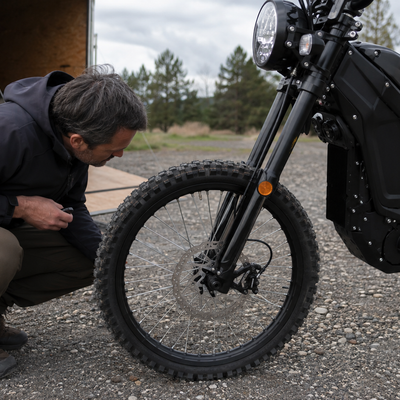
Electric Dirt Bike Brake Rotor Rubbing: Diagnose the Cause Before Adjusting
LEARN MOREYou may also like
Moto eléctrica todoterreno para adultos EM-5 con luz
VALTINSU EM-5 Pro Off-Road Black Electric Dirt Bike
VALTINSU EM-5 Pro Green Electric Dirt Bike
VALTINSU EM-5 Ultra Electric Dirt Bike
VALTINSU EM-5 & EM-5 Pro Combo
Further reading
Electric Dirt Bike Trailside Power Loss: Recovery Plan When the Battery Is Dead
Electric Dirt Bike Fall Riding on Wet Leaves: Grip, Hidden Obstacles and Braking
How to Lift a Fallen Electric Dirt Bike Without Hurting Yourself or the Bike