Electric Dirt Bike Safety Gear Checklist: Helmet, Pads, Gloves & First-Ride Rules
Electric dirt bike safety gear is the first thing riders should get right before ever touching the throttle, because it protects the head, joints, and body in every type of crash scenario.
Cover what hits first. That is the whole rule. Head, eyes, hands, knees, elbows, chest, back, ankles, feet, roughly in that order, all of it sorted before you ever touch the throttle.
A buddy of ours learned it the hard way. Borrowed bike, gravel driveway, the half-shell bicycle helmet that happened to be in the garage. He grabbed a fistful of throttle, the rear stepped out, and he slid maybe ten feet on a bare forearm. Nothing broke. The arm looked rough for a week. Forty dollars of gloves would have saved the skin, and he should have owned them on day one.
New riders miss this part. An adult electric off-road motorcycle is not a pedal bike with a battery. Heavier. The power lands the instant you twist. And the back tire flings dust and rock the second it breaks loose. Bike-lane gear does not survive that. Across the Valtinsu electric dirt bike range the entry EM-5 already runs to 40 mph, and the EM-5 Pro hits 52. Motorcycle speeds. So the gear matches a motorcycle, not a bicycle.
What follows is a full electric dirt bike safety gear checklist (helmet, goggles, pads, gloves, boots), a printable kit ranking, first-ride habits that beat any single pad, a 60-second pre-ride check, and a quick guide on where these bikes are legal.
|
Key takeaways
Helmet first. A DOT or ECE full-face is the one piece you never skip.
Five before you ride: helmet, goggles, gloves, knee pads, over-ankle boots.
Heavier and faster than an e-bike, so the gear has to be tougher.
Habits matter as much as armor. Low-power practice, brake drills, a quick pre-ride check.
Off-road only. Not street legal. Rules shift by state and park.
|
The Electric Dirt Bike Safety Gear Checklist
This 2026 full checklist for new riders and parents: Print it. Tick each box as the kit comes together. Then ride. Eight pieces, and the order roughly tracks how much each one earns its keep on real dirt.

|
Gear
|
What it protects
|
Priority
|
Owned?
|
|
Full-face helmet (DOT/ECE)
|
Skull, face, jaw, brain
|
Essential
|
☐
|
|
Goggles
|
Eyes, vision in dust and roost
|
Essential
|
☐
|
|
Full-finger gloves
|
Palms, knuckles, grip control
|
Essential
|
☐
|
|
Knee pads or braces
|
Knees on low-side falls
|
Essential
|
☐
|
|
Elbow pads
|
Elbows in washouts
|
High
|
☐
|
|
Chest / back protector
|
Roost, branches, bar strikes
|
High
|
☐
|
|
Over-ankle riding boots
|
Ankles, shins, toes on pegs
|
Essential
|
☐
|
|
Long sleeves + riding pants
|
Skin, abrasion, sun
|
Medium
|
☐
|
|
Quick fit test. Buckle up, then bend, squat, twist the way you ride. A pad that creeps down your shin during that is a pad that goes missing in the crash. Fix the fit at home. Not on the trail.
|
|||
Helmet: The One You Never Skip
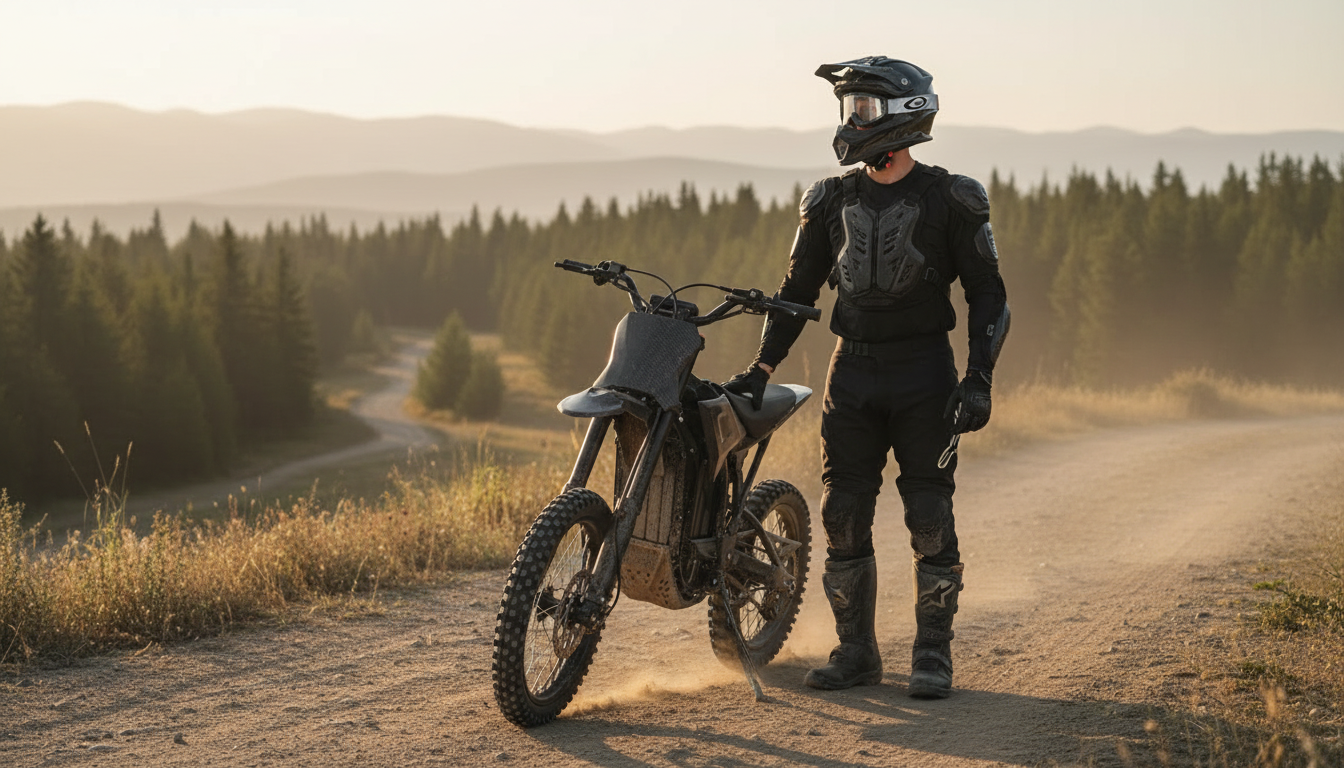
Head first. Skip nothing here. Ride faster than a walking pace on loose ground and the helmet quits being a comfort item. It turns into the call that drives every other piece you buy.

Get a full-face built for dirt or motorcycle use. A DOT label means it cleared the U.S. federal motorcycle standard. The NHTSA puts it plainly: the DOT symbol shows the helmet meets Federal Motor Vehicle Safety Standard No. 218. Riding abroad? ECE 22.06 is the standard you want. It tests angled hits, which is closer to how a real crash lands.
Why not the trail-bike lid in the garage? Two reasons. A crash throws you forward, and a chin bar covers the jaw a half-shell leaves bare. The protection is measured, too. The CDC ties motorcycle helmets to a steep drop in head and brain injuries, traumatic brain injury included.
Helmet pros and cons
Where it wins:
-
Chin bar covers the jaw, the part most likely to land first.
-
DOT and ECE labels are a floor you can verify, not a brand promise.
-
Runs as a system with goggles for full eye cover in roost.
The catch:
-
Hotter and heavier than an open-face. Vents matter in July.
-
One real hit and it is spent. The foam crushes once.
|
Skip the used helmet. Retire yours after any crash impact. Same goes if the strap frays, the shell cracks, or the fit loosens with age. A lid that no longer hugs your head no longer protects it.
|
Goggles, Gloves, and Boots: Where You Touch the Bike
After the head, the injuries get boringly predictable. Dust steals your vision. Hands meet the ground first. Ankles roll on a bad dab. These three protect you and steer the bike at the same time, which is why they travel as a set.

Goggles
Quiet speed is the trap. No engine note, so you are going faster than it feels, and the dust shows up early. Goggles that seal and vent keep your eyes working. Foam seal. Scratch-resistant lens. Tear-offs if you ride wet or sit behind other riders. Skip the bargain pair, because the bargain pair fogs at the worst moment.
Gloves
Full-finger, no debate. They take the palm road rash, and they hold your grip when the bars go slick with dust or sweat. Palm padding, knuckle cover, a wrist strap that stays put. Anything bulky enough to mute the brake lever is the wrong glove, because mushy throttle feel is its own hazard on a bike that fires the moment you twist.
Over-ankle boots
Pegs are narrow. They bite into soft shoes. That is the problem with sneakers and hikers, which flex sideways and hang the ankle out to dry, turning a routine foot-dab into a six-week sprain. A real off-road boot climbs past the ankle, stays stiff side to side, and locks the foot onto the peg. Buckles that hold through a slide. Best dollar-for-dollar buy in the kit, honestly.
How the control layer stacks up
Where it wins:
-
Vision stays clear, and vision drives every reaction out there.
-
Grip and braking improve, on top of crash protection.
-
Ankle twists, the quiet ride-ender for new riders, mostly vanish.
The catch:
-
Boots need breaking in and run warm.
-
Cheap goggles fog at low speed, right when tight trail wants a clear view.
Pads and Armor: Cover the Impact Zones
Pads do not make you crash-proof. Nothing does. What they do is soften the outcome when a normal beginner mistake shows up, and one will. You are not gearing up like a pro racer on day one. You are covering the spots that take repeated knocks, then adding more when speed or terrain asks for it.

Knee pads first. They eat direct hits, scrapes, the slide across gravel, and they are the smart opening buy. Braces come later, once you are jumping or nursing an old injury. Elbows go down fast in a low-speed washout, so a basic elbow pad turns a nasty scrape into a bruise. A chest protector handles roost, stones, the stray branch. Back protection earns its spot the day you land off balance.
|
Two ways to run armor. A jacket keeps shoulder, elbow, chest, and spine pads in one piece, simpler for casual riders. A separate chest-and-back protector breathes cooler on a hot day. Neither is wrong. The right one fits and stays put when the trail turns rough.
|
Why These Bikes Need More Gear Than an E-Bike
Electric dirt bike safety gear—such as a full-face helmet and over-ankle boots—is necessary because higher speed, instant torque, and rough terrain demand stronger protection than standard commuter e-bike gear.
An adult electric off-road motorcycle lands between a mountain bike and a small electric motorcycle. Friendly in the driveway. Then the instant power and the extra weight rewrite the math on every fall, and commuter e-bike gear comes up short.
Instant torque
Twist it and the power is just there. A small wrist move can launch the bike before a beginner is set. That is the whole story behind whiskey throttle, a spinning rear wheel, a sudden tip-over. An

EM-5 Pro lays down 177 lb-ft low in the range, where it hits hard and early, so the gear is on before the throttle gets interesting. First rides are for smooth throttle. Not speed.
Weight
These outweigh most pedal bikes by a wide margin. The EM-5 sits around 126 lb. That heft can pin a leg or wrench a foot, and it needs more room to stop than you would guess. Drill braking on flat ground first. Loose dirt later.
Dirt, rocks, roost
The surface changes every few feet. Packed dirt, then gravel, then a root, then a rut hunting your front wheel. Roost off the rider ahead stings your chest and face with no warning. Goggles, gloves, chest protection. They earn their keep on a short loop behind the house, never mind the real trail.
Match Your Gear to Where You Ride
The kit shifts with the place. Backyard lap, forest trail, wet loop, night ride. None want the same setup. Build for the hardest stretch of the day, not the easy part.
|
Where you ride
|
Minimum gear
|
Add for the conditions
|
|
Backyard / private land
|
Helmet, gloves, closed boots
|
Knee and elbow pads on hard or gravel ground
|
|
Dirt trails / forest roads
|
Full-face, goggles, gloves, pads, boots
|
Chest protector for roost and branches
|
|
Street crossings / mixed
|
Full kit plus bright or reflective gear
|
Front and rear lights near vehicles
|
|
Rain and mud
|
Vented goggles, wet-grip gloves
|
Stable boots, spare socks for long days
|
|
Night / low light
|
Full kit plus reflective detail
|
Strong front and rear light, slow down
|
Big-wheel cruiser like the EM23, running a 19-inch front for open-ground stability? Same rule. Dress for the roughest part of the loop, never the gentle bit.
Where you ride is also a legal question, and it trips up more new owners than the gear ever does. PeopleForBikes keeps a state-by-state breakdown of how much the rules vary, and a high-powered bike often reads as a motorized vehicle, not a bicycle. The National Park Service says it straight: follow trail rules, wear proper safety equipment. Valtinsu bikes are off-road only and not street legal. Private property, closed courses, designated areas.
First-Ride Rules Before You Ride Faster

Gear is half of it. Habits are the rest. A rider who goes slow and drills the basics beats one in full armor who skips them. First ride is for throttle, braking, turning, body position. Speed waits.
-
Lowest power mode, always. Feel the bike without the launch, wrist relaxed so a bump does not roll the throttle for you. The beginner-friendly EM-5 has a soft 22 mph mode built for this.
-
Drill the brakes first. Both levers, flat ground. Slow stops, then firm ones, then stops on loose dirt. Eyes up the whole time.
-
Slow into corners. Most beginner falls happen in turns and ruts. Brake before the corner, look where you want to go, loose on the bars instead of clamping down.
-
No jumps on day one. Bad timing punishes hard, and a first-day jump usually ends nose-heavy. Throttle, braking, balance first. Both wheels stay down until that feels automatic.
-
Pick legal, open ground. Private land or a designated off-road area. Room to practice, no traffic, no pressure to keep up.
The 60-Second Pre-Ride Check
A quick 60-second pre-ride safety check catches the small issues before speed turns them into big problems.
-
Helmet strap buckled and snug under the chin, goggles sealed with the strap flat.
-
Roll slow, squeeze both brakes. Tracks straight, no grinding, no lever pulling to the grip.
-
Tires: pressure, cuts, debris. Chain: slack and damage.
-
Battery locked in, charged for the loop you planned.
-
Phone charged, water packed, small first-aid kit along. A short ride can turn into a long walk.
|
Battery and charger. The CPSC has flagged lithium-ion fire risk from e-bikes and similar products. Use the charger that came with the pack, charge in open space away from anything that burns, and unplug once it is full. A pack that swells, leaks, smells off, or buzzes is done. Replacement riding gear and accessories (including chargers and parts) come from Valtinsu, not a random third-party unit.
|
How We Built This Checklist
We ride and review adult electric off-road motorcycles for a living. So this list reflects what survives real dirt, not what photographs well. Three things steered every call.
Tested against real crashes
Across hundreds of rider setups we have looked at, the same gear keeps earning its place. Full-face helmets. Stiff boots. Knee protection. The pricey stuff that fails is almost always the gear that never fit right to begin with.
Standards over hype
DOT and ECE labels, CE-rated armor, government guidance. We weight those above any brand claim. A label is something you can check. A slogan is not.
Matched to the bike and rider
Gear advice tracks power and age. The EM-5 starts at 13+, the EM23 at 16+, the EM-5 Pro is adults only at 18+. Compare the full lineup to fit the bike to the rider, then fit the gear to the bike.
Conclusion: Gear Up, Then Ride
Your electric dirt bike safety gear checklist is not about looking the part at the trailhead; it protects the body parts that take the hardest hits and keeps your head clear so control and comfort stay connected. It guards the parts that take the hardest hits, and it keeps your head clear, because comfort and control travel together. A comfortable rider stays calm. A calm rider makes the right call when a corner tightens.
So build it in order. Helmet, goggles, gloves, pads, boots, before a dime goes to style. Then back it with habits: low-power practice, brake control, legal ground, a quick check before every ride. The best setup is the one you actually put on every single time.
Get that right and the gear disappears. You stop thinking about the crash you are dodging and start thinking about the trail in front of you. Which is the reason you bought the bike.
FAQs
What safety gear do I need for an electric dirt bike?
Eight pieces. Full-face helmet, goggles, full-finger gloves, knee pads, elbow pads, chest or back protection, over-ankle boots. Long sleeves and riding pants round it out. Each one guards a part that hits first, and on these bikes the ground comes up fast because the power lands the instant you twist. Start at the top and work down: helmet, goggles, gloves, knee pads, boots. Style can wait.
Do I really need more gear than for a regular e-bike?
Yes. Wider gap than it looks, too. A commuter e-bike lives on pavement, where a spill stays short and low. Dirt is different. Loose soil, ruts, a root that grabs the front wheel, roost off the rider ahead. Falls there twist and slide, and that is where bike-lane gear quits on you. So the half-shell becomes a full-face, the thin gloves go full-finger, and pads and boots join the kit. Faster and heavier and more off-road, the more it pays off.
Is a mountain bike helmet good enough?
Usually not. A downhill MTB full-face is a great lid for bicycle racing, but it was tested for a different job. Heavier bike, bigger hits, real speed. A moto-rated full-face carrying a DOT or ECE label is the safer pick. Read the label as a floor, not a finish line, then check the fit. Snug at the cheeks and crown, no hot spots, dead stable when you shake your head. Buckle it and try to roll it forward off your head. Comes off easy? Wrong shell.
How fast does an electric dirt bike go, and does that change the gear?
Depends on the model. EM-5 runs to 40 mph, the EM23 to 43.5, the EM-5 Pro to 52 in its top mode. More speed means more crash energy, which is exactly why chest armor and stiffer pads earn their place on the quicker bikes. The habit does not change, though. Lowest mode first, build the control, unlock the speed once braking and cornering feel like second nature.
Are electric dirt bikes street legal?
No. Valtinsu bikes are off-road only. Dirt, private property, closed courses, designated riding areas. Not roads, not sidewalks, not bike lanes. The rules swing hard from one state to the next, and a powerful bike often gets read as a motorized vehicle rather than a bicycle. Check what your state and your local park actually say before the first ride, and keep to legal ground if your machine is closer to a small motorcycle than a bicycle. Most of these are.
How do I keep the lithium-ion battery safe?
Right charger, and watch the pack. Most batteries never give trouble. The ones that do are usually damaged, off-brand, or charged carelessly, and the CPSC has flagged real fire risk there. Charge it in open space, away from anything that burns, and unplug it once it is full. A pack that swells, leaks, smells off, or buzzes is done. Stop using it. Store it cool and dry, wipe the port before you plug in, and treat it like the priciest part on the bike. It usually is.
What is the single most important piece of gear?
The helmet. Nothing else is close. Every other piece protects something that heals; the helmet protects the part that often does not. A full-face wraps the skull, face, and jaw as one unit, and helmets are tied to a sharp drop in head and brain injuries when a crash happens. One quality buy on day one? Make it a properly fitted DOT or ECE full-face. Goggles, gloves, and boots follow from there. Spend on fit before features, because a cheap helmet that fits beats a pricey one that slides.
Can a beginner ride one safely?
Yes, with the right start. Full kit on, lowest power mode, brakes drilled, and a legal open space with room to get it wrong. Control first. Speed much later. Slow circles, smooth throttle, gentle stops, balance while standing, until none of it takes thought. Skip the jumps, the traffic, the wet roots, and the urge to keep up with faster riders. Run through helmet, goggles, brakes, tires, and battery before every ride. Treat that first full charge as practice time, not a top-speed run.
Sources
-
National Highway Traffic Safety Administration, Choose the Right Motorcycle Helmet (2026)
-
Centers for Disease Control and Prevention, Universal Motorcycle Helmet Laws (2025)
-
U.S. Consumer Product Safety Commission, Stop Using FENGQS E-Bikes Due to Fire and Burn Hazards (2025)
-
PeopleForBikes, Electric Bike Laws State by State (2026)
-
National Park Service, Electric Bikes (E-Bikes) (2025)


Looking for something else?
Electric Dirt Bike Replacement Parts Availability: What Buyers Should Verify Before Ordering
LEARN MORE
How to Check an Electric Dirt Bike for Safety Recalls by Model and Serial Number
LEARN MORE
How to Choose an Electric Dirt Bike Repair Shop: Questions to Ask Before Service
LEARN MORE
How to Lift a Fallen Electric Dirt Bike Without Hurting Yourself or the Bike
LEARN MORELooking for something else?
Electric Dirt Bike Fall Riding on Wet Leaves: Grip, Hidden Obstacles and Braking
LEARN MORE
Electric Dirt Bike Trailside Power Loss: Recovery Plan When the Battery Is Dead
LEARN MORE
Electric Dirt Bike Plastics Replacement Guide: Fitment, Color Kits and Install Order
LEARN MOREYou may also like
Moto eléctrica todoterreno para adultos EM-5 con luz
$969.00
$1,559.00
VALTINSU EM-5 Pro Off-Road Black Electric Dirt Bike
$1,699.00
$1,899.00
VALTINSU EM-5 Pro Green Electric Dirt Bike
$1,699.00
$1,899.00
VALTINSU EM-5 Ultra Electric Dirt Bike
$2,199.00
$2,499.00
VALTINSU EM-5 & EM-5 Pro Combo
$2,658.00
$3,458.00