How Much Does an Electric Dirt Bike Weigh?
Electric dirt bikes span several distinct classes, from small youth machines to adult trail e-motos and full-size electric motorcycles. Because those categories are built for different riders and uses, a single market-wide average is not a useful buying benchmark.
For an adult trail bike, compare models within the same performance class and under the same weight definition. Net, curb, ready-to-ride and shipping figures can differ, so read what each number includes before using it to judge handling, recovery or transport.
|
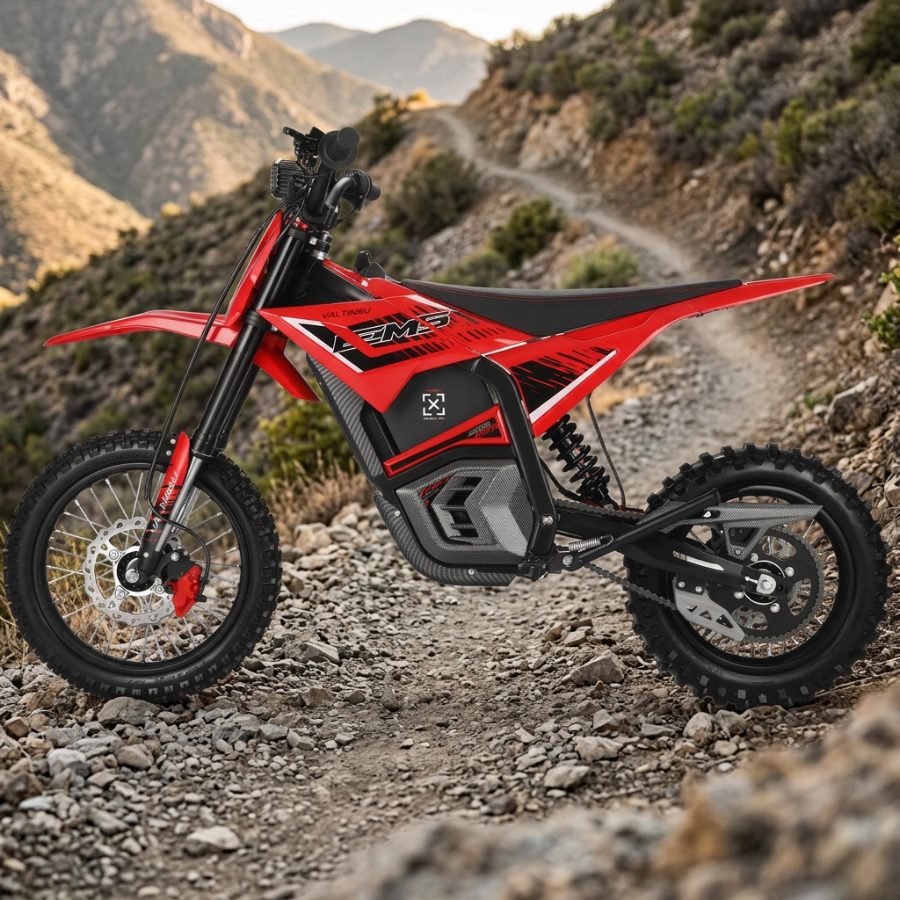
Electric dirt bikes span several size and performance classes, so compare models within the same class and using the same weight definition. Current Valtinsu listings show 126 lb net / 139 lb gross for EM-5 and 143 lb net / 161 lb gross for both EM-5 Pro and EM-5 Ultra. Net weight is not automatically the same as curb or ready-to-ride weight. |
Why a Published Weight Needs a Label
Four different numbers get called "the weight," and they are not interchangeable.
Net weight
Generally the product itself without packaging. Whether the battery, tools or removable accessories are included still varies by manufacturer, so the product page or manual has to define it.
Curb or ready-to-ride weight
The bike in operating condition. For an electric machine that normally means the traction battery installed. It is the most useful number for trail recovery, rack loading and handling comparisons — and not every electric dirt bike page publishes it.
Gross or shipping weight
Includes the crate, protective packaging, charger and boxed accessories. Use it for freight and warehouse handling, not for predicting trail handling. The EM-5's 13 lb difference between net and gross weight belongs to the packaged system rather than the rideable bike alone.
|
Weight term |
Useful for |
Do not assume |
|
Net weight |
Basic product comparison |
That every brand includes the same accessories |
|
Curb / ready-to-ride |
Handling, recovery, transport |
That "dry" and "curb" are interchangeable |
|
Gross / shipping |
Freight, delivery, crate handling |
That it represents the rideable bike |
|
Maximum load |
Rider + gear payload limit |
That it has anything to do with the bike's own weight |
What Actually Makes an Electric Dirt Bike Heavy
The battery is usually the single largest mass, but blaming it for everything misses most of the picture.
- Battery — more cells mean more stored energy and more mass. This is the one trade you cannot engineer around.
- Frame and swingarm — strength, stiffness and material choice move weight and durability together.
- Motor, reduction drive and controller — higher-output systems need larger conductors, cases, cooling paths and drivetrain parts.
- Wheels, tires and brakes — off-road grip and heat capacity add rotating and unsprung mass, which you feel far more than the same pounds carried low in the frame.
- Protection and equipment — skid plates, lights, stands, guards and displays each add a little, and they accumulate.
|
Removing weight from the wrong component costs you something else. A lighter frame, smaller rotor or thinner tire all show up on the scale as a win and on the trail as a compromise. |
How Weight Changes What Happens on the Trail
Acceleration and climbing
Acceleration depends on the whole moving system — bike, rider and gear — not the bike alone. That changes the arithmetic in a useful way.
|
Adding 15 lb to a 130 lb bike is a 12% increase in the bike's mass. But add a 200 lb rider in 15 lb of gear and the system is 345 lb, so the same 15 lb is only 4%. The spec-sheet difference between two bikes almost always shrinks once you put a person on them. |
On a climb, mass raises the force needed to gain elevation, which usually raises energy use — but speed, surface, tire slip and how efficiently the motor runs at that load all move the result too. Our Wh-per-mile guide shows how to measure the real number instead of estimating it from the scale.
Braking
More mass means more momentum and more kinetic energy at the same speed, and the brakes and tires have to absorb it. Read weight beside brake hardware and control feel — a heavier bike with better brakes can stop shorter than a lighter one with weak ones.
Direction changes and rider fatigue
A lighter bike is generally easier to lean, lift and redirect, and the difference is most obvious at walking pace and in tight switchbacks. But where the mass sits matters as much as how much of it there is. Two bikes with the same scale number can feel completely different if one carries its battery low and the other carries weight in the wheels.
Traction and stability
A planted bike feels calmer across rough, fast ground; a lighter platform feels more agile in tight terrain. Neither is a rule. Extra weight does not create grip, and less weight does not create nervousness — tire compound, pressure, suspension setup and rider position still decide it.

Weight becomes most noticeable during recovery, direction changes, braking and transport. The right target depends on the rider and terrain.
Is a Lighter Electric Dirt Bike Always Better?
No, and a very low number is worth a second look rather than instant approval. Light is genuinely valuable when you recover the bike alone, thread through technical terrain or load it several times a week. But that number can come from a smaller battery, a lighter chassis, shorter suspension travel, smaller brakes or youth-sized geometry — any of which might be right for one rider and wrong for another.
The better question is whether the mass is appropriate for the bike's power, chassis, brakes, terrain and rider. A machine with a large peak output and undersized brakes is not made safer by being light. See rated vs peak power for how the power side of that balance reads.
Valtinsu EM-Series Weight and Fit Comparison
|
Model |
Net weight |
Seat height |
Max load |
Battery |
Best-fit interpretation |
|
EM-5 |
126 lb net 139 lb gross |
28.3 in |
243 lb |
48V / 23.4Ah |
Lower seat and the lightest EM-series option — the most approachable first dirt bike |
|
EM-5 Pro |
143 lb net / 161 lb gross |
31.5 in |
287 lb |
60V / 27Ah |
143 lb net adult-oriented chassis with higher speed and power than EM-5 (age 18+) |
|
EM-5 Ultra |
143 lb net / 161 lb gross |
31.5 in |
287 lb |
72V / 25Ah Samsung |
143 lb net chassis with the highest current EM-series power and speed (age 16+) |
Figures verified against the current live product pages. All three models now publish net and gross weight; the table preserves the manufacturer's labels rather than converting them into an unverified curb-weight claim.
The EM-5 is 17 lb lighter by published net weight and sits more than three inches lower than the Pro and Ultra, which can matter during low-speed recovery and loading. The Pro and Ultra share the same published net weight, seat height and maximum load, so compare their power systems, intended rider and ordinary terrain rather than assuming the Ultra is heavier.
|
Where a weight is not published, do not fill the gap with a guess. Ask the seller in writing which figure they mean, or weigh the bike yourself. A number you cannot source is not a specification — it is a rumour with a decimal point. |
Check current specifications:EM-5 ·EM-5 Pro ·EM-5 Ultra. For how the three differ overall, see the full EM-series comparison.
Choosing the Right Weight for Your Use
|
If you mostly ride… |
Prioritise |
The test that settles it |
|
Tight technical singletrack |
Manageable mass, low-speed balance, fit, predictable throttle |
Can you stop, dab, pivot and pick the bike up on uneven ground? |
|
Open or faster trail |
Chassis stability, brakes, suspension, power delivery |
Does it stay composed under repeated braking on rough straights? |
|
Smaller or newer rider |
Seat height, reach, low-speed mode, recoverability |
Can the rider control it at walking pace before using higher modes? |
|
Heavier rider with gear |
Maximum load, suspension setup, tires, brakes |
Add boots, armour, hydration and luggage — not body weight alone |
|
Van, RV or hitch-rack transport |
Verified ready-to-load weight and rack rating |
Per-tray limit, tongue load, ramp angle and tie-down points |
Transport and Recovery Checklist

- Confirm whether the published figure is net, curb or shipping weight.
- Add the installed battery, guards, tools and accessories if the stated number excludes them.
- Check the rack's per-tray limit and the vehicle's tongue-weight limit — the lower of the two controls.
- Use a loading ramp rated above the complete bike weight, and secure it before rolling anything onto it.
- Plan tie-down points that do not crush brake lines, wiring or body panels.
- Practise a safe two-person lift if the bike is beyond what one person can control.
- On the trail, switch the bike off before recovery, stand uphill where possible, and keep fingers away from the chain and sprockets.
|
The lowest rating in the chain is your real limit. A 300 lb rack on a vehicle with a 200 lb tongue-weight limit is a 200 lb system. General load-securement guidance fromNHTSA applies here the same way it applies to any cargo. |
How to Compare Two Bikes Fairly
- Match the definition — curb against curb, net against net.
- Compare complete moving mass: bike + rider + gear.
- Check where the mass sits — battery height, wheel mass and chassis geometry all change the feel.
- Read weight beside battery energy, brakes, suspension, wheels and maximum load.
- Treat your transport and recovery limits as hard constraints, not afterthoughts.
Bottom Line: Match Weight to Recovery and Transport Needs
A practical fit check should be performed with the bike powered off, on stable ground and with assistance available. Confirm that the rider can balance and push it, move it through the intended storage area and load it with the actual ramp or carrier without exceeding published limits. Do not deliberately tip the bike or attempt an unsupported lift; when recovery ability is uncertain, ask a dealer or qualified instructor for a supervised demonstration.
For the current EM lineup, EM-5 is the lighter and lower option at 126 lb net with a 28.3 in seat. EM-5 Pro and EM-5 Ultra are each listed at 143 lb net with a 31.5 in seat, so choose between them by rider fit, power delivery and use case rather than an assumed weight difference. Treat any unlabeled weight as a question for support, not permission to relabel it as curb weight.
|
COMPARE RIDER FIT AND TRANSPORT LIMITS → Review seat height, maximum load and battery specifications across the Valtinsu electric dirt bike lineup, then compare them with the rider, terrain, rack and loading method. |
FAQs
What is the average weight of an electric dirt bike?
There is no useful single average across the entire category. Youth bikes, adult trail e-motos and full-size electric motorcycles serve different riders and are built to different standards. First identify the relevant class, then compare models that use the same weight definition and state whether the battery and operating equipment are included.
Is net weight the same as curb weight?
No. Net weight generally describes the product without packaging, but the included components vary by manufacturer. Curb or ready-to-ride weight describes the bike in operating condition, normally with the traction battery installed. Confirm each definition before comparing models or planning transport.
Can I carry an electric dirt bike on a hitch rack?
Only if the rack's per-bike limit and the vehicle manufacturer's tongue-weight limit both cover the complete transport setup. Include the carrier itself, installed battery and accessories, and follow any dynamic-load limits specified by the rack and vehicle manufacturers. The ramp angle, tie-down points and loader's physical ability must also support a controlled loading process.
Which Valtinsu model is lightest?
The EM-5 is the lightest current EM-series model at 126 lb net. EM-5 Pro and EM-5 Ultra are both listed at 143 lb net. Seat height still matters alongside weight: EM-5 is 28.3 in, while the Pro and Ultra are 31.5 in.
How do I find the weight if the spec sheet does not list it?
Ask the manufacturer or seller in writing which weight definition applies and what the figure includes. For an independent measurement, use a suitable platform scale for the complete bike and follow the service manual or dealer guidance. Do not rely on improvised household-scale methods for rack or vehicle-load decisions. Record whether the battery and accessories were installed so the result remains comparable.
Is a lighter electric dirt bike always better?
No. Lower weight can help with recovery and loading, but it is only one part of fit. Compare:
- ready-to-ride weight and seat height;
- rider fit and the manufacturer's maximum load;
- battery energy, chassis setup and intended terrain;
- rack, ramp and vehicle limits for transport.
Sources
- Valtinsu EM-5 product page — current net/gross weight, size and battery specifications
- Valtinsu EM-5 Pro product page — current size, load and battery specifications
- Valtinsu EM-5 Ultra product page — current size, load and battery specifications
- NHTSA — vehicle and load safety guidance
- U.S. CPSC — Micromobility Information Center
- U.S. DOE Alternative Fuels Data Center — electric vehicle basics


Looking for something else?
Electric Dirt Bike Replacement Parts Availability: What Buyers Should Verify Before Ordering
LEARN MORE
How to Check an Electric Dirt Bike for Safety Recalls by Model and Serial Number
LEARN MORE
How to Choose an Electric Dirt Bike Repair Shop: Questions to Ask Before Service
LEARN MORE
How to Lift a Fallen Electric Dirt Bike Without Hurting Yourself or the Bike
LEARN MORELooking for something else?
Electric Dirt Bike Fall Riding on Wet Leaves: Grip, Hidden Obstacles and Braking
LEARN MORE
Electric Dirt Bike Trailside Power Loss: Recovery Plan When the Battery Is Dead
LEARN MORE