Rated Power vs Peak Power on Electric Dirt Bikes: What the Numbers Actually Mean
Electric dirt bike listings often lead with the largest wattage on the page. That is usually peak power. It can be relevant to how hard a bike launches or how much short-duration reserve it has, but it does not tell you what the drive system can sustain through a long climb, repeated acceleration or deep, power-hungry terrain.
Rated power and peak power describe different parts of the same performance story. Read them together, then check battery voltage, controller limits, gearing, total moving weight, traction and thermal conditions before deciding which bike is stronger for your trail.
Quick Answer
Rated power is the output a motor or drive system is specified to deliver continuously under defined conditions. Peak power is a higher output available for a shorter period under favorable conditions. Rated power is usually the more useful starting point for sustained work; peak power is most relevant to short bursts. Neither number is a complete trail-performance score.

What Rated Power Means
Rated power — also called nominal or continuous power in some specifications — is intended to describe the output a motor can maintain without exceeding its defined operating limits. The important phrase is “under defined conditions.” Cooling, ambient temperature, battery state, vehicle speed and the manufacturer’s test method all affect the number.
For a trail rider, rated power is the more relevant of the two figures when the load lasts: a long access-road climb, a series of uphill switchbacks, repeated pulls out of corners or extended riding in soft ground. It still does not guarantee the same performance on every trail. A system can reduce output when the battery voltage falls, the controller reaches a current limit or components approach a temperature threshold.
What Peak Power Means
Peak power is the highest output the system can deliver briefly. The extra reserve can sharpen a launch, help the bike surge over a ledge or provide a short burst on a steep pitch. It is a ceiling, not an all-day operating point.
A peak figure without a duration and test condition is incomplete. Two bikes can publish the same peak wattage but deliver it for different lengths of time, at different battery charge levels, or at different points in the electrical and mechanical system. That is why the largest number is not automatically the most useful number.
Why Peak Output Cannot Be Treated as Sustained Output
High output creates heat in the battery, controller, motor and conductors. As temperature rises, protective control logic may reduce current or power. Battery voltage also falls under load and changes with state of charge. Bosch’s drive-unit guidance makes the same broad point: maximum power is short-duration output, and the available duration depends on cooling, charge level and outside temperature.
Electrical input power can be approximated as voltage multiplied by current, but that is not the same as mechanical power delivered to the wheel. Conversion losses occur in the controller, motor and drivetrain. If one brand reports battery-side electrical input and another reports mechanical output, the figures are not directly comparable.

Conceptual illustration only. Real output curves and durations require controlled testing from the manufacturer.
What Each Number Changes on the Trail
Starts and Short Obstacles
Peak reserve can matter when the demand lasts only a few seconds. But the rear tire must transmit that force. On dust, wet roots or loose gravel, a softer throttle map can be faster and more controllable than an abrupt burst that spins the tire.
Long Climbs and Repeated Acceleration
Rated power, cooling and battery behavior matter more as the effort stretches out. A bike that feels explosive for one launch may not maintain the same pull after repeated climbs. For this use, ask for sustained-output or repeated-run data rather than relying on one maximum figure.
Soft Terrain and Low-Speed Load
Sand, mud and steep technical climbs can demand high torque at relatively low speed. Low vehicle speed may also reduce airflow around components. The complete system — gearing, controller calibration, motor efficiency, tire choice and thermal protection — matters more than wattage alone.
Top Speed
More power can help a bike overcome aerodynamic drag and maintain speed under load, but top speed also depends on voltage, motor speed, gearing, wheel size and software limits. Peak watts alone do not predict the final speed.
Rated and Peak Power Across the Valtinsu EM Series
Use the current Valtinsu electric dirt bike collection for lineup context, then verify the exact product page before publication. Product pages can change, so keep a dated verification note beside the comparison.
|
Model |
Rated power |
Peak power |
Battery |
Current positioning |
|
EM-5 |
1,200W |
3,840W |
48V / 23.4Ah |
More approachable first dirt-bike platform |
|
EM-5 Pro |
2,500W |
5,600W |
60V / 27Ah |
Adult-ready performance with stronger reserve |
|
EM-5 Ultra |
3,000W |
8,000W |
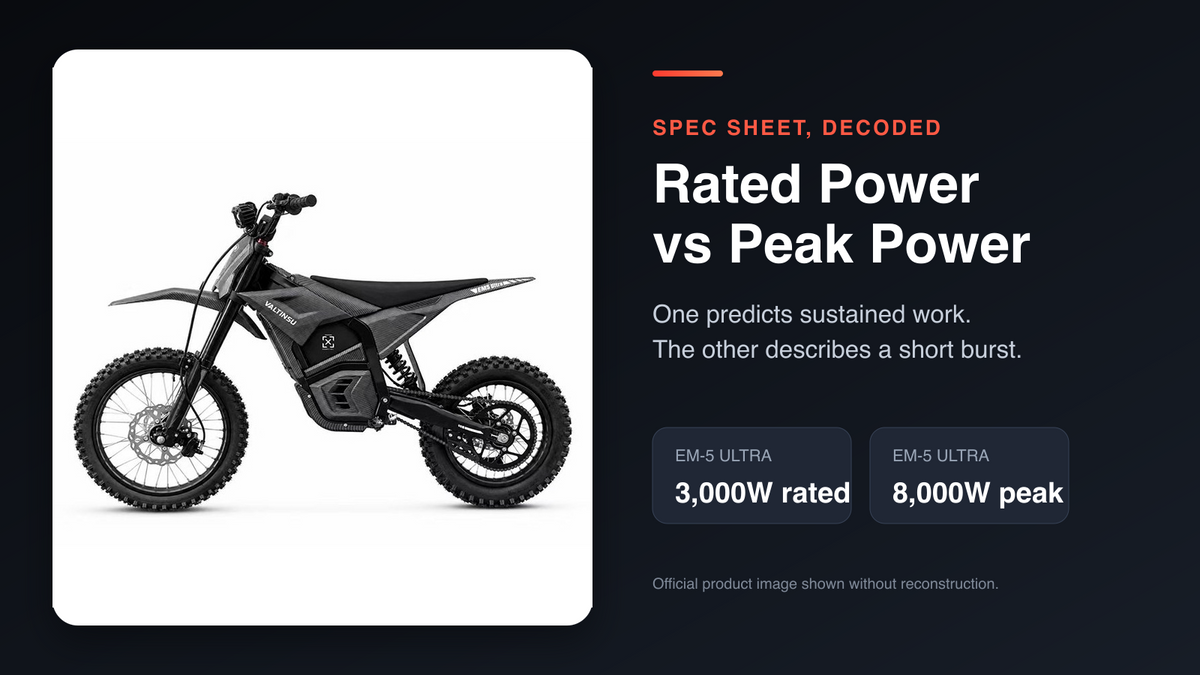
72V / 25Ah Samsung |
Highest EM-series listed power and speed |
These are current published specifications, not independent dyno results. Valtinsu’s product pages do not currently state the duration of peak power, the exact test temperature or whether the figures are measured electrically, at the motor shaft or at the wheel. Those details should not be assumed.
Compare current models: EM-5 · EM-5 Pro · EM-5 Ultra
Five Questions to Ask Before Comparing Two Specification Sheets
- Is the number rated, nominal, continuous, maximum or peak? Treat unlabeled wattage as incomplete.
- Where is output measured — battery input, controller output, motor shaft or rear wheel? Different measurement points produce different numbers.
- How long is peak output available, and at what battery state and temperature? If the duration is missing, do not turn the figure into a sustained-performance claim.
- What limits the complete system? Battery current capability, controller calibration, gearing and cooling can prevent a motor’s theoretical rating from becoming usable wheel output.
- Are the bikes being compared at similar total mass and on similar terrain? Rider, gear, tire and surface conditions change the load the system must overcome.
Why Torque, Gearing and Wheel Size Can Matter More Than Watts
Watts describe the rate of energy conversion. They do not show how much turning force reaches the rear tire at a given speed. Wheel torque depends on motor torque, reduction ratio, drivetrain efficiency and effective tire radius.
A shorter reduction can produce stronger wheel torque and easier low-speed control, but it may trade away motor-speed headroom. A larger rear tire changes the leverage at the ground. Controller mapping then decides how abruptly the available torque arrives. These factors explain why two bikes with the same advertised power can feel completely different in a switchback or on a loose climb.
For a buying comparison, ask for gearing or drive type, wheel size, total mass and throttle behavior alongside rated and peak watts. On technical terrain, predictable drive and usable traction often beat the larger headline number.
Which Number Matters Most for Your Riding?
|
Riding priority |
Read first |
Then verify |
|
Short launches and brief obstacles |
Peak power and throttle calibration |
Traction, gearing and how quickly output tapers |
|
Long hills |
Rated power |
Temperature behavior, state of charge and sustained-speed data |
|
Tight technical trail |
Power delivery and controllability |
Bike weight, gearing, tire grip and low-speed response |
|
Open, faster terrain |
Rated power plus voltage/top-speed system |
Brakes, chassis stability and software limits |
|
Range-focused riding |
Battery watt-hours and efficiency |
Wh/mile under comparable terrain; do not infer range from peak watts |
Common Misconceptions
- “Peak power is fake.” Not necessarily. It can describe useful short-duration reserve, but it needs time and test-condition context.
- “Rated power is what the bike always produces.” No. Output changes with throttle demand, speed, load, battery state and protection logic.
- “Twice the watts means twice the acceleration.” No. Acceleration depends on total mass, traction, torque at the wheel and how power is delivered.
- “A higher peak number guarantees better climbing.” No. Long climbs expose sustained output, heat management, gearing and traction.
The Bottom Line
Use peak power to understand short-burst potential. Use rated power to begin evaluating sustained work. Then ask how the numbers were measured and how the complete bike handles heat, battery voltage, gearing, weight and traction. A transparent specification sheet is more valuable than a larger wattage with no test context.
For Valtinsu shoppers, compare the rated and peak figures published on the current product pages, then check whether the test conditions and peak duration are disclosed. Use those figures as inputs alongside rider fit, terrain, gearing, thermal behavior and traction; they do not prove that one model will be faster or better for every rider.
FAQs
What is the difference between rated power and peak power?
Rated power is the output level intended to describe sustained operation under defined conditions, while peak power is a short-duration maximum. Neither number is fully meaningful without duration, voltage, controller limits, temperature, and measurement location.
Which power number matters more when comparing electric dirt bikes?
Rated power is the better baseline for sustained work; peak power is useful for short acceleration or brief obstacles. Compare both only after rider fit, battery voltage and energy, total mass, tires, gearing or drive design, and test definitions are aligned.
Does higher peak power mean better hill-climbing performance?
Not automatically. Real climbing is limited by traction, wheel torque, rider and bike mass, controller programming, battery voltage under load, speed, cooling, and how long the climb lasts; unused power may become wheelspin or heat.
Can peak power be maintained for an entire ride?
Not as a continuous rating. Peak output describes short-duration capability and may decrease when the controller, motor or battery reaches current, voltage, state-of-charge or temperature limits. If a specification does not state the duration and test conditions, do not interpret peak watts as sustained output.
Why can two bikes with the same wattage feel different?
The same headline wattage can produce different acceleration and control because the complete systems differ. Relevant factors include:
- Controller mapping, current limits, and throttle calibration
- Battery voltage and voltage sag under load
- Motor efficiency, drivetrain ratio, tire radius, and total mass
- Traction, ride mode, and thermal state
Does more motor power always reduce range?
No. Available power is not the same as energy actually used, but higher speed and repeated hard acceleration usually raise consumption. Battery watt-hours and measured Wh per mile are better range inputs than the motor’s peak-power label.
Sources and Fact Checks
- Bosch eBike Systems — Power in the context of the drive unit — definitions and heat/battery caveats
- Valtinsu EM-5 product page — current product specifications
- Valtinsu EM-5 Pro product page — current product specifications
- Valtinsu EM-5 Ultra product page — current product specifications
- NZ Transport Agency research report — rated/peak terminology and ventilation context


Looking for something else?
Electric Dirt Bike Replacement Parts Availability: What Buyers Should Verify Before Ordering
LEARN MORE
How to Check an Electric Dirt Bike for Safety Recalls by Model and Serial Number
LEARN MORE
How to Choose an Electric Dirt Bike Repair Shop: Questions to Ask Before Service
LEARN MORE
How to Lift a Fallen Electric Dirt Bike Without Hurting Yourself or the Bike
LEARN MORELooking for something else?
Electric Dirt Bike Fall Riding on Wet Leaves: Grip, Hidden Obstacles and Braking
LEARN MORE
Electric Dirt Bike Trailside Power Loss: Recovery Plan When the Battery Is Dead
LEARN MORE