Electric Dirt Bike Throttle Control on Low-Traction Trails
Throttle control on a low-traction trail means setting a stable drive request before the surface changes, keeping the throttle hand relaxed, and avoiding both a sudden roll-on and sudden roll-off. Begin on level, predictable ground under qualified supervision; if the rear tire steps sideways, drive response becomes delayed, or rollback begins, abort the run rather than testing the traction limit.
On many adult electric off-road motorcycles there is no clutch-based transition between request and wheel. Your right hand, the controller, the mode, the contact patch and the terrain form one system.
Five stages build control:
- A power-off control check, followed by a supervised walking-pace response check
- Straight-line low-output starts
- A constant-drive lane
- Wide low-traction turns
- A mild incline or surface transition
Exact settings vary by rider, motorcycle and terrain. Keep the throttle hand relaxed, support body weight through the pegs rather than the grip, look through the intended line, and use coach-directed fore-aft weight transfer as traction and grade change. Never use a universal throttle percentage, tire pressure or slope as a substitute for the exact manual and site conditions.
Define Traction Control as Repeatable Drive
Repeatable drive is the goal, not speed or anything that photographs well. A successful repetition shows all of this:
- The rear tire drives forward without a sudden lateral step
- The motorcycle follows the planned lane
- Throttle movement is deliberate rather than reactive
- The rider is not repeatedly opening and closing the throttle
- Speed builds predictably
- The throttle can close without upsetting the chassis
- Wheelspin, when it happens, gets recognized early
- The rider can explain what changed in the surface or the response
Success is never a fixed amount of wheelspin. This is not a burnout, a drift or a traction-limit test. The objective is moving useful torque through whatever contact patch the surface allows.
Understand Why Electric Torque Can Break Traction Quickly
Torque Request vs Available Grip
The throttle sends a drive request. The controller and motor turn it into wheel torque, and the tire transmits that torque only while grip exceeds the force demanded at the contact patch. Loose soil, gravel, sand, wet clay, roots and polished rock all cut into that margin. Exceed what the surface supports and the rear tire spins faster than the bike moves.
Geared Motor vs Direct Drive
A geared motor increases wheel torque through reduction gearing, but actual grip response still depends on controller mapping, selected mode, throttle calibration, total ratio, tires, load and surface. Small inputs may produce more drive than a novice expects, so learn the documented low-output response at walking pace under qualified supervision.
The EM-5 Pro runs a 60V, 5,600W geared motor with 177 lb-ft of listed wheel torque. The consequence matters more than the number: reduction gearing puts strong force at the wheel at low RPM, so an 80 kg adult on a loose Arizona hardpack gains more from a precise input than a large opening.
Smooth Does Not Mean Slow Response
A controllable motorcycle still answers when you ask. You want a predictable link between hand movement and wheel response, not a delay that leaves you guessing whether the request landed.
Build a Legal Low-Traction Practice Area
Terrain selection is part of the method.
Start With One Consistent Loose Surface
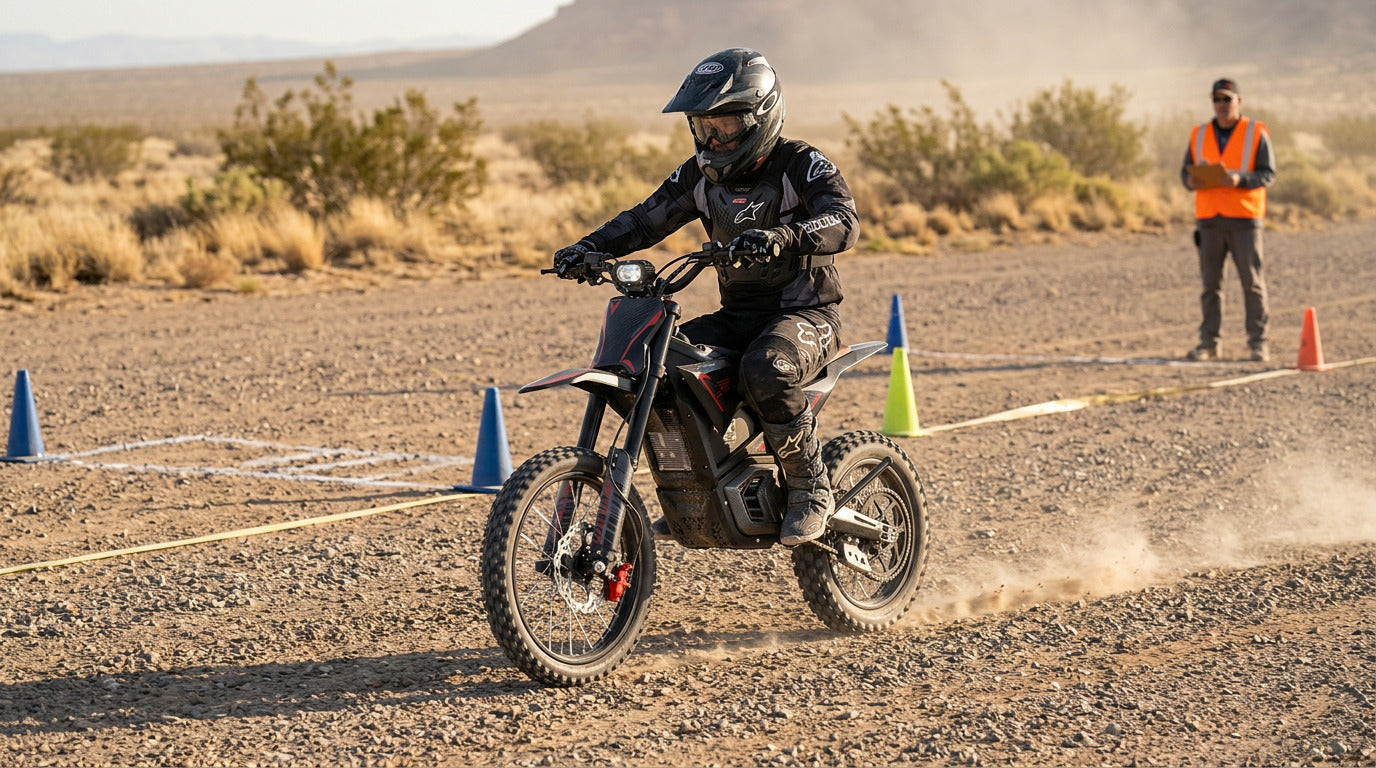
Choose legal closed terrain with clear sightlines, level ground, consistent loose material, no buried rock or drainage cuts, no riders crossing the course, wide runoff, and access for a spotter. A maintained dirt lot works. So does firm hardpack under a light, even layer of loose material.
Avoid public trails, active roads, crowded trailheads, steep climbs, deep sand, mud holes, wet roots, exposed rock and side slopes on a first session.
Create Separate Drive and Shutdown Zones
Mark a staging area, start line, straight drive lane, throttle-close marker, coast or braking zone, and runoff area. Size the lane from demonstrated walking-pace closures and controlled stops on firm ground. Keep an unobstructed buffer beyond the longest stop, extend the drive section only after repeated controlled runs, and re-size the course whenever surface, mode, rider or motorcycle changes.
Keep One Variable Per Set
Do not change surface, mode, tire setup, direction and lane shape inside one set. MSF DirtBike School builds off-highway skills in controlled environments before complex terrain, and the logic holds for a patch you build yourself. Gear up as for a trail ride; our safety gear checklist covers what a loose-surface session assumes.
Inspect the Controls Before Testing Traction

A throttle fault imitates poor technique convincingly. Rule it out first.
Check Throttle Movement and Return
Before powering up, turn the bars through the documented steering range, confirm the throttle moves freely, release it from several small openings, and check that it returns fully to closed. Look for damaged grips, housings, cables or wiring, and confirm handguards do not restrict movement.
Stop there if the throttle sticks, returns slowly, changes feel as the bars move, or looks damaged.
Confirm Brake and Cutoff Behavior
Verify brake-control movement and find out whether your machine uses a brake cutoff or another motor-inhibit system. Never assume a brake lever cancels motor output. The manual for your exact model settles it.
Use One Documented Configuration
Select the instructor-approved setting and leave it alone for the full set. Do not invent controller values, alter throttle curves, bypass safety systems or import tuning advice from a different motorcycle. Setup details live in the Valtinsu user manuals.
Use One Correction During Each Practice Set
One variable per set, one correction per set. More than that and nobody learns which change worked.
This is a supervised progression. The qualified observer watches one main target per short set—opening rate, closing rate, eye direction, lane position, rear-tire sound or exit alignment—and stops the run immediately for unexpected drive, a lateral rear step, control confusion or rollback.
Then one short correction before the next run:
- Open more slowly.
- Hold the input steady.
- Look through the lane.
- Set a stable, model-appropriate drive or deceleration plan before the transition; avoid both a sudden roll-on and a sudden roll-off, and account for the selected regenerative behavior.
- Do not chase the slide with more throttle.
Do not stack corrections about throttle, elbows, knees, feet, mode, brakes and body position into one breath. Advance only when the result repeats. One clean run establishes nothing.
Stage 1: Establish a Reliable Closed-Throttle Reference
Rehearse Small Open-and-Close Movements
With power off and the motorcycle stable, confirm the throttle returns freely and the control area is unobstructed. Do not perform a powered stationary throttle test unless the exact model manual provides an approved procedure. Verify live response only during a clear, level, unobstructed walking-pace roll under qualified supervision.
Separate Hand Movement From Upper-Body Movement
You should move the throttle without pulling the bar, stiffening the shoulders, or steering off line. A bump moves your body, and if the grip is doubling as a support point, that movement becomes unintended acceleration. It looks like a skill problem and is not.
Progression Gate
Advance when the rider can open slightly and consistently, return fully without delay, keep the bar stable, work it without looking down, and notice abnormal resistance. Stop if the response differs from documented behavior.
Stage 2: Practice Low-Output Straight-Line Starts
Begin on Consistent Loose Ground
Start upright and aligned with the lane. Introduce only enough drive to begin moving cleanly. No fixed percentage, no target acceleration time. The question is observable: did the bike move forward predictably, or did the rear tire spin, step sideways, dig in, or throw material?
One Deliberate Roll-On vs Repeated Pulsing
- One deliberate roll-on: drive goes in smoothly and the rider watches what the surface does with it
- Repeated throttle pulsing: input alternates between too little and too much, unloading and reloading the rear tire
The first gives clean feedback. The second makes the surface impossible to read, because the tire never settles long enough to tell you anything.
Progression Gate
A short set of controlled starts should show:
- No sudden surge
- No lateral rear-wheel movement
- No repeated throttle chopping
- No lane departure
- A deliberate throttle close at the marker
- Similar acceleration run to run
If wheelspin appears, reduce the drive request or simplify the surface. Nobody should be told to hold it open and ride through.
Stage 3: Hold Constant Drive Through a Loose Lane

Settle the Motorcycle Before Entering
Begin on predictable ground, settle into a controlled low pace, and enter the loose lane without adding a large new input at the boundary. The surface becomes the only thing that changes.
Steady Throttle vs Acceleration
- Steady input: maintains predictable drive
- Increasing input: asks the tire to transmit additional force
- Abrupt closing: changes chassis balance and rear-tire loading, which is its own disturbance
The drill does not need a motionless hand. It needs small, intentional corrections.
Read the Tire and Chassis
Early wheelspin usually announces itself before you feel it:
- Motor sound or pitch rising faster than ground speed
- Loose material displaced suddenly
- The rear of the motorcycle stepping outward
- Forward acceleration decreasing despite more input
- Steering corrections getting larger
Progression Gate
Five passes with a consistent line, no abrupt speed increase, no repeated rear step, similar entry and exit pace, and a controlled close after the lane.
Stage 4: Add Wide Low-Traction Turns

Begin With a Large Arc
Use a wide, visible turn on consistent loose ground. Never full steering lock, never an aggressive lean angle. Enter settled, look through the exit, and add no large input while the bike is still changing direction.
Straight-Line Drive vs Corner-Exit Drive
- Straight-line acceleration: most of the available grip can go toward forward drive
- Cornering acceleration: the tire is already spending grip on turning, leaving less for drive
No fixed traction percentage applies. The margin moves with surface, tire, load, speed, steering angle and setup.
Early Roll-On vs Sudden Exit Burst
A progressive exit input starts only once you can see and hold the exit line. A sudden burst pushes the rear outward, widens the turn, or points the bike off the trail.
Left vs Right Turns
Ride both directions on identical dimensions and surfaces. Record whether one produces earlier throttle opening, more tension, a wider exit, more wheelspin or more downward vision.
Progression Gate
Several controlled turns each way should show a relaxed wrist, weight supported through the pegs, eyes through the exit, no intentional slide, no cone contact, no repeated wheelspin, similar exit lines and no drive spike at apex or exit. Repetition count follows rider condition and coach judgment.
Stage 5: Integrate a Mild Incline or Surface Transition

Flat Loose Ground vs Mild Climb
A climb raises the drive force needed at the rear tire, and asking suddenly can exceed what the surface supports. The coach chooses the slope on site; no universal safe grade exists to publish. Start with a straight, mild incline: clear crest, no turn, no ledge, no rut, no deep loose material, wide rollback and exit area.
Momentum vs Extra Throttle
- Planned momentum: the rider enters in control and carries enough motion to avoid needing a large mid-climb input
- Late torque request: the rider slows too much, then demands a sudden increase on the weakest section
The drill teaches planning. Attacking the hill is a different activity.
Firm-to-Loose Surface Transition
A level transition from firm dirt into a consistent loose patch works as well as a slope. The skill is not opening sharply at the exact point where grip drops away.
Progression Gate
Incline practice is coach-led only. Before momentum is gone, establish the documented braking hold and stop the attempt. If uncontrolled rollback begins, follow the instructor-verified emergency exit and dismount to the uphill side; nobody stands directly behind or downhill of the motorcycle. Do not add a turn and a slope in the same progression.
Recognize Wheelspin Without Turning It Into the Goal
Useful Recognition vs Deliberate Roost
Recognizing the start of unwanted slip is the skill. Producing wheelspin to prove you can is not. Intentional roost damages the surface, reduces forward drive, throws debris at whoever is behind you, and trains a habit that surfaces later on ground where it matters. More trail-craft sits in our User Guide hub.
Reduce the Drive Request Smoothly
When unexpected wheelspin starts, look toward the intended escape path, avoid sudden steering, and reduce drive progressively rather than snapping the throttle closed. Use only the documented braking or regenerative behavior. If the rear continues to step sideways or the rider cannot hold the line, abort the run and stop practice.
End the Run After a Large Slide
If the rear steps significantly sideways, the exercise has passed its boundary. Reset the course, surface, mode, entry pace or instruction. Do not repeat the same input hoping for a better result. The next run targets earlier detection, not a better save.
Throttle Modulation vs Traction Control Electronics
Rider Throttle Modulation
Modulation is deliberate adjustment of the drive request. It works only when the machine responds predictably and the controls function correctly, which is why inspection comes before the drill.
Electronic Traction Control
Electronic traction control may cut drive when the system detects conditions it reads as excessive slip. Sensors, intervention strategy and adjustment range vary by model. Sur-Ron describes its Ultra Bee as using an off-road traction-control system alongside selectable modes and a regenerative system. The system may reduce drive when it detects slip; consult the exact model manual for intervention limits and settings. It does not remove the need to read terrain and meter inputs.
Assistance On vs Assistance Off
Nobody should disable traction control to learn properly. Use the manufacturer-approved setting, chosen with a coach, and keep it fixed through the set.
Ride Mode vs Throttle Skill
Lower Output Mode
A lower documented mode may reduce available speed, power or response, making early practice more manageable depending on the programming.
Higher Output Mode
A higher mode raises the consequence of a poor input. It teaches nothing and creates no grip.
Fixed Mode vs Frequent Switching
Keep one mode through a full set. Switch often and you cannot tell whether the rider improved or the bike behaved differently. Valtinsu lists three EM-5 Pro modes at 26, 40 and 52 mph maximum. Those are labels, not practice speeds; the coach sets pace independently. Our watts and torque guide covers how power and wheel torque relate.
Tires and Suspension Change the Available Grip
Knobby Tire vs Street-Oriented Tire
A knobby tread penetrates loose material and creates mechanical keying in dirt. A street pattern may not develop the same drive. Tread alone does not establish grip, though: compound, wear, carcass construction, load, pressure, temperature and surface depth all contribute, which our electric dirt bike tire guide works through by terrain.
Fresh Tire vs Worn Tire
Rounded, damaged or missing knobs change both drive and breakaway behavior. Michelin is blunt on pressure: use the cold figure from the owner manual or vehicle information plate, not the maximum stamped on the sidewall. Do not continue on a damaged tire.
Suspension Tracking vs Wheel Hop
Suspension helps the tire follow uneven ground. When the rear wheel skips or unloads, the contact patch cannot transmit drive consistently, and no throttle discipline fixes that. Sag, damping and preload belong to the manufacturer documentation or a suspension technician. Our full-suspension explainer covers why the second shock matters on loose ground.
Compare Low-Traction Features Across Adult Electric Dirt Bikes
Nothing below is ranked by wheelspin, and no software here replaces skill.
|
Model |
Low-Traction-Relevant Features |
Rider Consideration |
|
60V 5,600W geared motor, 177 lb-ft wheel torque, three modes, 17/14-inch wheels, rear adjustable air suspension |
Strong low-RPM wheel force asks for deliberate modulation, at $1,699 |
|
|
Same adult platform in Valtinsu’s signature Volt Green |
For riders who want the Pro specification in the brand’s most recognizable color |
|
|
SRTC traction control, selectable riding modes, regenerative system, larger 19-inch chassis |
More electronic assistance and a deeper aftermarket, with different system behavior that belongs in a separate buying guide |
|
|
Talaria Sting R MX4 |
Enclosed gearbox drive and four adjustable regenerative-braking levels |
Adjustable regeneration changes closed-throttle behavior, so the level must stay fixed during training |
|
High-output enduro platform with power adjustable from roughly 10 to 80 hp, plus on-the-go engine-braking and regeneration settings |
Deep tuning flexibility, though the available output makes formal coaching more important, not less |
Sur-Ron lists off-road traction control on the Ultra Bee; Talaria lists four adjustable regeneration levels on the Sting R MX4. Both change how a machine answers a request, and neither delivers one universal low-traction setting. Ultra Bee output figures have moved across model years, so check the current sheet. The relevant product point is that the EM-5 Pro’s documented configuration and fit must be verified before practice, while Sur-Ron and Talaria bring deeper aftermarket support at higher prices. The rest of the Valtinsu lineup sits around the Pro if fit points you elsewhere.
Diagnose Common Low-Traction Errors
Match the symptom, apply one correction, run another set.
|
Symptom |
Possible Practice Cause |
One Correction |
|
Rear tire spins immediately from a stop |
Initial drive request is too abrupt |
Open more gradually |
|
Motorcycle surges after a delay |
Rider adds input while waiting for a response |
If delay is new, inconsistent or abnormal: close the throttle, stop, power down and follow the manual or technician route. Do not wait for a surge. |
|
Rear moves sideways in a turn |
Too much drive added while cornering |
Delay added drive until the exit opens |
|
Rider repeatedly opens and closes the throttle |
Input is reactive rather than planned |
Hold one smaller drive request |
|
Bike loses momentum on a mild climb |
Entry plan does not match the terrain |
Simplify the slope and rebuild momentum |
|
Rider grips the bars tightly |
Upper body is using the throttle side as support |
Relax and reset on easier terrain |
|
Results vary run to run |
Mode, surface, entry pace or line is changing |
Fix every variable except one |
|
Motor response feels abnormal |
Possible throttle, cutoff, controller or wiring issue |
Stop riding and follow the manual |
Do not label every traction problem a rider error. Tires, surface contamination, suspension behavior, chain condition, control faults, battery state and controller protection all imitate poor modulation.
Stop the Session When the Response Becomes Unpredictable
Stop practice when:
- The throttle sticks or returns slowly
- Motor output arrives after an unusual delay
- The motorcycle surges without a matching input
- Power continues when you expect it to stop
- Brake-cutoff behavior changes
- A warning or fault appears
- Wiring, controls, tires, chain or suspension components show damage
- The rear repeatedly steps sideways
- The rider starts chasing wheelspin
- Fatigue makes inputs larger
- The rider becomes tense, frustrated or target-fixated
- The surface turns wetter, deeper, rutted or inconsistent
- Another rider, person, vehicle or animal enters the course
Record what happened before changing anything, and never test a suspected throttle fault on a slope. Mechanical concerns go to How to Maintain an Electric Dirt Bike or a technician first.
Transfer the Drill to Real Loose Trails One Variable at a Time
The ladder builds smooth starts on loose soil, predictable drive through gravel, controlled corner exits, earlier wheelspin recognition, planned momentum for mild climbs, and deliberate closure before a surface change. A real trail stacks camber, ruts, roots, rock, mud, sand, blind turns, descents and other users together, often inside fifty yards.
Add one challenge at a time. Do not step from a level lane onto a steep rutted Moab climb or a wet root section in the Pine Barrens. Controlling one surface is not mastering mixed traction. If terrain is steering your next purchase, our Best Electric Dirt Bike for Trails guide and our other riding guides go deeper.
Conclusion
Electric dirt bike throttle control on low-traction ground starts with a reliable closed-throttle reference, not a faster pace. Straight-line starts show how the motor and tire connect. A constant-drive lane teaches steadiness. Wide turns show how cornering spends the grip you wanted for driving. A mild incline tests whether you can plan momentum instead of demanding torque.
The useful result is not a spray of dirt. It is a forward drive that stays predictable when the surface goes weak underneath you.
Complete this supervised low-traction progression only after a qualified off-road instructor and Valtinsu technician have verified the exact motorcycle, mode, control state, surface and abort procedure, then review the Valtinsu EM-5 Pro for more demanding loose terrain.
FAQs
How do you control an electric dirt bike on loose or slippery ground?
Use a predictable entry pace, look through the intended line, and increase drive gradually rather than treating the throttle like an on/off switch. Keep these variables stable while learning:
- One manufacturer-approved ride mode for the entire practice set
- A straight or wide line before adding tighter turns
- Small throttle corrections instead of repeated large pulses
- Tires, pressure, load, and surface conditions checked against the model documentation
Why does the rear wheel spin or fishtail when I add throttle?
The rear tire is being asked to transmit more drive or side force than the available grip can support. Common contributors include abrupt throttle input, accelerating while leaned, loose or wet terrain, poor alignment, worn or unsuitable tires, and a high-output setting.
What should you do when wheelspin begins?
Reduce the drive request early and smoothly; do not add more throttle to force the motorcycle through. Then:
- Keep your eyes on the intended escape line and avoid a sharp steering correction.
- Straighten the motorcycle if the available space and instructor-approved plan allow it.
- Stop the attempt if the slide continues, the line is lost, or another person enters the area.
- Return to an easier surface, line, or approved mode before trying again.
Which ride mode is best for low-traction trails?
There is no universal best mode because names and controller behavior vary by model. Use the lowest manufacturer-approved setting that lets the rider produce smooth, repeatable starts, and do not change modes mid-drill.
Do traction control and regenerative braking prevent slides?
No. Traction control may reduce excessive drive in some conditions, while regeneration changes closed-throttle deceleration; neither can create grip or replace line choice, suitable tires, smooth inputs, and mechanical brakes.
Sources
- Motorcycle Safety Foundation, DirtBike School
- Motorcycle Safety Foundation, Tips & Practice Guide for the Off-Highway Motorcyclist
- Motorcycle Safety Foundation, Library (off-road group riding and practice-site guidance)
- Bureau of Land Management, Off-Highway Vehicles
- Tread Lightly!, Respected Access
- National Highway Traffic Safety Administration, Motorcycle Safety
- National Highway Traffic Safety Administration, Choose the Right Motorcycle Helmet
- Michelin, Tips and Advice for Motorcycle Tires
- Motorcycle Safety Foundation, Tips & Practice Guide for the Off-Highway Motorcyclist (electrical-system context only; the standard does not evaluate off-road traction or throttle technique)


Looking for something else?
Electric Dirt Bike Replacement Parts Availability: What Buyers Should Verify Before Ordering
LEARN MORE
How to Check an Electric Dirt Bike for Safety Recalls by Model and Serial Number
LEARN MORE
How to Choose an Electric Dirt Bike Repair Shop: Questions to Ask Before Service
LEARN MORE
How to Lift a Fallen Electric Dirt Bike Without Hurting Yourself or the Bike
LEARN MORELooking for something else?
Electric Dirt Bike Fall Riding on Wet Leaves: Grip, Hidden Obstacles and Braking
LEARN MORE
Electric Dirt Bike Trailside Power Loss: Recovery Plan When the Battery Is Dead
LEARN MORE