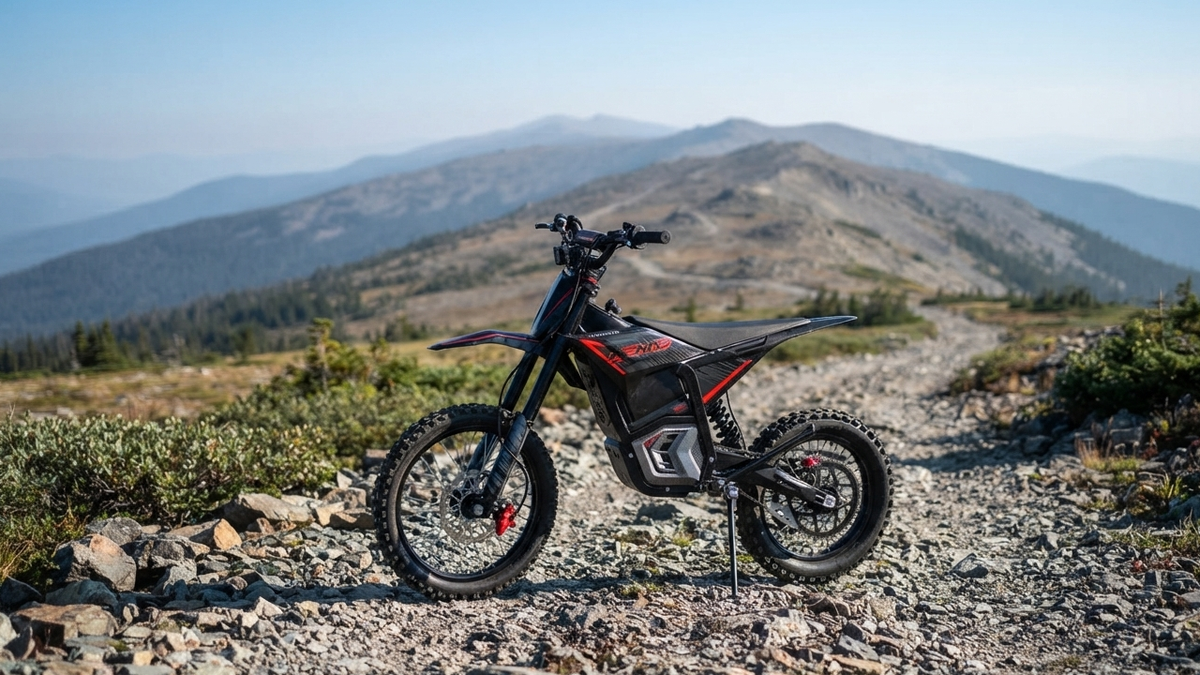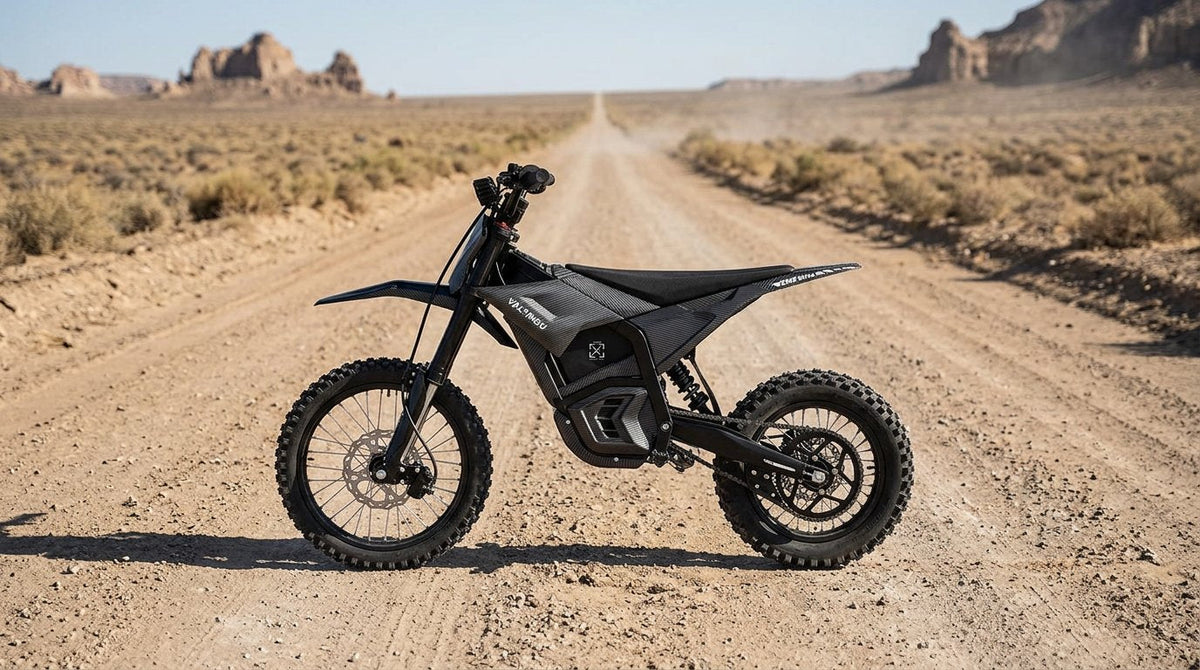
Electric Dirt Bike Energy Use: How to Measure Wh per Mile on the Trail
Battery size tells you how much energy a pack is designed to store. Watt-hours per mile tells you how quickly your ride spends it.
That distinction matters on dirt. A 1,800Wh battery can support a long steady route or disappear quickly in deep sand, repeated hill climbs and hard acceleration. Wh/mi turns the ride into a measurable energy budget. Once you know your own value on a familiar trail, you can estimate range, set a return reserve, and notice when tires, temperature or battery condition start costing you.
|
Wh per mile = measured watt-hours used ÷ measured miles travelled The equation is trivial. The measurement behind it is where accuracy is won or lost. |
Valtinsu’s editorial rule is to use Wh/mi to explain a ride before using it to rank two bikes. A number without a defined measurement boundary and route context may look precise, but it is not yet comparable.
What Wh per Mile Means
A watt-hour is a unit of energy. If a bike uses 600Wh over 20 miles, its measured consumption is 30Wh/mi for that ride.
Wh/mi is not a permanent rating for the bike. It reflects one combination of rider, route, pace, weather, tires, setup, measurement boundary, and battery state. Use it as a personal benchmark on the same loop or as a comparison metric only when the test conditions are genuinely comparable.
Lower Wh/mi means less energy was used per mile under the recorded conditions, which usually supports more potential range. It does not make one bike universally better; a technical route can reasonably consume more energy than a smooth route.
Choose the Right Energy Source
There are three common ways to get energy data, and they do not measure the same thing.
1. Bike-display energy data
Some systems report cumulative watt-hours or amp-hours consumed. Convenient - but confirm what the display actually measures and whether the counter resets cleanly between runs.
2. Approved inline energy meter
A properly rated meter can measure voltage, current, and accumulated energy delivered from the battery. Use only compatible connectors and ratings. Do not open a sealed pack, bypass protection, or improvise high-current wiring; follow CPSC micromobility safety guidance and the manufacturer’s instructions.
3. Charger-wall energy meter
A plug-in wall meter records the AC energy used to recharge after a ride. It is accessible and non-invasive, but the number includes charger losses. Label it “wall-to-battery Wh,” not “battery-output Wh.”
Do not mix these sources in one comparison. A 700Wh wall-recharge reading and a 620Wh battery-output reading can describe the exact same ride - they simply measure different boundaries. Keep the label attached to the number and the comparison stays honest.
A Repeatable Trail Measurement Protocol
Use a fixed loop and repeat the run. Record the route, mass, pace, surface, elevation, temperature, tire setup and start/end battery state; this is the short protocol for one energy measurement.
Before the ride
- identify the bike, battery and production configuration;
- charge with the approved charger in a safe, attended location;
- record starting state oIdentify and battery temperature if available;
- set and record cold tire pressure;
- weigh the rider with normal gear and record the trip distance and the energy counter;
- pick one riding mode. Set one pace rule, and hold both.
During the ride
- follow the mapped route;
- do not switch modes unless mode switching is the thing being measured;
- record stops, detours and wheelspin-heavy sections;
- save GPS distance, moving time, average speed and elevation gain.
After the ride
- record ending state of charge;
- note any power reduction, warning or cutoff;
- record energy consumed;
- let the battery cool before charging;
- if using wall energy, measure the net recharge back to the same defined start point.
Repeat the route at least three times under similar conditions before publishing the value as a benchmark.
Calculate Wh per Mile
- Battery-output Wh/mi = battery-output Wh used ÷ miles traveled
- Wall-recharge Wh/mi = AC Wh drawn during recharge ÷ miles traveled
- Keep the measurement boundary attached to every Wh/mi result.
A rider completes a 24-mile loop and the approved meter records 792Wh delivered from the pack:
792Wh ÷ 24 mi = 33Wh/mi
This is an illustrative calculation, not a Valtinsu test result. To publish it as evidence, the rider would also have to record mass, speed, elevation, surface, temperature, tire pressure, mode and repetition.
Turn Your Measurement into a Planning Range
First estimate the energy you are willing to use. Nominal energy is commonly approximated as nominal voltage × rated amp-hours - a planning approximation, since actual delivered energy varies with pack design, age, temperature, load and the management system.
|
Planned usable Wh = estimated usable Wh × (1 − reserve) Planned range = planned usable Wh ÷ measured Wh/mi |
Worked through: if you estimate 1,500Wh usable, keep a 20% reserve and measured 30Wh/mi:
1,500 × 0.80 = 1,200Wh available → 1,200 ÷ 30 = 40 miles of planning range
Again, illustrative. A reserve is not a guarantee—it is a decision buffer for route changes, temperature, headwind, unexpected climbs and battery variation. Recalculate when the route, pace, temperature, tire setup or battery condition changes; yesterday’s Wh/mi is evidence for a similar ride, not a promise for the next one.
Treat Wh per Mile as an Estimate with a Confidence Level
High confidence: battery-output energy and GPS distance are recorded on three or more comparable runs, with route, mass, pace, elevation, temperature, tire setup and battery endpoints documented.
Moderate confidence: wall-recharge energy is measured back to the same start point on repeated comparable rides. This is useful for ownership planning, but it includes charger and conversion losses.
Low confidence: energy is inferred from display percentage or nominal pack capacity. Label the result as an estimate and do not rank it against a battery-output measurement.
Report the individual runs and their spread. If consumption varies more than the range decision you are trying to make, use the higher credible Wh/mi for planning and collect better data before publishing a bike-to-bike comparison.
What Changes Wh per Mile on Dirt

Elevation gain
Climbing raises gravitational energy demand directly. Descending does not return all of that energy: many electric dirt bikes lack regenerative braking, and tire, drivetrain, aerodynamic, and braking losses dissipate energy.
Surface
Deep sand, soft soil, mud, and tall grass deform under the tire and increase resistance. Wheelspin consumes energy without producing the same forward distance, so it can raise Wh/mi substantially.
Speed and acceleration
Aerodynamic demand rises with speed, and repeated hard acceleration draws high power while increasing losses in the motor, controller, wiring, and battery. The U.S. Department of Energy describes these general EV range factors, but trail results still require model- and route-specific measurement.
Total mass
Rider, protective gear, tools and cargo all count, and mass matters most on climbs and during acceleration. Publish total system mass whenever comparing two riders.
Tire pressure and tread
Lower pressure can improve traction but may raise rolling losses. Correct setup is a safety and handling decision first; the testing rule is simply to record what you ran.
Temperature
Cold can reduce available energy and increase internal resistance, while high temperature may trigger protective limits. U.S. Department of Energy cold-weather guidance documents the general range effect in electric vehicles. Record ambient temperature and battery temperature when the system reports it.
Battery state of health
Tracking Wh/mi can help separate vehicle energy consumption from battery capacity. If Wh/mi remains stable while range declines, investigate usable battery energy and measurement consistency. If Wh/mi rises, first check route, pace, tires, drivetrain drag, temperature, load, and measurement method. No single pattern diagnoses battery health by itself.
Comparing Bikes Fairly
Do not compare Wh/mi numbers unless the measurement boundary and the conditions match. A fair comparison uses the same route and direction, similar rider-plus-gear mass, similar speed and mode rule, an identical energy source type, similar temperature and trail condition, and repeated runs with the order alternated.
|
Rated and peak motor power do not determine efficiency. A higher-power system ridden gently can consume less than a lower-power system ridden near its limit. The route decides what power is demanded; the bike and rider decide how efficiently that demand is met. |
EM-Series Battery Context
Current EM-series product pages list different battery, motor, wheel, and chassis configurations. Record the exact model and published battery specifications used in a test, but treat those figures as inputs rather than measured usable energy.
Nominal voltage multiplied by amp-hours gives a useful capacity-class comparison, but it is not a measured usable-energy result. The same Wh/mi protocol has to be applied to each model before any trail-efficiency benchmark is published.
Common Measurement Errors
Common ways a Wh/mi calculation becomes misleading include:
- Dividing total battery capacity by trip miles when the battery was not fully used.
- Treating a display percentage as a precise energy meter.
- Comparing charger-wall Wh with battery-output Wh.
- Ignoring elevation gain or a change in surface.
- Using odometer distance for one run and GPS distance for another.
- Forgetting accessories, cargo or rider mass.
- Publishing a single run as a universal benchmark.
- Draining the pack past a safe stop point to make the range look larger.
|
MEASURE ONE LOOP, THEN PLAN FROM IT → Ride one familiar route, calculate your own Wh/mi, and use it to set a real reserve. Compare current battery specifications across theValtinsu lineup once you know the number your riding actually produces. |
Editorial Verdict: Wh per Mile Is a Ride Fingerprint, Not a Bike Score
Use Wh/mi as a personal baseline before treating it as a leaderboard. Track the same rider, route, pace, tire setup, and measurement boundary, then check whether consumption remains stable. A consistent trend can reveal when route conditions, tire pressure, drivetrain drag, temperature, or battery behavior deserves a closer inspection.
Wh/mi values should not be ranked when one uses battery-output energy and another uses wall-recharge energy, or when route, pace, terrain, temperature, or load differ materially. Label such results “not comparable yet.” If a rider’s own consumption rises unexpectedly, check measurement consistency, route conditions, tire pressure, drivetrain drag, temperature, and battery condition before diagnosing a component.
FAQs
What is a good Wh-per-mile number for an electric dirt bike?
There is no universal good number because Wh per mile is a result of the bike, rider, route, pace, temperature, and measurement boundary together. Build a personal baseline on a repeatable loop and compare only like-for-like rides.
How do you calculate Wh per mile on a trail?
Divide the energy used by the distance traveled. Use one clearly defined energy source:
- Battery-side estimate: nominal or measured watt-hours used ÷ trail miles
- Recharge-energy method: wall watt-hours required to restore the battery ÷ trail miles
Do not mix the two methods in one comparison because wall energy includes charger and conversion losses.
Should I use battery percentage to calculate energy use?
It can support a rough estimate, but it is not a laboratory measurement. Display percentages may be nonlinear and temperature-sensitive; document the start and end readings, battery capacity assumption, temperature, and method so the uncertainty is visible.
Why does Wh per mile rise on hills or loose ground?
Climbing adds gravitational work. Sand, mud, loose soil, and wheelspin also consume energy through tire deformation and surface movement. Frequent acceleration and low-speed, high-load riding can raise consumption further.
Can Wh per mile predict remaining range?
Yes, but only as a planning estimate when the next ride is reasonably similar. Divide the energy you are willing to use by a conservative Wh-per-mile value, then keep a separate reserve for route changes, weather, temperature, battery condition, and measurement uncertainty.
Why does wall-charger energy differ from battery energy used?
Wall energy is normally higher because the charger, wiring, and battery conversion process lose some energy as heat. That does not make the wall measurement wrong; it answers an ownership-energy question rather than a battery-output question.
Sources
- U.S. CPSC - Micromobility Information Center
- U.S. DOE Alternative Fuels Data Center - EV basics and range factors
- U.S. DOE - Electric vehicles in cold weather
- Valtinsu editorial range-test protocol — publication pending
- Valtinsu - Electric dirt bike collection and EM-series specifications


Looking for something else?
Electric Dirt Bike Battery: Voltage, Amp-Hour Range & Replacement Tips for Off-Road Riders
LEARN MORE
Electric Dirt Bike Tire Guide: Knobby vs Street Tires by Terrain
LEARN MORE
Electric Dirt Bikes for Adults: Mini, Full-Size and Off-Road Models Compared
LEARN MORE
Electric Dirt Bike vs Electric Motorcycle: Key Differences for Adult Riders in This 2026 Buyer Guide
LEARN MORELooking for something else?

Can You Ride an Electric Dirt Bike in a Neighborhood?
LEARN MORE
RTR eBike vs Valtinsu EM5 Pro: Which Trail Bike Should You Buy?
LEARN MORE
E Ride Pro SS 3.0 vs Valtinsu EM5 Ultra: Is It Worth $2,800 More?
LEARN MOREYou may also like
VALTINSU EM-5 Off-Road Electric Dirt Bike
VALTINSU EM-5 Pro Off-Road Black Electric Dirt Bike
VALTINSU EM-5 Pro Green Electric Dirt Bike
VALTINSU EM23 Electric Dirt Bike
Further reading
Electric Dirt Bike Energy Use: How to Measure Wh per Mile on the Trail
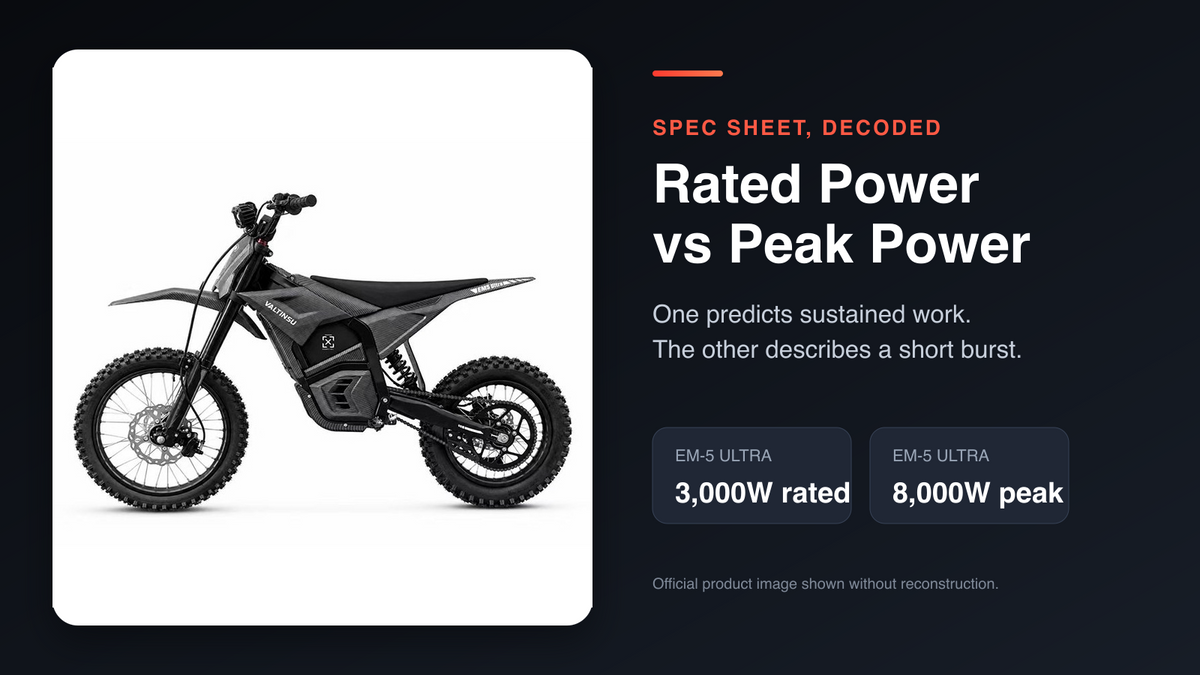
Rated Power vs Peak Power on Electric Dirt Bikes: What the Numbers Actually Mean

How We Test Electric Dirt Bike Range: A Repeatable Real-World Protocol