Failed Hill-Climb Recovery on an Electric Dirt Bike: Stop, Stabilize and Exit
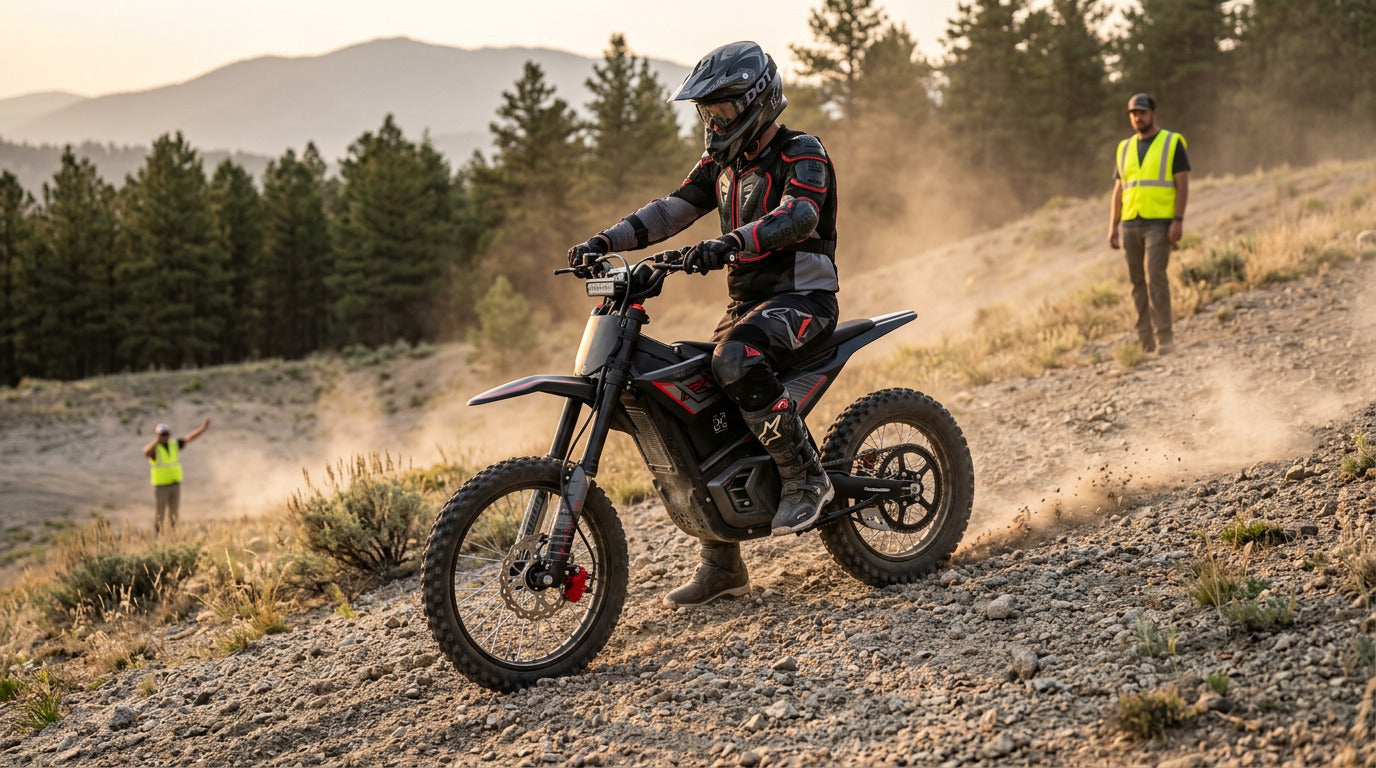
If a hill climb is failing, abort before forward momentum disappears. Close or reduce drive, keep the motorcycle aligned, establish the documented braking hold before rollback begins, and protect the downhill travel zone. Once fully stopped, place the motorcycle in the manufacturer-designated non-driving state before anyone approaches. If uncontrolled rollback begins, use the instructor-verified emergency exit and dismount to the uphill side.
A failed hill climb can progress from lost momentum to a static stop, uncontrolled rollback or extraction. Electric models add a model-specific shutdown check because silence does not confirm that drive is disabled. Never place a helper downhill, directly behind the motorcycle or inside its possible slide path.
If this is happening now: (1) abort while directional control remains; (2) establish braking before momentum reaches zero; (3) keep the motorcycle aligned and clear the downhill zone; (4) once stable, use the manufacturer-designated power-off or kill state—brake cutoff alone is not shutdown; (5) assess rider, battery and terrain; (6) choose a coach-approved ride-out, walk-out or professional extraction. If rollback starts, exit uphill under the trained emergency procedure.
Recognize the Failed Climb Before the Bike Stops
Early recognition is the safest recovery tool you have. Signs a climb is failing:
- Forward speed falling while motor sound rises
- Rear-wheel spin replacing forward drive
- The bike drifting off the planned line
- Steering corrections getting larger
- A rut or obstacle blocking the rest of the route
- The front end becoming hard to direct
- No safe crest or stopping area left within reach
- Motor output becoming limited, inconsistent or unavailable
More throttle here turns a recoverable loss of momentum into a buried tire, a sideways bike, an uncontrolled rollback or a tip-over.
The question is not whether the bike can still make torque. It is whether you still have a controlled stopping option. MSF puts terrain reading, special situations and hill traverses inside controlled practice for that reason, and full gear is assumed throughout: see our safety gear checklist.
Early Abort vs Forced Stop
Early Abort
An early abort happens while you still have forward movement, directional control, a visible stopping area, predictable brake response, and room to avoid a rut, drop or another rider. Stop adding drive while forward control remains, keep the motorcycle aligned, and establish the documented braking hold before momentum reaches zero. If the bike will not remain stopped, treat it as an active rollback and use the trained uphill-side emergency exit.
Forced Stop
A forced stop comes after momentum is nearly gone or the bike can no longer hold its line. The priority changes from finishing the climb to preventing uncontrolled rollback, a downhill fall, unintended motor output, the bike crossing the trail, and injury to anyone below.
Why Earlier Is Usually Better
Stopping while control remains leaves you choices. Waiting until the motorcycle is sideways, buried or moving backward burns through those choices fast. Nobody should be advised to make one final full-power attempt after a climb has clearly failed.
Use a Four-Question Failed-Climb Decision Tree
1. Is the Motorcycle Still Moving Forward Under Control?
If yes, use the coach-approved early-abort process and stop in the safest available spot. If no, go straight to stabilization.
2. Is the Motorcycle Stable and Prevented From Driving?
Confirm the bike is physically supported and in its documented non-driving state. If either is uncertain, do not step around it and do not start turning it.
3. Is a Controlled Ride-Out Still Available?
A ride-out needs a visible downhill line, working controls, adequate traction, enough trail width, nobody and nothing below, and coach approval. Missing any one of those, use assisted or no-power recovery.
4. Can the Bike Be Recovered Without Exceeding the Rider’s Capacity?
Weigh slope, motorcycle weight, footing, injuries, heat, battery condition, trail exposure and available help. If the answer is no, secure the area and call for assistance rather than forcing a solo recovery.
Stabilize the Stopped Motorcycle Before Doing Anything Else
Holding a stopped bike on a hill is its own skill, separate from riding up one.
Stop the Motorcycle’s Movement
The coached procedure has to prevent continued forward drive and rollback. Begin the documented braking action before all forward speed is lost so the motorcycle is held before rollback begins. The exact front, rear or combined control sequence must come from the exact model manual and qualified instructor. Brake layout, surface grip, slope direction, rider position and motorcycle design decide it.
Establish Secure Footing
Identify the higher side of the slope, the lower or exposed side, loose rock or soil under your boots, ruts that could trap a foot, and whether the bike is leaning toward support or away from it.
Use two states: if the motorcycle is fully stopped and stable, remain aboard only when that is the coach-verified safest support; if uncontrolled rollback or a downhill fall begins, follow the trained emergency exit and dismount to the uphill side while the downhill zone remains empty. The motorcycle may be more stable with the rider aboard until a coach or helper is in position.
Keep the Motorcycle From Crossing the Trail
A stopped bike must not become a hazard for riders approaching from below. Use a spotter or trail marshal when practicing, and stop other riders before the recovery starts.
Isolate Electric Drive Before Repositioning the Bike

Close the Throttle Completely
Confirm the throttle has returned to its normal closed position. If it sticks, returns slowly, feels damaged, or changes response as the bars move, stop the recovery and follow the manual or support procedure.
Select the Documented Non-Driving State
With the motorcycle held stable, close the throttle and use the manufacturer-designated stop, kill or power-off state, including key handling only where the manual specifies it. Disconnect or remove the battery only if the exact manual authorizes that action in this condition. A brake cutoff, side-stand interlock or display indication alone is not a shutdown method.
Do Not Trust Silence Alone
An electric motorcycle can be powered and ready to move without making a sound. Riders and helpers verify its state before touching the throttle-side bar, the rear wheel, the chain or the controls.
Follow the Exact Manual
Use the direct manual for the exact Valtinsu model to confirm its manufacturer-designated shutdown process, and that governs recovery, not internet advice. The EM-5 Pro lists a 60V, 5,600W geared motor and 177 lb-ft of wheel torque. Reduction gearing puts that force at the wheel at low RPM, which is the condition you are standing beside on a slope. Unintended drive is a real concern, not a theoretical one.
Stable Stop vs Tip-Over vs Rollback
Stable Upright Stop
The bike stays upright and does not move while you hold the approved controls. This state may allow a coached ride-out, controlled repositioning, or an assisted turn.
Motorcycle Resting on the Slope
The bike has tipped and the ground is holding it. Do not rush to lift. Isolate drive, stop riders below, check for injury, assess battery and control damage, and work out whether lifting would start it sliding.
Active Rollback
The bike is already moving downhill, so this is no longer a static turning exercise. If forward momentum is almost gone, establish braking before rollback begins. If uncontrolled rollback starts, do not attempt a feet-down backward ride: use the instructor-verified emergency exit and dismount to the uphill side, keeping every helper out of the downhill travel path. Do not improvise a feet-down backward descent, turn the bars sharply, or step off while holding a live throttle.
Why the Distinction Matters
A method that works on an upright stationary bike can be unsafe the moment the wheels are turning or the machine is lying downhill.
Ride-Out vs Walk-Out vs Assisted Extraction
Controlled Ride-Out
Appropriate when the bike is stable and fully functional, aligned with a visible downhill route, and ridden by someone who has practiced the procedure with a coach.
No-Power Walk-Out
Worth considering when slope, footing, motorcycle weight and control layout allow the bike to be moved without motor assistance. Never stand directly downhill of the motorcycle, place a foot beneath it or enter its fall line. Keep helpers outside the travel path and stop if the motorcycle cannot be held stationary. The exact side and brake control for a walk-out require hands-on instruction for the model; otherwise escalate to professional recovery. A rider standing on the wrong side can be pulled downhill or trapped.
Assisted Extraction
Do not improvise with straps, anchors or winches. Contact trail staff or a qualified recovery operator and use only manufacturer-approved recovery points, rated equipment and an established line-of-pull exclusion zone. One qualified leader controls the operation.
The Correct Choice
Pick the method with the lowest consequence if the motorcycle moves unexpectedly. Not the one that looks fastest.
Do Not Turn the Bike Until the Slope Is Controlled

Assess the Turn Area
Before repositioning, confirm the bike has stable support, enough trail width, clear space for both wheels, no downhill drop or exposed edge, no buried wheel, nobody below, and a helper or coach in the right position.
Upright Turn vs Ground-Assisted Reorientation
An upright turn keeps the bike on its wheels and demands controlled balance and braking. A ground-assisted reorientation starts with the motorcycle resting safely on the slope, which lowers the balance demand and adds lifting and sliding risk. Neither is universally better.
Front-End Movement vs Rear-End Movement
Moving the front or the rear changes how gravity acts on the machine. Which one is better depends on where each tire is supported and which movement avoids pulling you downhill.
Turn Only Under Hands-On Instruction
This article gives you the decision boundaries deliberately, not a step-by-step pivot. The method for your motorcycle gets learned on an easy closed slope with a qualified off-road coach standing next to you.
Manage Rollback Without Treating It as Reverse Riding
Prevent Rollback Before It Begins
Early abort, stable braking, secure footing and prompt drive isolation give you more control than anything available once the bike is already moving backward.
Keep Rollback Straight and Limited
A backward-moving motorcycle destabilizes quickly if the bars turn, the rear crosses a rut, or a foot loses support. No universal rollback distance or speed gets published here.
Reverse Mode vs Gravity Rollback
Some electric motorcycles offer reverse or crawl functions. Those features do not make a steep-slope recovery safe on their own. Three different states:
- Powered reverse: controller-driven movement inside model-specific limits
- Gravity rollback: movement caused by the slope
- No-power repositioning: human-controlled movement with drive isolated
Abort the Rollback When Control Is Lost
If the bike starts turning across the hill, accelerating backward, pulling you downhill, or heading toward an obstacle, the planned rollback has failed. Follow the coach’s emergency procedure instead of continuing.
Extract a Bike With No Power or a Drive Fault

Identify Why Drive Is Unavailable
Causes include battery depletion, a loose or damaged battery connection, controller protection, a brake-cutoff input, a display or interlock state, a throttle fault, damaged wiring, impact damage, or a motor or drivetrain fault. Do not troubleshoot any of it while the bike is unstable on the slope.
Separate Diagnosis From Extraction
Secure the bike and get it out of exposure first. Diagnose it on stable ground, powered down according to the manual.
Consider Motorcycle Mass
The EM-5 Pro is listed at 143 pounds net, before gear or anything strapped to it. A solo rider on loose footing may not be able to hold, turn or lower that mass safely, and a 287-pound load rating says nothing about what one person can control on a hill.
Use Help Before Strength Becomes the Plan
Request assistance when the bike is above you, the slope leads to a drop, the wheels are buried, you are injured, the battery or controls look damaged, the bike cannot be held without sliding, or the extraction path crosses active trail traffic.
Lift Only After the Motorcycle Cannot Slide
A solo lifting technique practiced on flat ground may not transfer to a steep, loose or off-camber hill. Before lifting, confirm:
- Electric drive is isolated
- You are uninjured
- The bike will not slide once weight comes off the ground
- The downhill side is clear
- Both wheels have secure support
- A helper can control the far end if needed
- The intended resting position is ready
- No hot, sharp or damaged component creates a new hazard
Do not grab the throttle, brake hoses, spokes, chain or damaged bodywork. Before any handling, clear every person from downhill and the motorcycle’s possible travel path. If the bike starts sliding, do not try to catch or hold it from below; use the trained escape route and prioritize people over the motorcycle rather than getting trapped underneath. MSF pairs this with pre-ride inspection, protective equipment, a tool kit and trained practice.
Inspect the Motorcycle After a Tip, Slide or Hard Stop
Check the Controls
Look for restricted throttle return, shifted or damaged brake controls, bent handlebars, pinched cables or wiring, damaged grips or handguards, a broken display or switch housing, and any change in lever or pedal movement.
Check the Chassis and Drive System
Inspect visible areas around the wheels and axles, tires, brake rotors and calipers, chain and sprockets, forks and rear suspension, foot pegs, frame, and the motor mounting area.
Check the Battery and Electrical System
If the battery area is smoking, venting, hissing, swelling, deformed, giving off a strong chemical or burning odor, or showing rapidly rising heat, do not touch or move the motorcycle. Keep people away and upwind/uphill where terrain permits, call local emergency services or the land manager, and follow manufacturer and fire-service instructions. For stable visible damage without active emergency signs, keep the motorcycle out of service and arrange qualified inspection. Our battery guide covers the post-crash case, mount, wiring and connector checks in more detail.
Do Not Restart Automatically
A successful extraction does not prove the bike is safe to ride. Work through the post-incident checks in our maintenance guide before the wheels turn again, and hand anything uncertain to a qualified technician.
Practice the Decision Tree on an Easy Closed Hill

Stage 1: Walk the Hill
Rider and coach identify the base, the crest, abort points, stable stopping areas, runoff, side exposure, ruts and loose zones, helper positions, and the trail-closure procedure.
Stage 2: Stationary Stabilization
With the bike at an instructor-selected position, rehearse drive isolation, communication, footing assessment, helper approach and power-off confirmation. Do not simulate a loss of control.
Stage 3: Coached Early Abort
Do not rehearse stopped-slope recovery as self-practice. Keep initial drills on level ground with clear start, stop, runoff and exclusion zones. A qualified instructor may demonstrate a mild-slope stop only after confirming the exact model, mode, communication signal, braking sequence and failed-stop escape plan.
Stage 4: Static Reorientation Demonstration
The coach demonstrates the chosen method for that motorcycle. The rider repeats it only under direct hands-on supervision.
Stage 5: No-Power Extraction
Rehearse moving the bike with drive isolated and helpers in assigned positions.
Progression Gate
Advance only when the rider can recognize the abort point, stop before losing control, isolate electric drive without hesitation, communicate clearly with helpers, choose correctly between ride-out, walk-out and assisted extraction, and stop the exercise when conditions change. Do not practice by attacking a hard hill until somebody fails.
Solo Recovery vs Group Recovery
Solo Recovery
Alone, nobody stops traffic below, stabilizes the far side, calls for help, controls a strap or winch, watches you for injury or fatigue, or retrieves dropped equipment. That shrinks the margin for experimenting with difficult climbs.
Group Recovery
A group adds capability only when roles are clear. Assign one recovery leader, one person stabilizing the motorcycle, one trail spotter, one managing equipment, and one ready to call for help.
More People vs Better Coordination
Five riders pulling in five directions is less safe than two trained helpers following one plan. Coordination beats manpower.
Rider Recovery vs Motorcycle Recovery
Check the rider first. Head impact, neck or back pain, dizziness, breathing difficulty, arm, wrist, leg, ankle or knee pain, heat illness, dehydration, panic or confusion, and any inability to keep footing.
Never ask an injured rider to lift, hold or walk a motorcycle downhill. If injury is suspected, secure the area and follow the emergency procedures for that location.
A motorcycle can sit on the slope while help arrives. A rider should not make an injury worse to protect equipment or reopen a trail faster.
EM-5 Pro Recovery Limits and Verification
No bike here is immune to a failed climb. What differs is weight, controls, torque delivery and what happens when you have to get it off the hill.
|
Model |
Hill-Relevant Characteristics |
Recovery Consideration |
|
60V 5,600W geared motor, 177 lb-ft wheel torque, three modes, 143 lb listed net weight |
Strong low-RPM force supports climbs, and that same weight and torque make abort discipline and drive isolation non-negotiable |
|
|
Same Pro drivetrain and adult fit in the signature Volt Green |
Color changes nothing about recovery. Same coach-led procedure |
|
|
Larger mid-size platform with model-dependent traction control, regeneration, and reverse or crawl assistance |
Rider aids help normal operation but replace no part of a physical recovery plan |
|
|
Talaria Sting R MX4 |
Enclosed gear drive and four adjustable regeneration levels, weight class similar to the Pro and varying by version |
Closed-throttle behavior and brake response shift with settings, so the manual governs rollback and shutdown |
|
Full-size enduro platform with power adjustable from roughly 10 to 80 hp |
Greater size and output make solo extraction harder, however sophisticated the power settings are |
The EM-5 Pro is listed with a 31.5-inch seat height, 17/14-inch wheels, a 287-pound load rating and 143-pound net weight. Those figures inform fit and handling but do not prove that a rider can recover it alone on a slope. Verify shutdown and approved recovery points in the exact manual, and escalate rather than improvising. Terrain-first picks sit in our Best Electric Dirt Bike for Trails guide.
Honestly: Sur-Ron and Talaria have larger aftermarket ecosystems and more established communities. Valtinsu’s advantage is adult geared torque at a much lower price, which does not remove the need for qualified hill training. The electric dirt bike collection covers the rest of the range.
Power vs Traction vs Recoverability
More Power
Power helps hold momentum when the surface can transmit it. It cannot fix a blocked line, a buried wheel, poor visibility, a route with no safe abort area, or a rider beyond their skill. Our watts and torque guide covers why the headline figure explains so little.
More Traction
Tires, surface condition, suspension tracking, load and rider input decide whether wheel torque becomes forward motion. No single pressure or tread suits every climb, which our electric dirt bike tire guide works through by terrain.
Better Recoverability
Recoverability comes from motorcycle mass, control layout, the drive-isolation process, trail width, footing, available helpers and safe downhill access. A bike that can climb a hill may still be brutal to recover once it stops sideways. Power is one part of hill suitability, and not the largest.
Common Failed-Climb Mistakes
|
Mistake |
Why It Raises Risk |
Better Decision |
|
Adding throttle after forward motion has ended |
Digs the tire, moves the bike sideways, destabilizes the rider |
Abort while control remains |
|
Waiting for the bike to roll backward |
Converts a static problem into a moving one |
Stabilize early |
|
Assuming silence means the bike is off |
Electric drive may still be active |
Verify the documented non-driving state |
|
Dismounting before securing the bike |
Removes rider support while gravity still controls it |
Stabilize first |
|
Turning without checking the downhill side |
Bike or rider may enter a drop, rut or active trail |
Clear and control the area |
|
Attempting a solo lift on loose footing |
Bike may slide or trap the rider |
Use trained help |
|
Restarting immediately after a fall |
Hidden control, battery, wheel or brake damage may remain |
Inspect before riding |
|
Repeating the climb while tired |
Fatigue cuts judgment and physical recovery capacity |
Rest or choose another line |
Stop the Recovery and Request Help When
Stop and call for help when:
- The rider is injured or disoriented
- The motorcycle cannot be prevented from sliding
- The bike is above the rider on the slope
- A drop, cliff, stream, road or active trail lies below
- The battery or electrical system appears damaged
- The throttle or brake controls behave abnormally
- The wheels are deeply buried or trapped
- The bike is too heavy for the available footing
- No safe downhill route is visible
- Weather or light is worsening
- The rider is alone without communication
- Recovery would mean entering closed terrain
- A strap, winch or anchor cannot be used under an approved procedure
The objective is ending the event without creating a second emergency.
Protect the Hill and Continued Trail Access
Repeated full-throttle attempts dig trenches, widen the route, expose roots and create bypass lines that outlast the ride. During recovery, stay on the designated motorized route, cut no new downhill exit, avoid dragging the bike across vegetation, and leave no straps, broken parts or battery debris. Repair displaced soil only where permitted, and report significant damage to the land manager.
This is not abstract. The Forest Service states on its Daniel Boone trail pages that cross-country motorized travel, including hill climbs, is not permitted, and that steep terrain may challenge beginners, who should always be accompanied. Rules vary by location, so confirm requirements before practicing. More sits in our riding guides.
Conclusion
A failed hill-climb recovery begins before the electric dirt bike rolls backward. Stop adding drive while directional control remains. Stabilize the bike before changing position. Isolate drive before anyone touches it. Then work out whether a controlled ride-out exists, and choose a walk-out or assisted extraction when it does not.
The best recovery is not the most dramatic turn or the strongest solo lift. It is the decision that keeps the rider, the motorcycle, the helpers and the trail inside a controlled plan.
Practice only under a qualified off-road instructor using a verified model-specific control sequence, clear downhill exclusion zone, defined stop signal and documented emergency-exit method before considering the Valtinsu EM-5 Pro for hill terrain.
FAQs
What should you do when an electric dirt bike fails a hill climb?
Stop adding drive before the motorcycle develops uncontrolled wheelspin, sideways motion, or rollback. Use the pre-agreed recovery sequence:
- Close the throttle and establish the model-approved brake hold.
- Stabilize the motorcycle before changing body position.
- Place the motorcycle in the verified non-driving state before anyone touches or moves it.
- Keep every person out of the downhill rollback path.
- Use the planned assisted walk-out or extraction if a controlled ride-out is not clearly available.
Should you keep the throttle open to stop the bike rolling backward?
No. Adding drive after the line or traction is lost can increase wheelspin, sideways movement, and the chance of a fall. Close the throttle, restore the approved brake hold, isolate drive, and use the recovery plan.
Can you turn around and ride back down after a failed climb?
Only when a qualified instructor has confirmed that the rider, motorcycle, slope, traction, turning space, and downhill line make that option controlled. Do not attempt it when:
- The motorcycle cannot be held stationary without strain
- The surface is loose, off-camber, wet, rutted, or blocked
- The rider cannot isolate drive before repositioning
- People or obstacles are inside the downhill escape path
Should one person lift a fallen electric dirt bike on a slope?
Not by default. Bike mass, slope, footing, rider condition, battery position, and the risk of the motorcycle moving downhill determine whether lifting is safe; use assistance or recovery equipment when control cannot be guaranteed.
Why will the motor not run after a fall or failed climb?
Possible causes include a brake-cutoff input, tip-over interlock, kill switch, connector movement, damaged control, fault code, or battery protection event. Keep the motorcycle in a non-driving state, check only the manual-approved items, and arrange qualified service if the normal reset procedure does not restore operation.
Sources
- Motorcycle Safety Foundation, DirtBike School
- Motorcycle Safety Foundation, Tips & Practice Guide for the Off-Highway Motorcyclist
- Motorcycle Safety Foundation, Safety Publications Library
- Bureau of Land Management, Off-Highway Vehicles
- USDA Forest Service, Redbird Crest Trail, Daniel Boone National Forest
- USDA Forest Service, Left Fork of Elisha Creek
- National Highway Traffic Safety Administration, Motorcycle Safety
- National Highway Traffic Safety Administration, Choose the Right Motorcycle Helmet
- Tread Lightly!, Respected Access
- Motorcycle Safety Foundation, Tips & Practice Guide for the Off-Highway Motorcyclist (electrical-system context only; the standard does not evaluate hill-climb recovery technique)


Looking for something else?
Electric Dirt Bike Replacement Parts Availability: What Buyers Should Verify Before Ordering
LEARN MORE
How to Check an Electric Dirt Bike for Safety Recalls by Model and Serial Number
LEARN MORE
How to Choose an Electric Dirt Bike Repair Shop: Questions to Ask Before Service
LEARN MORE
How to Lift a Fallen Electric Dirt Bike Without Hurting Yourself or the Bike
LEARN MORELooking for something else?
Electric Dirt Bike Fall Riding on Wet Leaves: Grip, Hidden Obstacles and Braking
LEARN MORE
Electric Dirt Bike Trailside Power Loss: Recovery Plan When the Battery Is Dead
LEARN MORE