What Electric Dirt Bikes Can Achieve Speeds of 120 MPH?
You've seen the clip. Some guy on a trail, a GPS number ticking past 110, a caption swearing the bike is bone stock. Looks real. Then you scroll to the comments and somebody who actually builds these things points out the downhill, the wrong wheel size feeding the dashboard, the gearing he conveniently left out. The number melts.
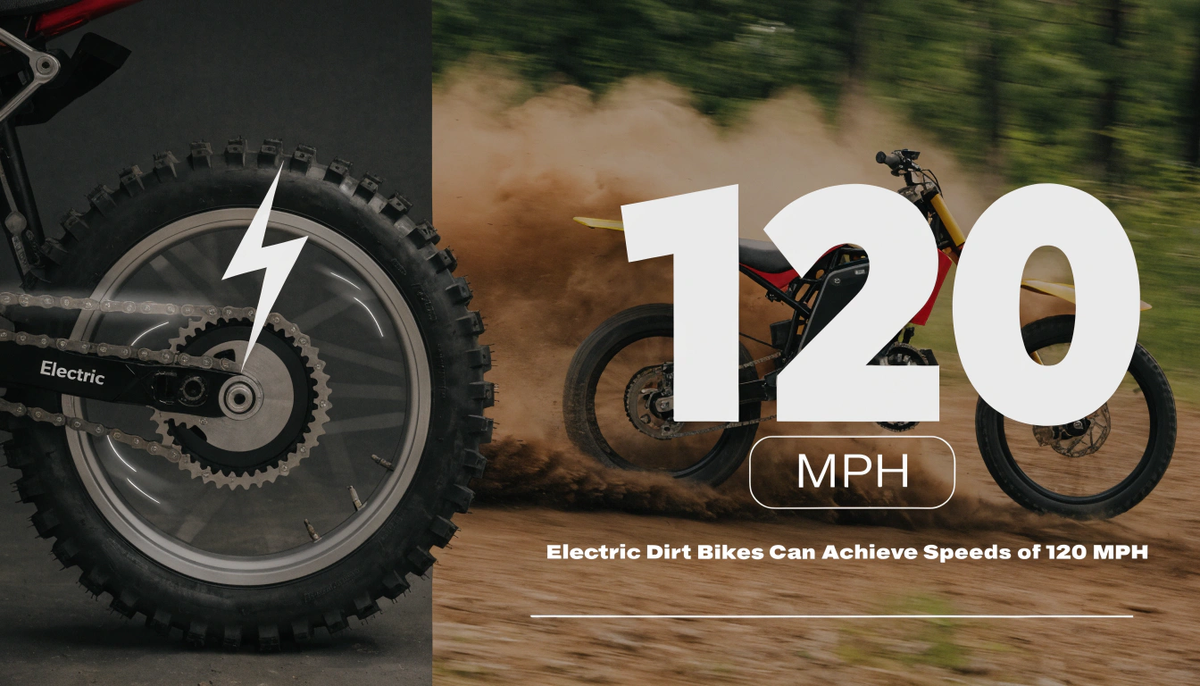
So let me just say it plainly. No adult electric off-road motorcycle you can buy off a showroom floor is rated by its maker for 120 mph. The quickest one anybody's announced claims a preliminary 90-something, and most real off-road machines run out of breath somewhere between 75 and 90. Can you build a 120? Sure. But by the time you're done, you're not looking at a dirt bike anymore — you're looking at a custom electric speed machine that happens to have knobby roots.
|
Quick answer: No stock electric dirt bike hits 120 mph. The closest, the Bonnell 902, lists 90-plus as preliminary — and even that ships with a “subject to change” asterisk. Getting to 120 means a high-voltage pack, a stronger motor and controller, taller gearing, serious cooling, road tires, bigger brakes, and a chassis that won't get squirrelly. Stack all that up and you've built a different bike.
|
The Fastest Electric Dirt Bikes Right Now
Forget the hype for a second. Here are the published manufacturer figures for the quickest electric off-road bikes you can actually order — or pre-order — in 2026. Read down the last column and watch how far every single one sits from 120.
|
Electric Dirt Bike
|
Published Top Speed
|
Peak Power
|
Status
|
Gap to 120 mph
|
|
Bonnell 902
|
90+ mph
|
65 kW
|
Preliminary, late 2026
|
~30 mph
|
|
Altis Sigma 2026
|
80+ mph
|
25 kW
|
Product listing
|
~40 mph
|
|
Ventus V1+
|
80 mph
|
28 kW
|
Current model
|
40 mph
|
|
Dust Moto Hightail
|
75 mph
|
32 kW
|
Current model
|
45 mph
|
|
Sur-Ron Storm Bee
|
68.3 mph
|
Model-specific
|
Current model
|
~52 mph
|
|
Sur-Ron Ultra Bee HP
|
59 mph
|
Model-specific
|
Current model
|
61 mph
|
|
Modified Sur-Ron
|
Build-specific
|
Build-specific
|
Custom
|
Not confirmed
|
The Bonnell 902 is the headline act, and notice its 90-plus number still wears that “subject to change” tag. The Stark VARG MX 1.2 likes to wave a big horsepower figure around — dial-a-power from 10 all the way to 80 hp — but Stark never prints a 120 mph claim, and there's a reason. Horsepower doesn't set top speed by itself. Gearing does. Motor RPM does. Tires and air do most of the rest.
The truly nutty clips? Those are modified Sur-Ron platforms. A few recorded runs really have nudged past 100. But that result belongs to that one bike — its pack, its controller, its sprockets, that rider, that stretch of road, that day. Copy the parts list and you still won't copy the number.

Why 120 MPH Is So Hard on an Electric Dirt Bike
Here's the part nobody making those clips wants to explain. A strong motor will launch you hard — that's the easy bit. Top speed is a totally different fight. Somewhere around 80 mph the bike stops wrestling you and starts wrestling in the air. And the air usually wins.
Aerodynamic Drag
A dirt bike is basically built to lose that fight. You're sitting upright behind wide bars, and the wheels, forks, and frame are all just hanging out there catching wind. The catch is that drag doesn't grow in a straight line — it piles up fast. Going from 80 to 120 isn't a 50% bigger ask. It's way more. Tuck down low and you'll claw some back, but a naked off-road bike has no fairing to hide behind, so you only get so far.
Motor RPM and Gearing
Every electric motor has a ceiling on how fast it can spin. Once it's pinned there, throwing more current at it just sharpens the launch — it doesn't buy you top end. So you gear taller, which trades revolutions for road speed. Fine, except taller gearing also robs you of wheel torque, and now the motor has to be strong enough to haul that tall gear up to speed in the first place. Guess wrong and you've built something that's actually slower than where you started. People learn this the expensive way.
Battery, Controller, and Heat
Voltage gives you speed potential, current gives you torque, and a 120 build is hungry for both — delivered without the pack sagging the moment you ask for everything. Then there's heat. Push it and the battery, controller, and motor all start cooking, so the bike does the sensible thing and quietly pulls power to save itself. Which is right when you wanted that last 20 mph. Switch the protection off and, well, now you're shopping for parts.
|
The heat trap: A bike that trips its thermal cutoff after one hot pass isn't a 120 mph bike. It's a one-run bike. Real top speed means cooling that holds up over the same load, in the same weather, run after run — not one lucky pull on a cold morning before everything warms up and gives out.
|
Tires and Chassis Stability
Knobby tires are made for dirt, not for three digits on pavement. Those tread blocks squirm and heat up at speed — not a feeling you want under you at 100. And trail geometry that feels sharp and playful on singletrack can turn twitchy on a long straight. A little vibration you'd never notice at 40 becomes a genuine problem at 100. Wheels, bearings, axles, the steering head — all of it has to stay dead calm while everything spins faster than it was ever meant to.

What a Real 120 MPH Build Actually Takes
If you're still set on it, go in clear-eyed: this is custom motorcycle work, not a Saturday in the garage. Every major system has to be in on the plan, and the people who pull it off usually know their way around high-voltage packs, chassis design, and an actual test track. Here's the short list of what has to change.
-
A high-voltage battery with enough voltage for speed and enough current for the launch — and that won't overheat or sag when you ask for all of it. Mounted solid, protected from impact.
-
A high-power motor and controller that keep pulling as drag climbs, matched to the pack, with honest temperature limits and a throttle that doesn't snap.
-
Taller final-drive gearing worked out so the rear wheel can actually reach 120 without redlining the motor — figured as one system, not eyeballed off a forum post.
-
Cooling that's real, heat sinks, forced air, or liquid — the kind that survives pull after pull in actual heat, not one cold run.
-
Road rubber, bigger brakes, a settled chassis: tires rated for the speed and load, brakes that can haul it down, and suspension that keeps it pointed straight.
Tally it up and the parts bill usually blows past what the bike cost in the first place. Which is the quiet punchline: a machine built from the factory for high speed almost always comes out cheaper than rebuilding a trail bike to chase one number on a screen.
And speed raises the stakes everywhere else, too. A 120 mph machine carries the risk profile of a road sportbike, not a trail toy — so if you ever test one, do it at a closed course in a real DOT-compliant motorcycle helmet (NHTSA FMVSS 218) and full gear, never on a public road. A big top speed doesn't make any of this street legal, either. Most electric dirt bikes are sold as off-highway vehicles, and California, for instance, treats electric motorcycles built for off-road use as off-highway vehicles that need OHV identification — road registration is a separate, much harder path. Check your own state's rules before you build or ride.
Stock vs Modified: Which Performance Is Worth It
A stock bike hands you a balance somebody already tested — power, range, cooling, a chassis that behaves itself. A modified bike can absolutely be faster. But the second you touch the powertrain, every quirk and every failure is now yours, warranty and all.
And top speed is just one slice of the pie. Reliability, range, charging, whether you can get it fixed, how it actually handles — that stuff shows up every ride. A planted 70 mph bike will post faster, safer laps than a nervous 120 build that taps out from heat halfway through the session. The slower bike usually lasts longer between repairs, too. Funny how that works.
|
Electric vs 450cc reality check: Most stock 450cc motocross bikes land around 75–90 mph — the exact same window as the fastest electrics. Neither one hits 120 in stock motocross trim. Displacement and peak watts don't tell you top speed on their own; gearing, terrain, how you're tucked, and how much runway you've got decide it.
|

Which is the whole reason a brand like Valtinsu doesn't chase the 120 headline. The Valtinsu electric dirt bikes lineup is built around exactly the speed window that actually gets used on dirt — fire roads, open fields, weekend sessions — with geared-motor torque that lands low in the rev range, right where a climb needs it instead of way up top where it doesn't. No asterisks, no “preliminary,” just the honest sheet:
|
Model
|
Top Speed
|
Peak Power
|
Torque
|
Battery
|
Age
|
|
EM-5
|
40 mph
|
48V 3,840W
|
148 lb-ft
|
48V 23.4Ah
|
13+
|
|
EM-5 Pro
|
52 mph
|
60V 5,600W
|
177 lb-ft
|
60V 27Ah
|
18+
|
|
EM23
|
43.5 mph
|
60V 4,000W
|
184 lb-ft
|
60V 27Ah
|
16+
|
Stack that against the chart up top and the gap to 120 looks huge — but that gap is the point, not a weakness. The EM-5 Pro's 52 mph sits right in the band where a real trail bike actually lives, and its geared 5,600W motor puts 177 lb-ft down low, where a fire-road climb needs it more than any top-speed number. The EM23 trades a little top end for the most torque in the family — 184 lb-ft — on big 19-inch front wheels that smooth out open-ground chop. None of them is a 120 fantasy. All of them are bikes you'd actually ride twice a week.
|
Valtinsu EM-5 Pro — Adult Electric Off-Road Motorcycle
60V geared motor | 5,600W peak | 177 lb-ft | 52 mph | IPX6 | Three ride modes | Age 18+ | Black or Volt Green
Built for fire roads, singletrack, and steep grades — off-road use only, not public roads.
From $1,699 USD | Free U.S. shipping — View the performance trail motorcycle for adult riders
|
Want to see how the whole dirt season could go? The electric dirt bike collection lays the models out side by side so you can pick the ride feel first and sweat the specs second.

Conclusion
So, no — no stock electric dirt bike has a confirmed 120 mph factory rating, and the next clip that tells you otherwise is missing some fine print. The Bonnell 902 leads with a preliminary 90-plus, the Altis Sigma and Ventus V1+ hover near 80, and the Dust Moto Hightail sits at 75. A custom build can creep toward 120, but only after a high-voltage pack, sustained power, a matched controller, taller gearing, real cooling, road tires, bigger brakes, and a stable chassis — at which point it's stopped being a trail bike entirely.
Chase the speed you'll actually use instead. A well-sorted 50-to-80 mph electric dirt bike gives you launch you can feel, handling you can lean on, range that gets you home, and parts that make it through the season in one piece. That's the number that matters — not the one flashing on a wobbly downhill clip somebody filmed once and never could again.
|
Bottom line: 120 mph is a custom-build target, not a showroom spec. For real tracks and trails, the right bike is the one that fits your riding area and your skill — the EM-5 to get started, the EM-5 Pro for adult performance, the EM23 for big-wheel open ground.
|
Which Valtinsu Fits Your Riding
|
EM-5 — Ages 13+ — Trail Starter
48V | 3,840W peak | 148 lb-ft | 40 mph | IPX6 | Three modes (22 / 32 / 40 mph). Only Valtinsu model rated under 16.
The easiest start into electric dirt — lower 28.3-inch seat, approachable size.
|
|
EM23 — Ages 16+ — Big-Wheel Open Ground
60V | 4,000W peak | 184 lb-ft | 43.5 mph | IPX4 | 19″ / 17″ wheels | 100A controller — highest torque in the line.
Faster launch and a planted feel across open fields and uneven dirt.
|
|
Age rule — no exceptions: EM-5 = 13+ | EM23 = 16+ | EM-5 Pro = 18+ adults only. A parent shopping for a rider under 16 should choose the EM-5.
|
FAQs
What dirt bike can go 120 mph?
None straight off the floor. No current stock electric dirt bike is officially rated for 120, and the closest announced model, the Bonnell 902, only claims a preliminary 90-plus. Custom land-speed and heavily modified electric builds can get near 120 in controlled conditions, but that number sticks to that one bike — not the next one off the same parts list.
How fast do electric dirt bikes go?
The quick ones run from about 59 mph on the Sur-Ron Ultra Bee HP up to a preliminary 90-plus on the Bonnell 902. Most serious off-road machines settle between 75 and 90. And honestly, dirt rarely hands you a straight long enough to ever see those peaks.
Why can't electric dirt bikes hit 120 mph?
Air. Past 80 mph, an upright bike with no fairing needs a huge jump in power for every extra mph. Pile on motor RPM limits, battery sag, heat, squirmy knobby tires, and twitchy trail geometry, and a motor that launches like a rocket still can't shove that shape to 120.
Is a faster electric dirt bike worth it?
Past usable speed, usually not. A planted 50-to-80 mph bike gives you better lap times, range, and reliability than a nervous 120 build that overheats. Suspension, tires, brakes, and your own skill pay off every ride — a top-speed chase only helps on one long straight you almost never have.
How fast is a Sur-Ron?
A stock Light Bee X does about 46.6 mph, the Ultra Bee HP is listed at 59, and the bigger Storm Bee hits 68.3. Modified Sur-Rons have crossed 80, 90, even 100 in recorded runs — but each of those numbers belongs only to that specific build, on that day, in those conditions.
Are electric dirt bikes faster than 450cc gas bikes?
They're basically neck and neck now. Most stock 450cc motocross bikes reach roughly 75–90 mph, and the fastest electrics sit right alongside them. Neither hits 120 in stock motocross trim. Electric wins on instant low-speed punch; gas still wins on a quick splash of fuel for long remote days.
How fast does a Valtinsu electric dirt bike go?
Depends which one. The EM-5 tops out at 40 mph, the EM-5 Pro at 52, and the EM23 at 43.5. Each has three ride modes, so you can start mellow and step it up as you settle in. None of them is built or sold as a 120 mph machine — they're built for real dirt.
Is a 120 mph electric dirt bike street legal?
A big top speed doesn't make any bike street legal. Most electric dirt bikes are sold as off-highway vehicles, and putting one on the road generally takes a road-accepted VIN, registration, insurance, a motorcycle license, and DOT equipment. Rules shift state to state, so check your DMV before you build or ride.
Sources
-
Bonnell, “Bonnell 902 Electric Dirt Bike — Preliminary Specifications.”
-
Stark Future, “Stark VARG MX 1.2 Power and Chassis Specifications.”
-
Ventus Bikes USA, “Ventus One Plus (V1+) Specifications.”
-
Dust Moto, “Dust Moto Hightail Specifications.”
-
California DMV, “Register an Off-Highway Vehicle (OHV).”
-
Valtinsu, “Electric Dirt Bike Collection.”
-
Valtinsu, “EM-5 Pro Electric Dirt Bike.”


Looking for something else?
Electric Dirt Bike Replacement Parts Availability: What Buyers Should Verify Before Ordering
LEARN MORE
How to Check an Electric Dirt Bike for Safety Recalls by Model and Serial Number
LEARN MORE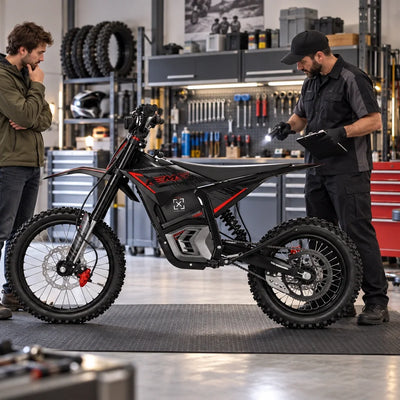
How to Choose an Electric Dirt Bike Repair Shop: Questions to Ask Before Service
LEARN MORE
How to Lift a Fallen Electric Dirt Bike Without Hurting Yourself or the Bike
LEARN MORELooking for something else?
Electric Dirt Bike Fall Riding on Wet Leaves: Grip, Hidden Obstacles and Braking
LEARN MORE
Electric Dirt Bike Trailside Power Loss: Recovery Plan When the Battery Is Dead
LEARN MORE
Electric Dirt Bike Plastics Replacement Guide: Fitment, Color Kits and Install Order
LEARN MOREYou may also like
Moto eléctrica todoterreno para adultos EM-5 con luz
$969.00
$1,559.00
VALTINSU EM-5 Pro Off-Road Black Electric Dirt Bike
$1,699.00
$1,899.00
VALTINSU EM-5 Pro Green Electric Dirt Bike
$1,699.00
$1,899.00
VALTINSU EM-5 Ultra Electric Dirt Bike
$2,199.00
$2,499.00
VALTINSU EM-5 & EM-5 Pro Combo
$2,658.00
$3,458.00