Electric Motorcycle Top Speed: How Fast Adult Models Really Go
Ask how fast an electric motorcycle goes and the honest answer is: pick a number between 35 and 200-plus mph. That’s not a dodge. It’s the whole point. One battery, two wheels, the same silent launch — and a spread wide enough to swallow most of the gas world.
A city bike taps out around 50. A highway machine clears 100 without drama. And then there’s the Lightning LS-218, wearing a published figure north of 200. The trouble is, those headline numbers get quoted like they’re interchangeable with what you’ll see on your morning ride. They’re not. A record run, a brochure claim, and the speed you can actually hold on a Tuesday are three separate things, and confusing them is how people end up disappointed.
So here’s the plan. We’ll sort adult electric motorcycles by speed band, dig into what really sets the ceiling, and pull apart the showroom spec from the salt-flat result. And if your riding is off-road, stick around — there’s a section where top speed quietly stops mattering at all.
|
Quick answer: Most adult electric motorcycles top speed out between 60 and 125 mph. Commuters sit lower; superbikes climb past 150. The eye-popping numbers — 200, 218 — come from record-spec bikes on closed courses, not a stock bike on a public road. Match the speed to where you ride, not to the biggest figure on the page.
|
How Fast Do Adult Electric Motorcycles Really Go?
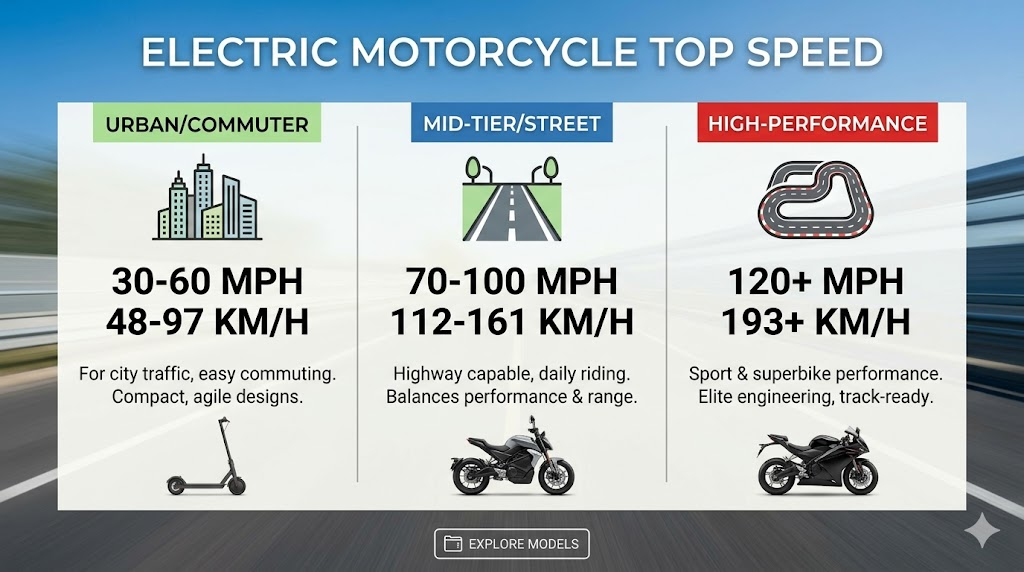
Most land between 35–60, 60–100, 100–150, 150+ mph . Below that, you’re looking at commuters; above it, full superbikes. Where any single bike falls comes down to motor power, battery voltage, gearing, cooling, and — more than anything — what it was built to do in the first place.
Which is why the right speed is almost never the highest one. A bike tuned for city traffic wants different gearing, range, brakes, and cooling than a track machine. Figure out the use first. The spec sheet makes a lot more sense after that.

Urban and Commuter: 35–60 mph
City bikes and seated scooters usually stop somewhere between 35 and 60 mph. That’s fine — local streets, short commutes, stop-and-go traffic where a smooth launch beats outright pace. Smaller packs, lighter frames, quick off the line. They do the job they were built for.
The catch shows up at the edges. A 35 mph machine has no business on a 65 mph highway. A 60 mph one can still wheeze up a long hill, into a headwind, or under a heavier rider. None of that is a flaw. It’s just the wrong tool for that particular road.
Highway-Capable: 60–100 mph
This is where things get serious. Bikes in this band handle most city and suburban highways, carrying stronger motors, bigger batteries, real suspension, and brakes that can actually slow the weight down. One thing trips people up: a 90 mph published max isn’t an invitation to cruise at 90. You want the headroom so you can hold 70–75 all day without pinning the motor at its ceiling.
A few fast off-road bikes wander into this range too — which doesn’t make them road legal, before anyone gets ideas. If you’re sizing up a high-power build, our breakdown of how fast 3000W really is shows where the wattage actually lands on the speedometer.
Performance: 100–150 mph
Now we’re matching gas sportbikes. The Zero SR/S, Verge TS Ultra, Tarform Luna, Evoke 6061-GT, and Energica Ego+ RS all sit in or near this band on paper.
And paper is the key word, because a big motor is only the start. These bikes need stable frames, motorcycle-grade tires, brakes that bite, battery cooling, and bodywork that manages air at speed. The acceleration tends to be violent — electric torque shows up the instant you twist the throttle — but the top number still hangs on gearing, power delivery, heat, and drag. All four have to cooperate.
Electric Superbikes: 150–218 mph
The top floor. Published figures run from 150 mph for the Energica Ego+ RS, to a claimed 200 for the Damon HyperSport, to the Lightning LS-218’s headline 218.
Few riders will ever feel those speeds outside a track, and that’s being generous. Tire condition, heat, charge level, wind, the length of road in front of you, the electronic limiter — every one of them gets a say in whether the bike sniffs its rated max. The 218 figure especially deserves an asterisk: Lightning ties it to record runs on special gearing and bodywork. That number lives on a salt flat. It does not live on your street.
Fastest Adult Electric Motorcycles Compared
Look at how far this market has stretched. Some of these are established road bikes; some are built a handful at a time; a couple are still announced models on schedules that can slip. Read the second column slowly — “published or claimed” is carrying a lot of weight there.

|
Model
|
Published / Claimed Top Speed
|
0–60 mph
|
Battery
|
Best Fit
|
|
Lightning LS-218
|
218 mph benchmark
|
Under 2 sec (claim)
|
Several pack options
|
Extreme / record
|
|
Damon HyperSport
|
200 mph (claim)
|
≈3 sec (claim)
|
20 kWh announced
|
Future superbike
|
|
Energica Ego+ RS
|
150 mph (limited)
|
2.6 sec
|
21.5 kWh
|
Track + road
|
|
Evoke 6061-GT
|
140–143 mph
|
≈3.6 sec (claim)
|
Electric touring
|
|
|
Verge TS Ultra
|
124–125 mph
|
2.5 sec (claim)
|
Varies
|
High-tech performance
|
|
Zero SR/S
|
124 mph
|
≈3 sec
|
Varies by market
|
Daily sport touring
|
|
Tarform Luna
|
120 mph
|
≈3.8 sec
|
12 kWh
|
Limited-build road
|
Read the second column slowly — “published or claimed” is carrying a lot of weight there.
|
Watch the range numbers too. A city-range figure measured at low speed reads far rosier than real highway range at 70 mph. It’s the same trap as top speed — context before comparison, every time.
|
What Actually Sets an Electric Motorcycle’s Top Speed?
Wattage alone does not determine top speed. High-voltage systems such as 60V and 72V can support stronger power delivery and higher motor speeds, but voltage is only one part of the setup. Gearing, controller limits, cooling, tires, rider weight, and aerodynamics work together to determine an electric motorcycle’s actual top speed.

Motor Power and Torque
Power is what shoves a bike through the air and keeps it pulling at speed. Torque is the launch — the shove that pins you back. Here’s the part people miss: a monster torque number doesn’t hand you the highest top end, because gearing multiplies wheel torque to sharpen the launch and that can cap wheel speed in the process. And peak power? Often a few seconds, then it backs off. The continuous number is the one that tells you what the motor can actually hold.
Battery Voltage and Discharge
Higher voltage supports higher motor speed and lower current for the same power. It does not, by itself, make a bike fast — the controller, motor, and gearing all have to be matched to the pack, or the extra volts go nowhere. Voltage also sags under load, which is why engineers leave margin so the bike doesn’t cut power right when you ask for everything. If you want to see the same physics play out lower down the ladder, here’s how fast a 48V system goes.
Gearing and Final Drive
Short gearing multiplies torque and sharpens the launch. Tall gearing trades that launch for more road speed at the same rpm. Swap a sprocket and yes, the speedometer moves — but only if the motor has the muscle to pull the taller ratio. No sprocket on earth out-guns aerodynamic drag.
Aerodynamics, Weight, and Heat
Past about 60 mph, air is the wall you’re fighting. A tucked rider, a clean fairing, a narrow frontal area — they all cut the power needed to hold pace, which is exactly why carbon-fiber bodywork shows up on bikes like the LS-218. Weight matters most when you’re accelerating or braking. And heat sets the real ceiling: cook the motor, controller, or pack and the software quietly trims power. Riders call it thermal derating, and it’s the reason a bike can flash 100 mph once and then settle in around 80 for the long haul.
Claimed Top Speed vs Real-World Top Speed
A claimed top speed is the manufacturer’s number. Real-world speed is what a specific bike, on a specific day, with you in the saddle, actually does. Sometimes those line up. Often they don’t.
Charge level, your weight, temperature, tire pressure, wind, software limiters, the grade of the road — they all push the number around. A bike that nails its rated figure at 90% charge can come up several mph short by the time the pack hits 20%. So when you read a speed claim, ask three things: stock or modified? Measured by GPS or by the dashboard? Repeated, or a single lucky run? A downhill pass with a tailwind behind it proves exactly nothing.
|
Peak vs sustained: Peak is the brief touch — there and gone. Sustained is the pace a bike actually holds without overheating or draining the pack. For commuting and touring, sustained is the only number that earns its place on the spec sheet.
|
Off-Road Electric Motorcycles: Where Top Speed Stops Being the Point
Take it off the pavement and the whole argument changes. On dirt, torque and control beat a big top number every single time — ask anyone who’s stalled out two-thirds up a climb. Valtinsu electric dirt bikes are built around that exact truth: adult electric off-road motorcycles tuned for climbs, loose ground, and fire roads, not salt-flat bragging runs.
Most off-road electric bikes top speed out between 40 and 65 mph. Sounds tame next to a 124 mph SR/S — right up until you’re halfway up a 45-degree fire road, front wheel skipping, rear tire clawing for grip. Up there the number you feel isn’t top speed. It’s torque arriving low in the rev range, and a geared motor lays it down from a dead stop, exactly where a high-rpm superbike would just light up the tire and spin.
Valtinsu also keeps its numbers honest, which matters more than it sounds. The entry EM-5 runs a real 40 mph across three modes. The EM-5 Pro reaches 52. The bigger-wheeled EM23 settles around 43.5. No inflated brochure math — what you read is what the bike holds on dirt.

|
Valtinsu EM-5 Pro — Adult Electric Off-Road Motorcycle
60V geared motor · 5,600W peak · 177 lb-ft torque · 52 mph (26/40/52) · 59-mile range · IPX6 · 45° climb
Adults 18+ only — no exceptions
From $1,699 USD · Black or Volt Green · Free U.S. shipping
|
And the question that always lands in the comments: can a Sur-Ron do 70 mph? Stock, no. A Light Bee X lives in the mid-40s to low-50s — right in EM-5 Pro territory. The ones that hit 70 off-road are heavily modified, and they carry every headache that comes with it: voided warranty, murky classification, a drivetrain working past its design. For a stock adult trail bike, 52 mph is already plenty of speed, and plenty of trouble if you’re careless with it.
Are High-Speed Electric Motorcycles Street Legal?
A fast electric motorcycle can be street legal — if it’s built, certified, registered, and insured as a road motorcycle. The motor type alone settles nothing. The NHTSA treats any vehicle carrying road equipment and topping 20 mph as a motor vehicle under federal safety rules, electric or not.
High-power e-bikes and electric dirt bikes usually land outside the bicycle rules entirely. The federal low-speed e-bike definition caps a true e-bike at 750W, working pedals, and a motor-only speed under 20 mph. A pedal-free machine putting down several thousand watts at 50 mph isn’t an e-bike by any reading — it’s a moped, a motorcycle, or an off-highway vehicle, and which one depends on your state.
|
Off-road note: Valtinsu electric dirt bikes are built for off-road use — private land, OHV parks, designated riding areas. Not street legal by default. And bolting on a headlight and mirrors doesn’t turn an off-road title into a road one; the VIN classification and the equipment both have to check out. Call your state DMV before you ride anywhere near a public road. Cheaper than the ticket.
|
What Top Speed Should an Adult Rider Choose?
The right electric motorcycle top speed for adult riders depends on where and how the bike will be used. A high peak number may look impressive, but the bike’s ability to maintain speed safely under load matters more. Consider braking, battery range, terrain, rider weight, and local speed limits before choosing.
-
City commuting: A sustained 45–70 mph range can cover most urban and suburban trips. Consistent speed, predictable braking, and stable handling matter more than a brief top-speed burst.
-
Highway riding: Look for a bike that can sustain about 90–110 mph when needed, rather than one that only reaches that speed for a few seconds. Confirm that the bike can hold 70–75 mph without overheating or draining the battery too quickly.
-
Touring: Range, charging access, comfort, and sustained cruising speed should guide the choice. A bike rated at 110–125 mph is useful only when it can maintain normal highway speed over longer distances.
-
Off-road riding: About 40–55 mph is usually enough when paired with strong low-speed torque and suitable suspension. Controlled, repeatable power on climbs and loose ground matters more than peak speed.
Leaning toward dirt? Compare the electric dirt bike collection by torque, climb angle, and seat height before top speed ever enters the conversation — those three decide how the bike actually feels under you.

Which Valtinsu Fits Your Riding?
|
EM-5 — Ages 13+ · Trail Starter
48V · 3,840W peak · 148 lb-ft · 40 mph (22/32/40) · 50-mile range · IPX6 · 28.3 in seat
The only Valtinsu model rated under 18 — built for first dirt rides.
From $1,259 USD
|
|
EM-5 Pro — Adults 18+ · Performance Trail
60V · 5,600W peak · 177 lb-ft · 52 mph (26/40/52) · 59-mile range · IPX6 · 45° climb
Black or Volt Green. Geared torque for fire roads and singletrack.
From $1,699 USD
|
|
EM23 — Riders 16+ · Open-Ground Cruiser
60V · 4,000W peak · 184 lb-ft (highest in lineup) · 43.5 mph (16/28/43.5) · 19"/17" wheels
Bigger wheels, faster off-the-line, mature open-ground feel.
From $1,999 USD
|

|
Age rule — no exceptions: EM-5 = 13+ · EM23 = 16+ · EM-5 Pro = 18+ adults only. Shopping for a rider under 18 means the EM-5 (or the EM23 for 16–17). Never the Pro.
|
Conclusion
So, how fast does an electric motorcycle go? Anywhere from about 35 mph on a city runabout to past 200 on a superbike — that’s the honest range, and where your bike lands depends entirely on what it was built to do. The Lightning LS-218 owns the ceiling with its 218 mph benchmark; bikes like the Zero SR/S and Tarform Luna deliver real highway pace well below it. And off-road, the fast number quietly steps aside — torque and control take the wheel.
The fastest bike on the page is almost never the right one for you. Weigh sustained speed over peak, then range, charging, brakes, cooling, legal status, and whether you can get it serviced. Pick the machine that handles your normal route without ever sitting at its limit — that’s the one you’ll still be grinning on a year from now. And if your route runs to dirt, that means a bike engineered around low-rev torque and proper suspension, which is exactly the corner of the market Valtinsu builds for.
FAQs
Can an electric bike go 80 mph?
Some can, but a true 80 mph machine isn’t a legal low-speed e-bike — it’s an electric motorcycle or a high-power off-road build. Reaching that speed needs a high-voltage battery, a strong controller, a real motorcycle frame, road-rated tires, and brakes to match. A bicycle-shaped frame doesn’t make it legal in a bike lane. Check the VIN, registration class, and local rules before buying anything advertised at 80 mph.
Can an electric bike go 70 mph?
A modified electric bike or a powerful electric dirt bike can reach 70 mph, but standard Class 1, 2, and 3 e-bikes can’t — they stop assisting at 20 or 28 mph. A 70 mph build usually runs 72V or higher with several thousand watts and road-speed gearing. At that point bicycle brakes and lightweight frames are past their safety margin, and the vehicle falls outside e-bike rules in most places.
What electric motorcycle goes 200 mph?
The Damon HyperSport has been promoted with a claimed 200 mph top speed, and the Lightning LS-218 is tied to an even higher 218 mph benchmark. Damon’s figure is still an announced target rather than a number backed by wide customer ownership. Lightning has the longer record, but its headline speed comes from controlled, specially-geared runs. Confirm current production status and delivered spec before ordering either.
What e-bike can go 100 mph?
Very few, and anything that does is really an electric motorcycle or a record build, not a pedal-assist e-bike. Hitting 100 mph takes motorcycle-level power, tires, brakes, suspension, and frame strength. One GPS run online doesn’t prove repeatable or safe performance. For triple-digit speed, buy a certified road motorcycle and use it on a legal closed course with full gear.
How fast will a 2000-watt electric bike go?
A 2000W electric bike commonly reaches about 30–45 mph when it isn’t software-limited. Battery voltage, controller current, gearing, wheel size, rider weight, and terrain all shift the result. A road setup with smooth tires lands at the top of that range; an off-road build with knobby tires runs slower but climbs harder. Peak power and continuous power matter too — some motors only hit 2000W in short bursts.
Is a 3000W e-bike street legal?
Usually not as a standard low-speed e-bike in the U.S. It may qualify for road use under a moped, motor-driven cycle, or motorcycle category if it meets state rules. Federal e-bike rules require working pedals, under 750W, and a motor-only speed below 20 mph. A 3000W machine often reaches 40–55 mph, well past those limits. Contact your DMV with the exact VIN before assuming you can register it.
How fast is 72V 3000W in mph?
A 72V 3000W setup typically reaches about 45–55 mph when motor, controller, gearing, and battery are matched. Higher voltage raises speed potential, but 72V alone doesn’t fix one figure — winding, wheel size, rider weight, and charge level all move it. A “3000W” label may also hide a higher short peak or a lower continuous output. Ask for a GPS-tested number under stated conditions.
Can a Sur-Ron go 70 mph?
A stock Sur-Ron Light Bee X doesn’t — it sits around the mid-40s to 50 mph, close to a Valtinsu EM-5 Pro. Modified Sur-Rons can reach 70 mph with a higher-voltage pack, a stronger controller, and new gearing, but those changes stress the drivetrain, void the warranty, and can change the bike’s legal classification. For a stock adult trail bike, that mid-50s ceiling is more than enough.
Sources
-
Lightning Motorcycles — LS-218 Product Information
-
Zero Motorcycles — SR/S Specifications
-
Energica — Ego+ RS Technical Data
-
Valtinsu — Electric Dirt Bike Collection
-
Valtinsu — EM-5 Pro Electric Dirt Bike


Looking for something else?
Electric Dirt Bike Replacement Parts Availability: What Buyers Should Verify Before Ordering
LEARN MORE
How to Check an Electric Dirt Bike for Safety Recalls by Model and Serial Number
LEARN MORE
How to Choose an Electric Dirt Bike Repair Shop: Questions to Ask Before Service
LEARN MORE
How to Lift a Fallen Electric Dirt Bike Without Hurting Yourself or the Bike
LEARN MORELooking for something else?
Electric Dirt Bike Fall Riding on Wet Leaves: Grip, Hidden Obstacles and Braking
LEARN MORE
Electric Dirt Bike Trailside Power Loss: Recovery Plan When the Battery Is Dead
LEARN MORE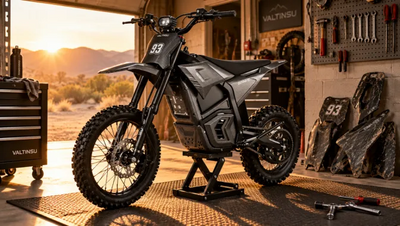
Electric Dirt Bike Plastics Replacement Guide: Fitment, Color Kits and Install Order
LEARN MOREYou may also like
Moto eléctrica todoterreno para adultos EM-5 con luz
$969.00
$1,559.00
VALTINSU EM-5 Pro Off-Road Black Electric Dirt Bike
$1,699.00
$1,899.00
VALTINSU EM-5 Pro Green Electric Dirt Bike
$1,699.00
$1,899.00
VALTINSU EM-5 Ultra Electric Dirt Bike
$2,199.00
$2,499.00
VALTINSU EM-5 & EM-5 Pro Combo
$2,658.00
$3,458.00