72V vs 60V Ebike: Speed, Range & Which One Is Right for You
This 72V vs 60V ebike comparison shows how voltage affects speed, torque, range, battery weight, charging needs, and overall ride feel. I've watched two riders roll up to the same trailhead on bikes that looked like twins — one 60V, one 72V — and you couldn't tell them apart from across the parking lot. Then they hit the first real climb, a loose, steep pitch that punishes a lazy throttle, and the gap opened up. Not as a bigger number on a screen. As the way one bike kept pulling while the other started to breathe hard.
So that's the question, isn't it. 72V vs 60V ebike. Voltage sets how fast a motor can spin and how much current the system has to pull to make a given amount of power. On its own, though, it tells you almost nothing. Battery size, controller limits, the motor itself, gearing, tires, how much you weigh, what the trail looks like — all of it shapes what you actually feel under the throttle. Judge two bikes by voltage alone and you'll guess wrong. If you're cross-shopping the Valtinsu electric dirt bikes range, the lineup is built on exactly this ladder — a 48V starter, two 60V adult machines, and a 72V flagship — so this is the call that decides which one ends up in your garage.
|
Quick answer: For most adult off-road riders, 60V is the smarter buy—fast enough, lighter, cheaper, and able to deliver practical range. Choose 72V when you need repeated hard launches, long steep climbs, heavier load support, or higher-speed runs on private land. A 72V vs 60V ebike should be compared as a complete electrical system, not just by the battery label, because the motor, controller, gearing, and current limits also shape performance. On a Valtinsu, both options are adult electric off-road motorcycles, not street-legal e-bikes.
|
What Battery Voltage and Higher Voltage Mean on an Ebike
Battery voltage works like electrical pressure, while a higher-voltage system can deliver the same power with less current when the motor and controller are properly matched.
How volts, amps, and watts fit together
Power is watts, and the rule is simple: watts = volts × amps. Do the math on a real number. A 60V system putting out 3,000W pulls around 50 amps. A 72V system making that same 3,000W pulls about 41.7. Same power, fewer amps. That one fact is why builders climb to higher voltage as their power goals grow — less current for the same output means less heat, as long as the motor and controller can handle the setup.
What higher voltage does — and doesn't — change
More voltage lifts a motor's unloaded RPM and its top-speed ceiling, and it drops the current needed for a given power level. A 72V pack also holds more energy than a 60V pack at the same amp-hour figure: 60V × 30Ah works out to 1,800Wh, and 72V × 30Ah to 2,160Wh. Call it 20% more on paper, before any real-world losses.
Now the part the spec sheets skip. Voltage alone won't hand you more range, stronger low-end grunt, or a guaranteed top speed. The controller can cap the current. The motor can cook itself at its thermal limit. The gearing can stop you from ever using that extra motor speed. And no amount of voltage saves weak brakes, bad traction, or a noodly frame. The battery is one piece of the puzzle, not the whole thing.
The 60V Ebike System: Balanced Performance
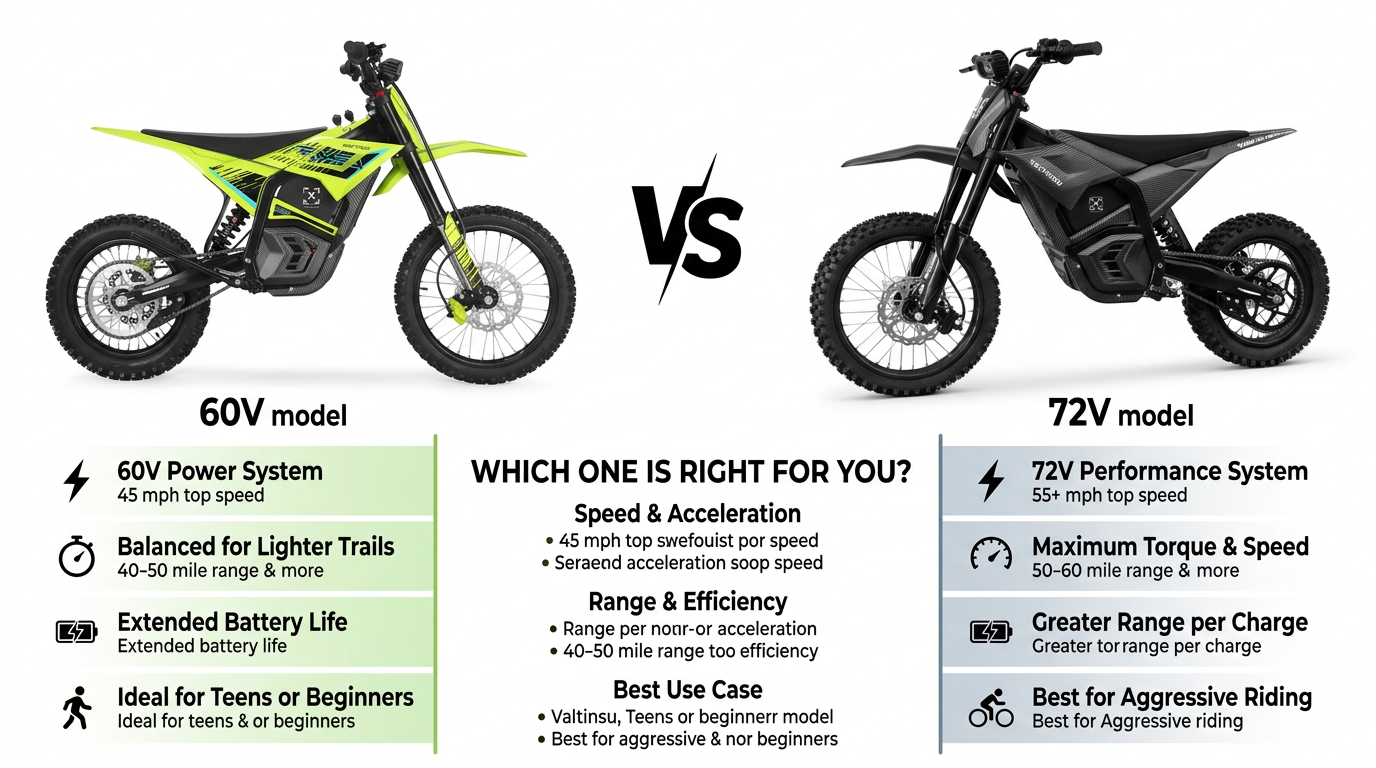
A 60V ebike offers strong torque and practical speed without the extra battery weight and cost of many 72V systems. Depending on the motor, controller, gearing, rider weight, and terrain, a performance-focused 60V ebike may reach about 35 to 52 mph on private land. Models such as the Valtinsu EM-5 Pro and EM-23 are rated at up to 43.5 mph.
Take the 60V performance trail bike for adults — the EM-5 Pro. It runs a 60V geared motor, a 27Ah pack, 177 lb-ft (240 N·m) of torque, and tops out at 43.5 mph. The EM-23 cruiser sits on the same 60V architecture and carries the most torque in the whole lineup. Both are adult or 16+ machines built for fire roads and singletrack. Neither belongs in a bike lane.

|
VALTINSU EM-5 Pro — 60V Adult Electric Off-Road Motorcycle 18+ adults only
60V geared motor | 4,800W peak | 177 lb-ft (240 N·m) torque | 43.5 mph | 60V 27Ah | IPX6 | Black or Volt Green
The value sweet spot — built for fire roads, singletrack, and steep grades. Hydraulic disc brakes front and rear.
|
|
Where 60V wins: Lighter, cheaper, and easier to find matching controllers for in the 3,000W–5,000W range. Where it gives a little back: it pulls more current at high power, so it runs warmer, and the top-speed ceiling sits just under what a 72V build can reach.
|
The 72V Ebike System: Higher Speed and Power
A 72V ebike is built for stronger acceleration, steep climbs, heavier loads, and higher-speed off-road riding. Depending on the motor, controller, gearing, and riding conditions, a 72V ebike may reach approximately [article ka existing speed range] on private land.
In the Valtinsu range, that's the EM-5 Ultra. A 72V geared motor making 7,000W peak, 203 lb-ft (275 N·m) of torque, a 56 mph top end, a 75-mile range, a Samsung pack, and — yes — a reverse gear. This is the bike for long desert loops, 45° climbs, and riders who plan on using every last watt. It ships August 8, 2026, with an early-bird pre-order at $1,999 against a $2,499 list price.

|
VALTINSU EM-5 Ultra — 72V Adult Electric Off-Road Motorcycle 18+ adults only
72V geared motor | 7,000W peak | 203 lb-ft (275 N·m) torque | 56 mph | 72V 25Ah Samsung | reverse gear | 75-mile range
Top-tier flagship for steep climbs and long loops. Pre-order — ships August 8, 2026. Early-bird $1,999 (regular $2,499).
|
|
The 72V trade-off is real. More cells in series means a heavier, pricier pack and a higher-spec controller, charger, and BMS. Fully charged, a 72V pack sits near 84V — enough to demand proper insulation, fusing, and a precharge or anti-spark connection. Great bones for a serious off-road machine. Overkill for a casual commute.
|
72V vs 60V Ebike: Head-to-Head
Here's how well-matched 60V and 72V systems usually stack up. Treat it as a direction of travel, not a guarantee — brands run different motors, capacities, controllers, wheels, and speed caps, and any of those can shift the numbers.
|
Feature
|
60V System
|
72V System
|
|
Typical role
|
Trail riding, 3,000W–5,000W
|
High-speed, off-road, 5,000W+
|
|
Top-speed potential
|
~35–52 mph
|
~45–56+ mph
|
|
Current at 3,000W
|
~50 amps
|
~41.7 amps (16.7% lower)
|
|
Heat under sustained load
|
Moderate
|
Lower
|
|
Voltage sag as pack drains
|
More noticeable
|
More headroom
|
|
Battery size & weight
|
Smaller, lighter
|
Larger, heavier
|
|
Component cost
|
Moderate to high
|
High
|
|
Build / setup complexity
|
Easier
|
More demanding
|
|
Valtinsu match
|
EM-5 Pro, EM-23
|
EM-5 Ultra
|
|
Best fit
|
Balanced performance
|
Maximum performance
|
One catch with the spec sheet: a watt rating is a power target, not the motor's actual speed behavior. Two bikes rated at the same wattage can top out at different speeds depending on motor winding, wheel size, and how the controller is programmed. When you can get it, compare motor RPM or kV — the headline watts only tell half the story.
Speed and Acceleration
Voltage buys you speed potential, not a fixed number. A 72V system tends to have more headroom when the motor, gearing, and controller are otherwise matched, and it holds acceleration at high power because it doesn't need as much current to get there. But don't write off 60V — a well-tuned 60V controller with strong phase current can launch just as hard off the line. Down low, traction usually decides more than voltage does. Dump too much current at the start and you'll just spin the rear tire instead of going anywhere.
How fast will a 60V ebike go?
Most high-power 60V ebikes settle between about 35 and 52 mph once they've got a motor and controller built for it. The Valtinsu EM-5 Pro and EM-23 both cap at 43.5 mph — plenty for fire roads and singletrack, where staying in control beats chasing a bigger number. A light custom build with tall gearing can push past that; a speed-limited model will fall short of it.
How fast will a 72V ebike go?
A 72V ebike usually lands around 45 to 56 mph with the right motor and controller — the EM-5 Ultra is built to hit 56 in its top mode. Take any quoted top speed with a grain of salt, though. It almost always assumes a light rider, a full battery, flat ground, and zero wind. Speed bleeds off as the pack drains, so trust a tested number under real conditions over whatever's on the brochure.
Range and Battery Capacity
Neither voltage wins range outright. What actually matters is watt-hours — and then how many watt-hours the bike burns per mile. Watt-hours are just nominal voltage × amp-hours, which is why a 60V 30Ah pack (1,800Wh) and a 72V 25Ah pack (1,800Wh) carry the exact same energy even though the labels look nothing alike.
Match the amp-hours and the 72V pack pulls ahead — roughly 20% more energy at 30Ah. That doesn't magically turn into 20% more distance, though. A heavier pack adds load, and a faster bike eats energy fighting the air. So that headroom becomes more range, more performance, or some blend of the two, and your throttle hand picks which. A 72V bike held wide open at 55 mph can run dry sooner than a 60V bike loafing along at 30. Slowing down is still the cheapest way to add miles.
On the Valtinsu side, the 60V EM-5 Pro is rated at 59 miles and the 72V EM-5 Ultra at 75 — a real gap that comes partly from the bigger energy store and partly from running lower current at a steady cruise.

Efficiency, Heat, and Voltage Sag
At equal power, 72V pulls fewer amps than 60V — about 16.7% fewer if you run the clean math. At 5,000W that's roughly 69 amps versus 83. Less current means less resistive heat in the wires, connectors, and cells, but only if the wire gauge, the connections, the cooling, and the controller are all up to it. Lean on a 72V controller for way more power and it'll run hotter, not cooler. Physics doesn't give freebies.
Then there's voltage sag, which is the half nobody mentions until they feel it. Battery voltage falls as you ride, and a hard pull causes a temporary dip; a tired pack can trip the controller or the BMS cutoff right when you're loading it. A 72V system starts with more headroom, so it tends to hold speed as the charge drops — it's that feeling on the third switchback of a long climb where a weaker pack starts to fade and this one just keeps going. Cell quality and pack resistance still set the limit, mind you. A cheap 72V pack can sag harder than a properly built 60V one.
Cost, Weight, and Build Complexity
A 72V build usually wants a higher-rated controller, charger, BMS, display, and connectors — which bumps the price and thins out your plug-and-play options. The pack weighs more too, since extra cells in series add up, and where that weight sits matters as much as how much there is. Mount it low and centered and the bike feels planted; hang it high or far back and it gets awkward in tight turns.
A 60V build isn't cheap once you use good cells and high-current parts, but the cost-to-performance balance is usually friendlier, and repairs tend to be easier because more mid-power components fit. On a factory bike like a Valtinsu this is already handled: the 60V EM-5 Pro is $1,699 and the 72V EM-5 Ultra $1,999 early-bird, with the electronics, BMS, and charger all matched at the factory. You're not standing in a garage cross-referencing controller specs at midnight.
Can You Run One Can You Run One Voltage on Another System? Controller and BMS Compatibility
Short version: not without checking every single part. The battery, controller, motor, charger, BMS, display, and wiring are one electrical system. Swap the voltage without confirming each link in that chain and you're looking at a dead component or, worse, a fire.
Take the question people ask most — can you run a 52V battery on a 72V motor? The motor might spin at 52V, but a 72V controller may refuse to wake up at all because of its low-voltage cutoff, so you'd need to check the controller's input range, current limit, and BMS rating first. Going the other way is the dangerous one: drop a 72V pack (up near 84V at full charge) onto 60V electronics and you can blow past the limits of the capacitors, transistors, display, and DC converter, and overspeed the motor while you're at it. A connector that clicks together doesn't mean the system is compatible. The safe route is a planned full-system upgrade — or a factory bike where the voltage already matches the motor and controller.
Safety and Legal Reality
These are off-road-only, OHV-class electric motorcycles, not street-legal e-bikes, and their motorcycle-level speed requires proper protective gear and responsible riding practices.Two things to sort before your first ride: the electrical side and the legal side.
On the electrical side, look for a complete system evaluated to a recognized standard, not just a claim about the cells — UL 2849 covers the whole drivetrain, battery, and charger together. The U.S. Consumer Product Safety Commission has pushed manufacturers to follow the applicable UL standards for battery-powered micromobility products. Use the right charger, keep your connectors dry, and stop using any pack that's swollen, cracked, or running hot.
On the legal side, the federal low-speed electric bicycle definition under 16 CFR Part 1512 calls for working pedals, a motor under 750W, and a motor-only top speed below 20 mph. Just about every 60V and 72V machine sails right past that — every Valtinsu included — which is exactly why they're sold as adult electric off-road motorcycles for off-road use only, not as street-legal e-bikes. For any on-road motorcycle use, the National Highway Traffic Safety Administration recommends a DOT helmet meeting FMVSS 218. Match your gear to the speed you'll actually ride, not to the fact that the thing has pedals.
|
Off-road, not street legal. Valtinsu electric dirt bikes are OHV-class machines for private property, OHV parks, and designated off-road areas. A quiet motor doesn't change that. Haul the bike to the trailhead — don't ride it there on public roads.
|
Which One Fits Your Riding?
Start with the basics: how fast, how far, what terrain, how much you weigh, your budget, and how hands-on you want to be. Then line it up against every Valtinsu off-road model. Most adult riders land on 60V. The ones who'll genuinely use every watt on a steep climb or a long desert loop are the ones who get their money's worth out of 72V.
|
You Are...
|
Pick
|
Why
|
|
A new or younger trail rider (13+)
|
48V EM-5
|
Manageable 3,840W, three ride modes, 40 mph cap. The only Valtinsu rated under 16.
|
|
An adult who wants the value sweet spot
|
60V EM-5 Pro (18+)
|
Real torque, 43.5 mph, lighter and cheaper than 72V. The bike most adults should buy.
|
|
A 16–17-year-old or comfort-first cruiser rider
|
60V EM-23 (16+)
|
Highest torque in the lineup, big-wheel stability, 43.5 mph.
|
|
A performance rider chasing climbs and long loops
|
72V EM-5 Ultra (18+)
|
7,000W, 56 mph, 75-mile range, reverse gear. The most headroom in the range.
|

|
Recommendation Block — Match the Voltage to the Rider
48V EM-5 (13+) → trail starter · 60V EM-5 Pro (18+) → value sweet spot · 60V EM-23 (16+) → cruiser · 72V EM-5 Ultra (18+) → flagship
Browse all four, compare specs side by side, and check stock and shipping on the collection page.
|
|
Age rule — no exceptions: EM-5 = 13+ | EM-23 = 16+ | EM-5 Pro & EM-5 Ultra = 18+ adults only. Shopping for a rider under 18? It's the EM-5 — or the EM-23 for a 16–17-year-old. The 60V Pro and 72V Ultra are adult machines, full stop.
|
Conclusion
A 60V ebike is the better choice for most adult riders who want strong speed, manageable weight, lower cost, and easier upkeep. It covers trail riding, weekend loops, and the bulk of real off-road use — which is exactly why the 60V EM-5 Pro and EM-23 anchor the Valtinsu range.
The 72V vs 60V ebike choice depends on your speed needs, terrain, rider weight, budget, and preferred rangs, and builds with room to grow. It makes the same power with less current, but the battery, motor, controller, charger, brakes, and wiring all have to support the higher voltage — on the Valtinsu EM-5 Ultra, they already do. Don't choose on voltage alone. Compare watt-hours, motor power, controller limits, weight, terrain, and the speed you can safely and legally use. Buy the system, not the sticker. For more trail guides and spec breakdowns, the VALTINSU rider blog is the place to keep digging.
FAQs
How fast will a 60V ebike go?
A high-power 60V ebike usually reaches about 35 to 52 mph. The Valtinsu EM-5 Pro and EM-23 both top out at 43.5 mph. Motor wattage, controller settings, gearing, rider weight, and battery charge all move the final number.
How fast will a 72V ebike go?
Many 72V ebikes reach about 45 to 56 mph, and the Valtinsu EM-5 Ultra is built to 56 mph in its top mode. Purpose-built machines can go faster, but they need stronger brakes, tires, and protective gear to match the speed.
Does a 72V battery make your bike faster?
It can raise motor RPM and top-speed potential, but only when the whole system supports it. Connecting a 72V pack to a 60V controller or display can damage the electronics. Voltage is potential — the controller and motor decide how much of it you actually use.
How fast is a 72V 3000W ebike in mph?
Roughly 40 to 55 mph, depending on motor winding, wheel size, gearing, and controller limit. A 3,000W rating sets a power target, not an exact speed, so two 72V 3,000W bikes can top out at different speeds.
How long does a 60V battery last on an ebike?
Per charge, it depends on amp-hours and how hard you ride. A 60V 30Ah pack stores about 1,800Wh; the 60V 27Ah pack on the EM-5 Pro is rated for a 59-mile range. High speeds, hills, and hard launches cut that quickly.
Can I run a 52V battery on a 72V motor?
The motor may spin at 52V, but a 72V controller may not start because of its low-voltage cutoff. Check the controller's input range, current limit, and BMS rating before connecting anything — a matching plug doesn't mean the parts are compatible.
Do any ebikes go 60 mph?
Yes, some high-power machines reach 60 mph or more. At that speed they fall outside the U.S. federal low-speed e-bike definition and are usually regulated as mopeds or motorcycles. Valtinsu bikes are off-road OHVs — not street legal.
Is a 72V system worth the extra cost over 60V?
Only if you'll use the extra power — steep climbs, heavy loads, long high-speed loops, or future upgrades. For trail riding and most adult off-road use, a 60V bike like the EM-5 Pro gives more performance per dollar with less weight.
Sources
-
U.S. Consumer Product Safety Commission, “Safety Standards for Battery-Powered Products.”
-
UL Solutions, “E-Bike Certification and Testing to UL 2849.”
-
National Highway Traffic Safety Administration, “Choose the Right Motorcycle Helmet.”
-
Electronic Code of Federal Regulations, “16 CFR Part 1512: Requirements for Bicycles.”
-
Valtinsu, “Electric Dirt Bike Collection.”
-
Valtinsu, “EM-5 Pro Electric Dirt Bike.”


Looking for something else?
Electric Dirt Bike Replacement Parts Availability: What Buyers Should Verify Before Ordering
LEARN MORE
How to Check an Electric Dirt Bike for Safety Recalls by Model and Serial Number
LEARN MORE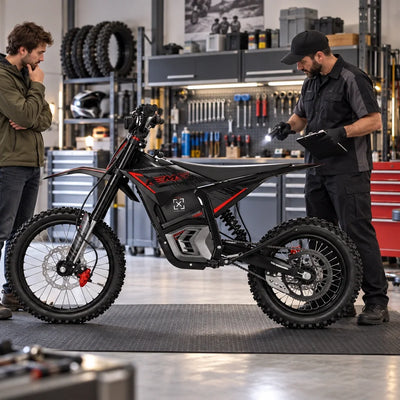
How to Choose an Electric Dirt Bike Repair Shop: Questions to Ask Before Service
LEARN MORE
How to Lift a Fallen Electric Dirt Bike Without Hurting Yourself or the Bike
LEARN MORELooking for something else?
Electric Dirt Bike Fall Riding on Wet Leaves: Grip, Hidden Obstacles and Braking
LEARN MORE
Electric Dirt Bike Trailside Power Loss: Recovery Plan When the Battery Is Dead
LEARN MORE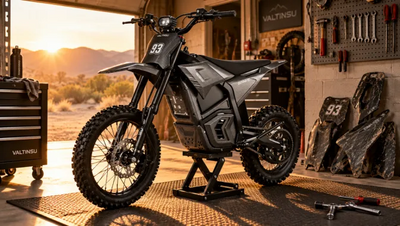
Electric Dirt Bike Plastics Replacement Guide: Fitment, Color Kits and Install Order
LEARN MOREYou may also like
Moto eléctrica todoterreno para adultos EM-5 con luz
$969.00
$1,559.00
VALTINSU EM-5 Pro Off-Road Black Electric Dirt Bike
$1,699.00
$1,899.00
VALTINSU EM-5 Pro Green Electric Dirt Bike
$1,699.00
$1,899.00
VALTINSU EM-5 Ultra Electric Dirt Bike
$2,199.00
$2,499.00
VALTINSU EM-5 & EM-5 Pro Combo
$2,658.00
$3,458.00