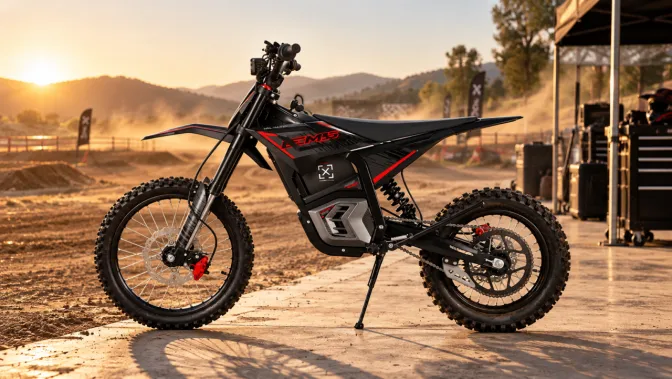
Electric Supermoto Conversion: Wheels, Street Tires and Handling Changes on an Electric Dirt Bike
The first thing everyone does is shop for wheels. A set of 17s with sticky street rubber is the whole look of a supermoto. But if you've ever ridden a converted bike that wasn't sorted properly, you know the wheels are only about half the story. The brakes, the suspension and the gearing all need attention afterwards, and that's what decides whether an electric supermoto conversion feels great or just twitchy.
We put this together for people who already own an adult electric off-road motorcycle and want to ride it on a kart track, a closed course or some private pavement. The EM-5 Pro comes up in these conversations a lot. One honest point before anything else: swapping wheels changes how the bike rides, not whether it's legal on the street.
What an Electric Supermoto Conversion Changes

More than you'd think. A 19 or 21-inch front becomes a 17, the knobbies go in the shed, and the first hard stop on asphalt will surprise you. That grip lands on parts that were set up for dirt, which is where most of the follow-up work comes from.
Why 17-Inch Wheels Became the Standard
Walk the rack at any tire shop and nearly every sport and supermoto tire on it is a 17, so that's the size that gives you choices. Fit is a separate question, and it comes down to the hub, the axle and where your brake rotor ends up.
How Street Tires Change Grip
Put a knobby on asphalt and you can feel it wriggle, because every block bends on its own. Road rubber sits flat. You brake later and lean further before anything slides, and all that extra force goes into the brakes, bearings and frame instead.
Fitment Checks Before You Order Wheels

Most conversions that go wrong are fitment problems, not tire problems. So before you click buy, pull the stock wheels and get the calipers out. Note the axle diameter and bearing bore at both ends, the space between the fork legs and the swingarm faces, and where each spacer lives (a phone photo helps). Check the rotor's spot inside the caliper and whether the rear sprocket lines up with the front. Get one wrong and the bike tells you fast, with a wheel that won't seat, dragging pads or a chain chewing its sprockets. And don't forget the speed sensor magnet, or the dash will show nonsense.
Stark Varg owners went through all of this in public. In a long supermoto thread on the Electric Dirt Riders forum, they worked out that KTM wheels do fit the Varg, but only with different spacers, and even then they sat about 2.5 mm off center. One rider bought a four-piston caliper and only then found his stock front master cylinder was too small to drive it.
|
Tip: tighten the axle, give each wheel a spin with your hand and just listen. Then hold a straightedge along the sprockets. Your eye will lie to you about chain line. |
Choosing Street Tires

Street vs Track Compounds
Street tires, unless you live at the track. You get grip on a cold morning, grip on a hot afternoon and grooves for when it rains on the ride home. Track rubber is stickier once it's hot, but a 20-minute session may never get it there, and electric torque will find the edge of a cold rear tire in a hurry.
Width and Chain Clearance
Going wider doesn't automatically help. On a Light Bee, the folks at Charged Cycle Works put the limit at 90/80-17 up front and 100/80-17 out back. Got a rub anyway? Measure the tire on the rim before swapping spacers, since the sidewall number isn't always the real width.
How 17-Inch Wheels Change Handling
Faster Turn-In
With a smaller front wheel the front end sits lower, the steering gets steeper and trail drops. You'll notice it the first time you tip into a corner, because it takes much less effort. On a tight kart track that's lovely. At higher speed it can feel a bit twitchy.
Lower Ground Clearance
Everything also sits closer to the ground, so pegs, stands and skid plates scrape sooner when you lean. More grip, less room to use it.
Suspension and Brakes for Pavement

Dirt suspension is soft on purpose, because it has to soak up roots, rocks and landings. On grippy asphalt, though, that softness mostly turns into brake dive.
Brake Dive and Sag
Every time the fork dives, the steering gets steeper, and when you let off the brake the front comes back up. We'd start with sag, since new wheels change ride height while preload stays where it was, then add compression damping a click or two at a time. The model-specific setup figures in the user manual are a better starting point than any one number we could give you.
Front Brake Upgrades
On the road your front brake does most of the work, because the bike's weight shifts forward as you slow down. A lot of full-size conversions end up with a 320 mm front rotor on a relocation bracket, the same size Stark uses on its factory supermoto. Braided lines give a firmer lever but they don't help with heat.
Gearing, Top Speed and Speedometer Error
The Rolling Diameter Math
Wheel size works like part of the final drive. If the tire's overall diameter goes from 26 inches to 23.5, you lose about 10% of road speed at the same motor RPM and gain about 10% more pull at the wheel. Riders on electric dirt bike forums sum it up simply: 17s cut top speed. One Varg owner says he runs a 15/45 sprocket combo whenever the supermoto wheels go on.
Sprockets can give some of it back. Go up a tooth at the front or down a few at the rear and the gearing gets taller again, as long as the chain adjusters have room left. Your speedometer will probably read high after the swap as well, so check it against GPS.
The 17/14 Platform Case

Some bikes are already partway there. The EM-5 Pro is a 60V electric dirt bike with a 17-inch front wheel, but its rear wheel is a 14. That smaller rear is one reason the 177 lb-ft geared motor launches so hard. Fit a 17 at the back and you get the opposite of a normal conversion: taller gearing, softer starts and a controller working harder.
Valtinsu doesn't offer a supermoto wheel kit for it, so this would be a custom job. Read the warranty policy first, because it doesn't cover unauthorized modifications or non-Valtinsu parts.
|
Editorial note: We'll be straight with you: the EM-5 Pro is designed and sold for off-road riding by adults 18 and up. If you'll spend most of your time on pavement, a factory road-certified supermoto makes more sense. |
Electric Power Delivery on Street Tires
Street tires grip hard, so the torque that used to spin the rear wheel on dirt now pulls on the chain, sprockets and hub instead. Check those more often.
If your controller has an adjustable throttle map, soften the first part of it. Turn regen up gradually, too. Long stretches at road speed heat the motor and battery more than trail riding does, and if thermal protection cuts in, figure out the cause rather than turning it off.
What an Electric Supermoto Conversion Costs
What's in the box moves the price far more than the brand does. Sur-Ron's own Light Bee kit lists at $699.99 CAD and comes ready to bolt on, with street tires, tubes, 203 mm discs, a 42-tooth sprocket and a chain. It only fits 2025 and earlier bikes.
The Warp 9 17-inch set is $799, and that's bare wheels. Rotors, a sprocket and mounted tires cost extra, and the build takes two to four weeks. Brakes, suspension and shop labor come on top.
Street Legality After the Swap
No, not on its own. NHTSA dealt with exactly this in a published interpretation from 2000. Once someone converts an off-road motorcycle for road use, it has to meet, and be certified to, every federal safety standard for motorcycles.
Registration is up to each state, so where you live matters. Valtinsu sells every bike in its lineup for off-road use only.
|
Warning: a DOT mark on a tire or light only covers that one part. It doesn't certify the bike. |
Conversion or Factory Electric Supermoto
If you already own a bike that suits it and your riding happens on kart tracks or private pavement, converting is the cheaper route. If public roads are the plan, a factory bike saves you the fitment work and the paperwork. The Stark VARG SM puts out up to 80 hp, weighs 274 lb, has a 7.2 kWh battery and is homologated for US roads. Stark sells it for $13,040.
Conclusion
If you remember one thing, make it this: it's a whole-bike job, not a wheel swap. Fitment first. After that come tires, sag, damping and brakes, plus a few calm rides before you start pushing. Keep the dirt wheels in the garage if trails are still on the menu, and get the registration question answered before the bike sees a public road.
Still choosing a bike? Compare wheel sizes across the electric dirt bike lineup before you buy parts.
FAQs
What is the best electric supermoto?
Stark's VARG SM, if you want one built at the factory. Up to 80 hp and 274 lb, and it's homologated for US roads out of the box. Converting a Sur-Ron or Talaria is far cheaper, but sorting out fitment and registration is then down to you.
How fast does a 3000W 72V conversion kit go?
Think 50 to 62 mph. That's the 80 to 100 km/h retailers list for a QS138 3000W mid-drive running 72V. Where you end up depends on gearing, and dropping to 17-inch wheels usually knocks a bit off.
How much does it cost to turn a dirt bike into a supermoto?
It starts at a few hundred dollars on e-moto platforms. Sur-Ron's own Light Bee kit is $699.99 CAD complete, while a bare Warp 9 17-inch set is $799.
Is there a kit that can convert a gas dirt bike to electric?
Yes, there are plenty. A QS138 motor paired with an EM-150 controller is a common choice for dirt bike frames. Most of the real work is the battery pack, the mounts, wiring, fusing and getting the chain to line up.
Can electric motorcycles go on the highway?
They can, once they're certified and registered for road use. Converted off-road bikes are where it gets complicated: NHTSA wants them to meet, and be certified to, every safety standard that applies, and the state still decides on registration.
What are the drawbacks of electric motorcycles for supermoto riding?
Range and heat are the big two. Stark quotes 73 miles of mixed urban riding for the VARG SM but just 49 on the highway. Charging isn't quick either; an EM-5 Pro takes 7 to 8 hours.
Does a supermoto conversion make an electric dirt bike street legal?
No. Street tires, lights and mirrors don't certify a bike on their own, so call your DMV with the VIN before you spend money on road equipment.
Can the Valtinsu EM-5 Pro be converted to a supermoto?
Not with a factory kit. It already runs a 17-inch front and a 14-inch rear, so putting a 17 on the back is custom work, and it makes the gearing taller. Keep in mind it's rated 18+ and sold for off-road use only.


Looking for something else?
Electric Dirt Bike Error Codes: What They Mean and What to Check First
LEARN MORE
Electric Dirt Bike Brake Rotor Rubbing: Diagnose the Cause Before Adjusting
LEARN MORE
How to Bed In Electric Dirt Bike Brakes for Consistent Stopping Power
LEARN MORE
7 Signs Your Electric Dirt Bike Brake Pads Need Replacement
LEARN MORELooking for something else?
How to Prevent Electric Dirt Bike Flat Tires
LEARN MORE
Electric Dirt Bike Brake Squeal: Causes and Safe Fixes
LEARN MORE