Brushless Motor vs Brushed Motor: Why It Matters for Off-Road Performance
If you've spent any time shopping for electric dirt bikes, you've seen the term "brushless motor" repeated across every serious product listing. It's treated as a selling point — sometimes the first technical specification a brand leads with. But most listings don't explain what it actually means, why it matters, or what the alternative looks like in practice.
The brushless versus brushed distinction is not marketing language. It describes a fundamental difference in how the motor works — a difference that has direct consequences for power output, heat management, maintenance requirements, longevity, and real-world off-road performance. Understanding it helps you evaluate whether a bike's motor is genuinely suited to hard use, or whether it's a component that will become a liability after the first season.
At Valtinsusport.com, all three adult electric dirt bike models use brushless motors. Here's exactly what that means, why it matters, and how to use this knowledge when comparing bikes.

Table of Contents
- How a Brushed Motor Works
- How a Brushless Motor Works
- The Key Differences Side by Side
- Heat, Efficiency, and What They Mean for Riding
- Maintenance: Why Brushed Motors Wear Out
- Power Density: Why Brushless Motors Do More with Less
- What Off-Road Riding Specifically Demands from a Motor
- Mid-Drive vs Hub Motor: The Other Motor Decision
- Brushless Motor Specs on Valtinsu Electric Dirt Bikes
- What to Look for in a Motor Spec Sheet
- Frequently Asked Questions
How a Brushed Motor Works
To understand why brushless motors are superior for high-demand applications, it helps to understand the problem they were designed to solve.
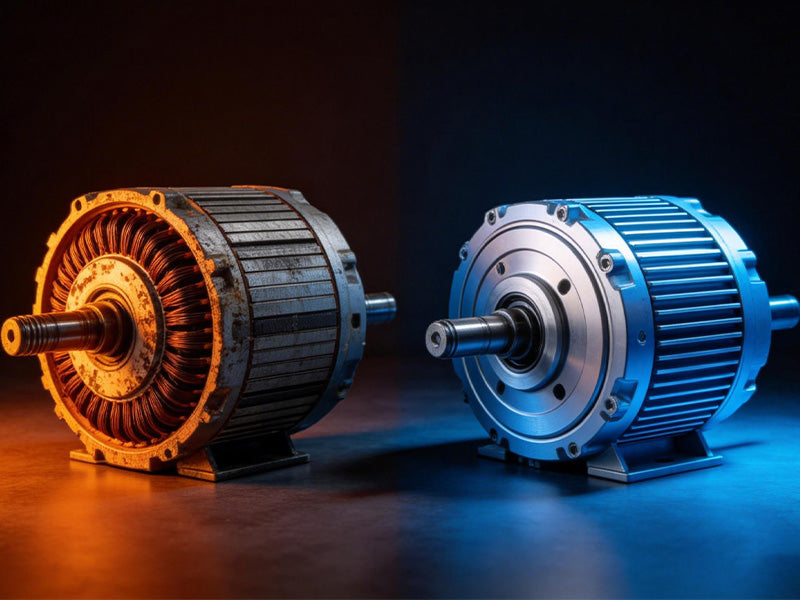
A brushed DC motor generates rotation through a straightforward electromagnetic principle. Inside the motor, there are two main components: a stationary outer housing with permanent magnets (the stator), and a rotating inner assembly of copper windings (the rotor or armature). When electrical current flows through the copper windings, it creates a magnetic field that interacts with the permanent magnets — that interaction produces rotational force.
The challenge is getting electrical current into a rotating component. You can't connect fixed wires to something that spins continuously. Brushed motors solve this with a mechanical contact system: two carbon or graphite blocks called brushes press against a rotating ring called a commutator, which is attached to the rotor shaft. As the rotor turns, the brushes maintain electrical contact by sliding along the commutator surface, switching current direction through the windings at the right moment to sustain continuous rotation.
This system works — brushed motors powered industrial machinery, early electric vehicles, and consumer devices for over a century. But the physical contact between brushes and commutator creates a set of fundamental limitations:
- Friction between brushes and commutator generates heat continuously during operation
- The brushes wear down over time and require periodic replacement
- The commutator surface wears and eventually requires resurfacing or replacement
- Electrical arcing at the brush-commutator contact generates electromagnetic interference
- The friction loss reduces efficiency — energy that could go to the wheel goes to heat instead
- Maximum rotation speed is limited by the mechanical constraints of the brush contact system
For a light-duty application with modest power demands and infrequent use, these limitations are manageable. For a motor being asked to deliver sustained high current under variable load conditions — which is exactly what off-road riding demands — they become significant engineering constraints.
How a Brushless Motor Works
A brushless motor achieves the same electromagnetic rotation principle — current through windings creating a magnetic field interacting with permanent magnets — but inverts the architecture to eliminate the brush-commutator contact system entirely.
In a brushless motor, the permanent magnets are on the rotor (the spinning part), and the copper windings are on the stator (the stationary part). Because the windings don't move, they can be connected directly to fixed electrical terminals — no sliding contact required. The current switching that was handled mechanically by the brushes in a brushed motor is handled electronically by the motor controller, which monitors rotor position through sensors and precisely sequences current through the stator windings to sustain rotation.
This architectural shift — windings on the outside, magnets on the inside, electronic commutation replacing mechanical brushes — solves each of the limitations of brushed motors:
- No brush-commutator contact means no friction wear on the commutation system
- No friction wear means no brush replacement maintenance
- No contact arcing means no electromagnetic interference from the commutation process
- Reduced friction means higher efficiency — more of the input energy reaches the wheel
- Without mechanical contact constraints, higher rotation speeds and power densities become achievable
- Heat is generated primarily in the stationary windings, which are easier to manage thermally than rotating components
The trade-off is complexity: the motor controller handling electronic commutation is a more sophisticated piece of electronics than the simple on/off switch that drives a brushed motor. This was historically a cost and reliability concern. In modern electric vehicles and power tools, brushless motor controllers are robust, well-characterized components — the complexity has been engineered to be reliable rather than fragile.
The Key Differences Side by Side
| Characteristic | Brushed Motor | Brushless Motor |
|---|---|---|
| Commutation method | Mechanical (carbon brushes on commutator) | Electronic (controller sequences winding current) |
| Efficiency | 75–80% typical | 85–95% typical |
| Maintenance | Brushes wear and require replacement every 50–200 hours | No wear parts in motor — bearing service only |
| Heat generation | Higher — friction at brush-commutator contact | Lower — no friction contact losses |
| Power-to-weight ratio | Lower — bulkier for equivalent output | Higher — more power from smaller, lighter package |
| Noise | More — brush contact creates audible friction | Less — only bearing and wind noise |
| Top speed potential | Limited by mechanical commutation constraints | Higher — no mechanical speed ceiling |
| Lifespan | Shorter — brush and commutator wear limits service life | Longer — no wear parts, bearing life typically 10,000+ hours |
| Cost (motor only) | Lower | Higher (offset by lower maintenance costs over time) |
| Controller complexity | Simple — basic current switching | Complex — electronic commutation with position sensing |
| Suitable for sustained high load | Limited — heat buildup under continuous high demand | Yes — designed for sustained high-current operation |
Heat, Efficiency, and What They Mean for Riding
Efficiency figures — 75–80% for brushed versus 85–95% for brushless — may look like small differences, but their consequences for a motor running under off-road load conditions are significant.
An electric motor converts electrical energy (from the battery) into mechanical energy (rotation). The energy that doesn't become mechanical output becomes heat. At 75% efficiency, 25% of the battery's energy is converted to heat inside the motor. At 90% efficiency, only 10% becomes heat — a 60% reduction in heat generation for the same power output.
Heat is the primary limiting factor for motor performance and longevity. When a motor overheats, several things happen: efficiency drops further, output torque decreases, the risk of winding insulation failure increases, and modern motor controllers typically implement thermal protection that reduces power output to protect the motor — exactly the moment on a demanding climb or in technical terrain when you most need full power.
For off-road riding, the heat implications are concrete:
Sustained climbing. A long, steep climb is one of the most thermally demanding things you can ask of an electric motor — high current, low motor RPM (which reduces self-cooling from the motor's internal airflow), sustained duration. A brushed motor's higher heat generation under these conditions accelerates brush wear, risks thermal limiting, and in severe cases can cause premature failure. A brushless motor's lower heat generation under the same conditions keeps thermal margins wider and sustains full output longer.
Technical terrain with repeated stop-start cycles. Each full-torque launch from a standstill demands a current spike through the motor. Repeated current spikes generate heat. Brushless motors manage these spikes more efficiently — less heat per spike means more margin for sustained technical riding without thermal issues.
Battery range. The efficiency difference has a direct effect on how far a battery takes you. A brushed motor converting 25% of battery energy to heat versus a brushless motor converting 10% means the brushless system extracts more riding distance from the same battery capacity. On a pack with a fixed watt-hour rating, efficiency is one of several factors determining real-world range — and brushless motors contribute meaningfully to range advantage over equivalent brushed designs.
Maintenance: Why Brushed Motors Wear Out
The maintenance implications of the brush-commutator system deserve specific attention because they directly affect the total cost of ownership and the reliability of a bike in the field.
Carbon brushes in a brushed motor are consumable components. They wear down through physical contact with the commutator at operating speeds, typically requiring inspection every 50–100 operating hours and replacement when worn beyond service limits. In a demanding application like off-road riding — high current draws, variable loads, vibration from terrain — brush wear accelerates relative to light-duty applications.
When brushes wear unevenly or are not replaced in time, contact quality degrades. Poor contact increases electrical resistance at the commutation point, which increases heat generation further and reduces motor efficiency. In advanced wear, brush fragments can contaminate the motor interior. Commutator surfaces develop grooves from worn brushes, eventually requiring resurfacing or replacement of the commutator assembly — a more complex and expensive repair.
A brushless motor has no brushes and no commutator. The only wear components in the motor itself are the bearings — standard sealed bearings that require no regular maintenance and have service lives measured in thousands of hours under normal operating conditions. There is no scheduled motor maintenance interval for a brushless system beyond what the manufacturer specifies for bearings.
For electric dirt bike owners, the practical difference is this: a brushless motor requires no motor-specific maintenance for the life of the bike under normal use. A brushed motor requires periodic brush inspection and replacement — and the frequency and cost of that maintenance increases with the intensity of use.
The Valtinsu EM-5, EM-5 Pro, and EM23 all use brushless motors, and none of them list motor brush replacement in their maintenance schedules. The chain drive requires periodic lubrication and tension adjustment; the brakes require pad inspection; the battery requires correct charging habits. The motor itself is maintenance-free.
Power Density: Why Brushless Motors Do More with Less
Power density — the amount of power output per kilogram of motor weight, or per unit of motor volume — is a key engineering metric for any application where weight and size matter. Off-road dirt bikes care about both.
Brushless motors achieve significantly higher power density than brushed motors of equivalent output because they don't need the physical mass of the brush and commutator system, and because their higher efficiency allows them to produce more output from a given motor volume without the same thermal constraints that force brushed motors to be physically larger for thermal headroom.
The SH-grade magnets used in the Valtinsu EM-5's brushless motor are a specific example of power density optimization. Magnet grade affects the strength of the magnetic field produced per unit of magnet mass — higher-grade magnets produce stronger fields from smaller, lighter magnets. SH-grade neodymium magnets are rated for higher operating temperatures than standard neodymium grades (150°C versus 80°C for standard N-grade), which means the motor can sustain high output in hot operating conditions without the magnets losing their magnetic properties — a failure mode called demagnetization that permanently degrades motor performance.
For riders: a brushless motor with quality magnets delivers more torque and power from a lighter, more compact package than a brushed motor at equivalent output specifications. In a machine where unsprung weight, center of gravity, and total bike weight all affect handling, the power density advantage of brushless technology translates into better riding dynamics — not just better motor specifications on paper.
What Off-Road Riding Specifically Demands from a Motor
A motor that performs adequately in a controlled test environment may be a poor match for the specific demands of off-road use. Understanding what trails actually ask of a motor clarifies why the brushless advantage matters in this context more than in others.
Variable and unpredictable load. On a flat road, a motor runs at relatively steady current draw. On off-road terrain, the load changes continuously — loose surfaces increase resistance, hard-packed surfaces reduce it, obstacles require sudden torque bursts, descents allow the motor to recover. This variability creates repeated current spikes and drops that stress the commutation system in brushed motors through repeated thermal cycling. Brushless motors handle variable load more gracefully through electronic commutation.
Vibration. Off-road terrain transmits significant vibration through the frame to every component on the bike, including the motor. The mechanical brush-commutator contact system in a brushed motor is vibration-sensitive — vibration can cause brush bounce, intermittent contact, and accelerated commutator wear. Brushless motors have no mechanical contact to disrupt — the electronic commutation is unaffected by physical vibration.
Sustained high-current demand on climbs. As discussed in the heat section — the thermal demands of sustained climbing are among the most severe a motor faces. This is where brushed motors are most likely to thermal-limit and most likely to accelerate wear. Brushless motors' efficiency advantage is most pronounced precisely in this high-demand scenario.
Exposure to moisture and debris. Off-road riding involves mud, water crossings, rain, and fine particulate debris. Brushed motors are more vulnerable to moisture and dust ingress at the brush-commutator interface — moisture affects contact quality and accelerates corrosion; fine debris contaminates the contact surfaces. Brushless motors' sealed stator windings are inherently more resistant to environmental ingress at the commutation point. This is one reason why high-IP-rated electric dirt bikes consistently use brushless motors — the architecture lends itself to better environmental sealing.
Repeated full-power starts. Every time you launch from a standstill with full throttle, the motor draws peak current. Recreational off-road riding involves many such starts — top of a climb, clearing an obstacle, restarting after a stop on a technical section. Each full-power start is more demanding on a brushed motor's commutation system than sustained operation at constant speed.
Mid-Drive vs Hub Motor: The Other Motor Decision
Beyond brushed versus brushless, the other significant motor architecture decision for electric dirt bikes is placement: mid-drive versus hub motor. Both can be brushless. The distinction matters for off-road performance in different ways.
Hub motors are integrated directly into the wheel hub — typically the rear wheel. The motor is the wheel's axle. This simplifies drivetrain design (no chain drive from motor to wheel) and reduces mechanical losses between motor and ground contact. Hub motors are common in electric bicycles and entry-level electric motorcycles.
For off-road use, hub motors have meaningful limitations. Their mass is unsprung weight — weight that moves with the wheel over terrain rather than being isolated by the suspension. High unsprung weight degrades suspension response and handling on rough terrain. Hub motors also cannot use the bike's gear reduction — the motor directly drives the wheel at its own RPM, which means the motor must be designed to produce useful torque across the entire speed range without gearing assistance. And hub motors are difficult to service or replace without wheel disassembly.
Mid-drive motors are mounted centrally in the frame and drive the rear wheel through a gearbox and chain — the same configuration as a gas dirt bike's engine and transmission. This placement keeps motor mass as low and central in the frame as possible, improving the bike's handling characteristics. More importantly, the gearbox allows significant torque multiplication between motor and rear wheel — which is how the Valtinsu EM-5's motor shaft torque of a relatively modest figure becomes 193 Nm at the rear axle.
All three Valtinsu adult electric dirt bikes use brushless mid-drive motors. This combination — brushless efficiency and longevity, plus mid-drive gearing and mass centralization — is the configuration used in serious off-road electric motorcycles across the price spectrum, from recreational machines to competition-grade builds.
Brushless Motor Specs on Valtinsu Electric Dirt Bikes
Valtinsu EM-5 — $1,299
48V 2,600W brushless mid-drive | SH-grade magnets | 70A controller | 193 Nm rear axle torque | 40° climb | 40 mph | IPX6
The EM-5's brushless motor specification leads with its magnet grade — SH-grade neodymium, rated to 150°C operating temperature versus the 80°C of standard neodymium grades. This thermal rating directly addresses the primary failure mode of motors under sustained off-road load: magnet demagnetization when operating temperatures exceed the magnet's rated limit. SH-grade magnets give the EM-5's motor significant thermal headroom on demanding climbs and sustained high-current operation.
The 70A controller is a high current specification that ensures the motor can draw the current needed for peak torque without the controller becoming the limiting factor. Many budget electric dirt bikes use controllers rated at 40–50A — adequate for light use, but current-limited exactly when terrain demands peak output. The 70A controller in the EM-5 matches the motor's torque potential with sufficient current capacity to sustain it.
Result: 193 Nm at the rear axle, 40° maximum climbing angle, and a motor designed to sustain performance under real off-road thermal loads.
Valtinsu EM-5 Pro — $1,699
60V / 4,800W peak / 2,500W rated brushless | High-current controller | 51 mph | IP65 | 30° climb
The EM-5 Pro's brushless motor operates on a 60V system — higher voltage than the EM-5's 48V. Higher voltage enables higher power output from the motor (power = voltage × current) while maintaining the same or lower current draw, which reduces resistive losses in the wiring and controller. The result is a motor optimized for higher sustained speed — 51 mph top end — rather than maximum torque multiplication at low speed.
The IP65 environmental protection rating is significant in the context of brushless motor durability. IP65 means fully dust-tight and protected against sustained water jets — the most demanding environmental standard in the Valtinsu lineup. Achieving this rating requires sealed motor construction that the brushless architecture enables: no brush access ports, no commutator ventilation requirements, just sealed windings and protected bearings.
Valtinsu EM23 — $1,999
60V 2,500W rated / 4,000W peak brushless mid-drive | 60V/80A 18-tube controller | 8.4 Nm motor shaft → 19.7 Nm intermediate → 71.9 Nm rear axle | 30° climb | 43.5 mph
The EM23 provides the most complete motor specification disclosure in the lineup — publishing the full torque chain from motor shaft through gearbox to rear axle, along with the 80A controller rating. The 18-tube controller designation refers to the number of MOSFET transistor tubes managing current switching in the controller — a higher tube count means the current is distributed across more switching elements, reducing heat per element and improving controller reliability and sustained current capacity under high-load conditions.
The brushless motor's torque chain transparency — 8.4 Nm at motor shaft, multiplied through gearing to 71.9 Nm at the rear axle — is a textbook illustration of how mid-drive brushless architecture delivers real-world performance: the motor produces modest shaft torque at high efficiency, and the drivetrain multiplies it into the wheel force that actually moves the bike.
What to Look for in a Motor Spec Sheet
When evaluating any electric dirt bike's motor specification, here are the questions that separate informative listings from vague ones:
Brushless or brushed? This should be the first filter. For adult off-road use, brushed motors are a compromise. Any serious adult electric dirt bike listing should specify brushless explicitly. If a listing doesn't specify, treat it as brushed until confirmed otherwise.
Mid-drive or hub motor? For off-road performance, mid-drive is the better architecture. Hub motors simplify construction and reduce cost but compromise handling through unsprung weight and cannot leverage gearing for torque multiplication.
Continuous vs peak wattage? Peak wattage figures can be 2× or more the continuous (sustained) figure. The continuous rating is the honest measure of what the motor can sustain. If only a single wattage figure is published without qualification, ask whether it's continuous or peak.
Controller amperage? The controller's current capacity determines whether the motor can actually draw what it needs for peak torque. A 3,000W motor rated at 60V requires 50A of controller current at full output. A 40A controller will current-limit the motor below its rated output. Match controller amperage to motor requirements.
Magnet grade? SH, UH, or EH grade neodymium magnets indicate high-temperature capability — relevant for sustained hard use. Standard N-grade magnets are adequate for light use but may demagnetize under sustained thermal load in demanding off-road applications.
Rear axle torque and climb angle? These are the practical outputs of the entire motor and drivetrain system. If a listing provides only motor shaft torque, the real-world climbing performance is unknown without the gearbox ratio. Rear axle torque and maximum climb angle translate the specs into terrain capability.
Warranty coverage? Motor warranty length reflects manufacturer confidence in the design. The Valtinsu lineup offers a 2-year motor and controller warranty — meaningful coverage for components that could otherwise represent significant replacement cost.
Frequently Asked Questions
Can you replace a brushless motor if it fails?
Yes. Brushless motors are replaceable components, though the process varies by bike design. Mid-drive brushless motors are typically more accessible for replacement than hub motors, which require wheel disassembly. In practice, brushless motors in quality electric dirt bikes rarely fail under normal use — the sealed bearing life is long and there are no wear parts to replace. Warranty coverage (2 years on Valtinsu motor and controller) covers failure within the warranty period.
Are all electric dirt bikes now brushless?
Not all, but most serious adult machines are. Entry-level and children's electric bikes sometimes use brushed motors to reduce cost. Budget adult bikes in the under-$500 category may use brushed hub motors. In the $1,000+ adult category, brushless mid-drive is the standard for any brand that prioritizes performance and longevity over minimum purchase price.
Do brushless motors require any maintenance at all?
No motor-specific maintenance beyond bearing service, which is typically only needed after thousands of operating hours. The practical maintenance items on an electric dirt bike with a brushless motor are chain lubrication and tension, brake pad inspection, tire pressure, and battery care — not motor service.
Does a higher wattage brushless motor always outperform a lower wattage one?
Not necessarily in all performance dimensions. Motor wattage determines power output and top speed potential, but torque depends on motor design and gearing. A lower-wattage motor with higher gear reduction can deliver more rear axle torque — and therefore better climbing and low-speed performance — than a higher-wattage motor with different gearing. The Valtinsu EM-5 at 2,600W produces 193 Nm rear axle torque; the EM23 at 2,500W rated produces 71.9 Nm — different gearing priorities produce different torque outputs from similar rated power.
What causes a brushless motor to fail?
The most common failure modes for brushless motors are bearing failure (after extended use), winding insulation damage from sustained overheating beyond the motor's thermal limits, and controller failure (a separate component from the motor itself). Quality brushless motors with appropriate thermal ratings — like the SH-grade magnet motor in the EM-5, rated to 150°C — have wide thermal margins that make overheating failure unlikely under recreational riding conditions. Bearing failure after normal service life is the more typical end-of-life scenario.
Is the brushless motor the same as a BLDC motor?
Yes. BLDC stands for Brushless Direct Current — the full technical name for the motor type described throughout this article. You may see the terms used interchangeably in motor specifications. Both refer to the same architecture: permanent magnets on the rotor, windings on the stator, electronic commutation via controller.
How does motor type affect waterproofing ratings?
Brushless motors are more compatible with high waterproofing ratings because they don't require brush access ports or commutator ventilation openings that would create sealing challenges. The Valtinsu EM-5 Pro achieves IP65 — fully dust-tight and protected against sustained water jets — in part because the brushless motor architecture allows the motor housing to be fully sealed. Achieving equivalent environmental ratings with a brushed motor design would be significantly more difficult.
The Bottom Line
Brushless motor technology is not a premium upgrade on serious adult electric dirt bikes — it is the baseline requirement for a motor that can handle the thermal demands, variable loads, vibration, and environmental exposure of real off-road use without becoming a maintenance liability or a performance bottleneck.
When evaluating electric dirt bikes, treat "brushless mid-drive" as a minimum specification for adult off-road use, and use the deeper specifications — magnet grade, controller amperage, rear axle torque, and warranty coverage — to distinguish quality designs from budget builds that meet the brushless label but compromise on the details that determine long-term performance.
The Valtinsu lineup publishes the specifications that let you make this evaluation:
- Valtinsu EM-5 — $1,299 — 48V 2,600W brushless mid-drive · SH-grade magnets · 70A controller · 193 Nm · 40° climb · 40 mph
- Valtinsu EM-5 Pro — $1,699 — 60V 4,800W peak brushless · IP65 · 51 mph · 30° climb
- Valtinsu EM23 — $1,999 — 60V 2,500W rated brushless · 80A 18-tube controller · 71.9 Nm rear axle · 30° climb · $600 off retail
All three ship free to US addresses in 3–7 days with a 2-year motor and controller warranty and 1-year battery warranty.
Questions about motor specs and which model matches your riding demands? Call 1(888)830-0737 (Mon–Fri 9am–5:30pm EST) or email service@valtinsu.com. Browse the full lineup at Valtinsusport.com.
All motor specifications sourced from Valtinsusport.com product pages. Specifications subject to change — verify current details at the product page before purchasing.


Looking for something else?
Electric Dirt Bike Replacement Parts Availability: What Buyers Should Verify Before Ordering
LEARN MORE
How to Check an Electric Dirt Bike for Safety Recalls by Model and Serial Number
LEARN MORE
How to Choose an Electric Dirt Bike Repair Shop: Questions to Ask Before Service
LEARN MORE
How to Lift a Fallen Electric Dirt Bike Without Hurting Yourself or the Bike
LEARN MORELooking for something else?
Electric Dirt Bike Fall Riding on Wet Leaves: Grip, Hidden Obstacles and Braking
LEARN MORE
Electric Dirt Bike Trailside Power Loss: Recovery Plan When the Battery Is Dead
LEARN MORE