A 30-Minute Electric Dirt Bike Beginner Orientation Plan
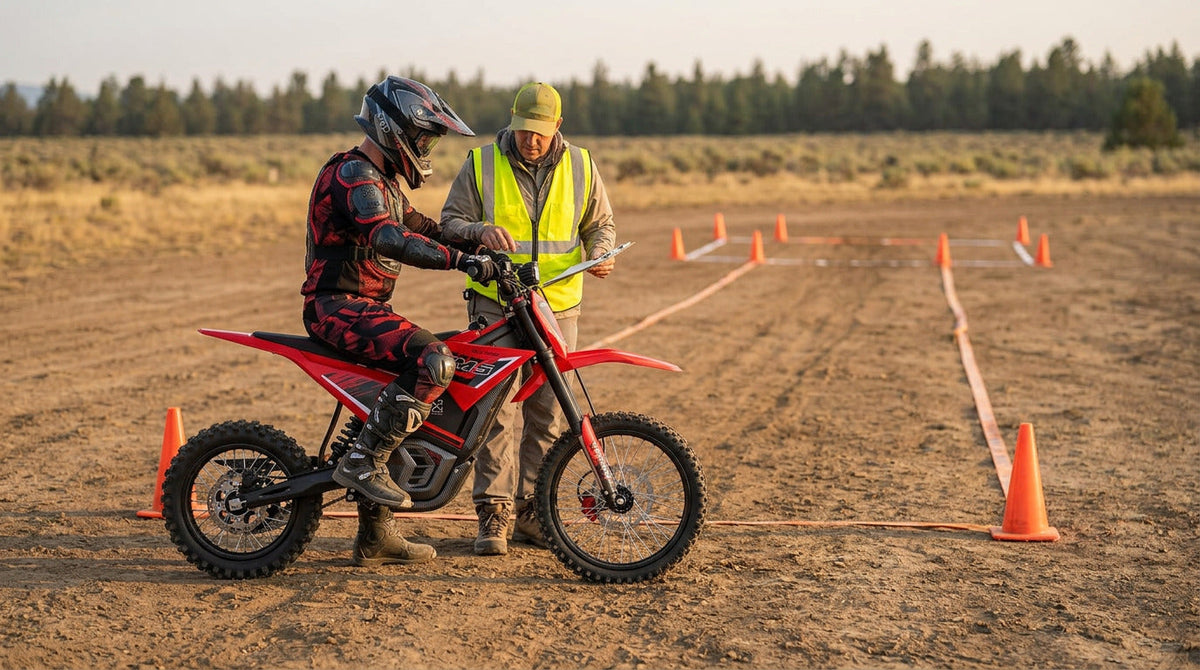
Use one electric dirt bike, one adult beginner, one quiet closed range and one qualified off-highway instructor who knows the exact model and controls, controls the range, owns the emergency plan and can stop the exercise. An experienced friend is not automatically qualified. That is the whole setup for a first session, and it is deliberately not a first trail ride.
Electric drive removes some jobs. There is usually no clutch to feed, no idle to manage, no engine to stall and restart. It removes none of the others. Throttle response, braking, balance, steering, the weight of an adult electric off-road motorcycle, the shutdown procedure and plain judgment all still belong to the rider.
This 30 minute electric dirt bike beginner practice plan runs in six blocks:
- Minutes 0–5: rider fit, gear, and motorcycle inspection
- Minutes 5–10: powered-off control rehearsal
- Minutes 10–15: controlled first movement
- Minutes 15–20: planned straight-line stops
- Minutes 20–25: wide directional changes
- Minutes 25–30: shutdown, review, and post-session inspection
The clock organizes the lesson. It does not certify competence.
Define Success Before the Session Starts
Success is observable control, not distance, speed, or finishing every block. A good first session may include:
- Correctly identifying the controls
- Using the documented shutdown process
- Beginning movement without a surge
- Closing the throttle deliberately
- Stopping on a planned line
- Looking toward the intended path
- Following one coaching instruction at a time
- Recognizing tension, fatigue or confusion
Success does not require trail riding, higher output, tight turns, standing, hills, or the full 30 minutes. Ending early after several clean repetitions is often safer and more useful than finishing the schedule with deteriorating control.
Prepare a Legal Closed Practice Range
The venue is part of the training system, not the backdrop.
Choose Predictable Ground
Use legal private property, an approved off-highway training area, or another location that expressly permits the motorcycle. The surface should be level, visible and consistent, with no traffic, pedestrians, animals, steep slopes, deep sand, mud, roots, loose rocks or blind exits.
No universal surface type applies. Local ground, weather and season decide what counts as consistent.
Separate the Practice Zones
Identify a staging and shutdown area, a straight starting lane, a planned stopping area, a wide turning area, runoff, and the coach position.
Size the course from a walking-pace roll and controlled stop on firm, level ground. Mark entry, movement, stop and runoff zones; keep the instructor outside the travel path; preserve a clear buffer beyond the longest demonstrated stop; and extend the lane only after repeated stable closures and stops. The coach, motorcycle, rider and venue determine the space actually needed.
Control Distractions
One lead coach, one rider, one active motorcycle. Spectators, cameras, children, pets and other riders stay outside the range. The first session is not a group event.
Use Pass Gates Instead of Automatic Progression
Every block ends with one of three decisions, and the clock does not make it.
Pass
The rider repeats the intended action with predictable results and can explain what the motorcycle did. Both halves matter. A rider who cannot describe the response has not yet noticed it.
Reset
The rider is calm and the motorcycle is working normally, but the action is inconsistent. Simplify the task and repeat the same block.
Stop
End the session when the rider becomes confused, panicked, fatigued or unable to follow instructions, or when the motorcycle develops a throttle, brake, steering, battery, electrical, tire, drivetrain or warning-indicator concern.
Unused minutes are not currency. They do not convert into faster riding or harder drills.
Preconditions Before the 30-Minute Riding Block
Confirm Adult Rider Fit
Before anything moves, establish whether the rider can:
- Mount and dismount without catching clothing or gear
- Hold the motorcycle upright with manageable effort
- Identify the exact model’s throttle, front-brake control, rear-brake control, power/kill state and mode controls; then confirm the rider can reach them
- Place boots securely on the pegs or controls
- Turn the handlebars through the documented range
- See the display
- Operate the power and motor-inhibit controls
- Walk and turn the motorcycle with drive isolated
Both feet flat on the ground is not a universal requirement. Inseam, seat width, suspension movement, boot design, rider strength and coaching method all affect practical fit, and a rider who cannot manage the machine physically has a fit problem rather than a confidence problem.
Check Protective Equipment
A properly fitted motorcycle helmet, eye protection, gloves, over-ankle off-road boots, long abrasion-resistant clothing, knee and elbow protection, and any torso protection the exercise warrants. Our protective equipment checklist covers the selection detail this section deliberately skips.
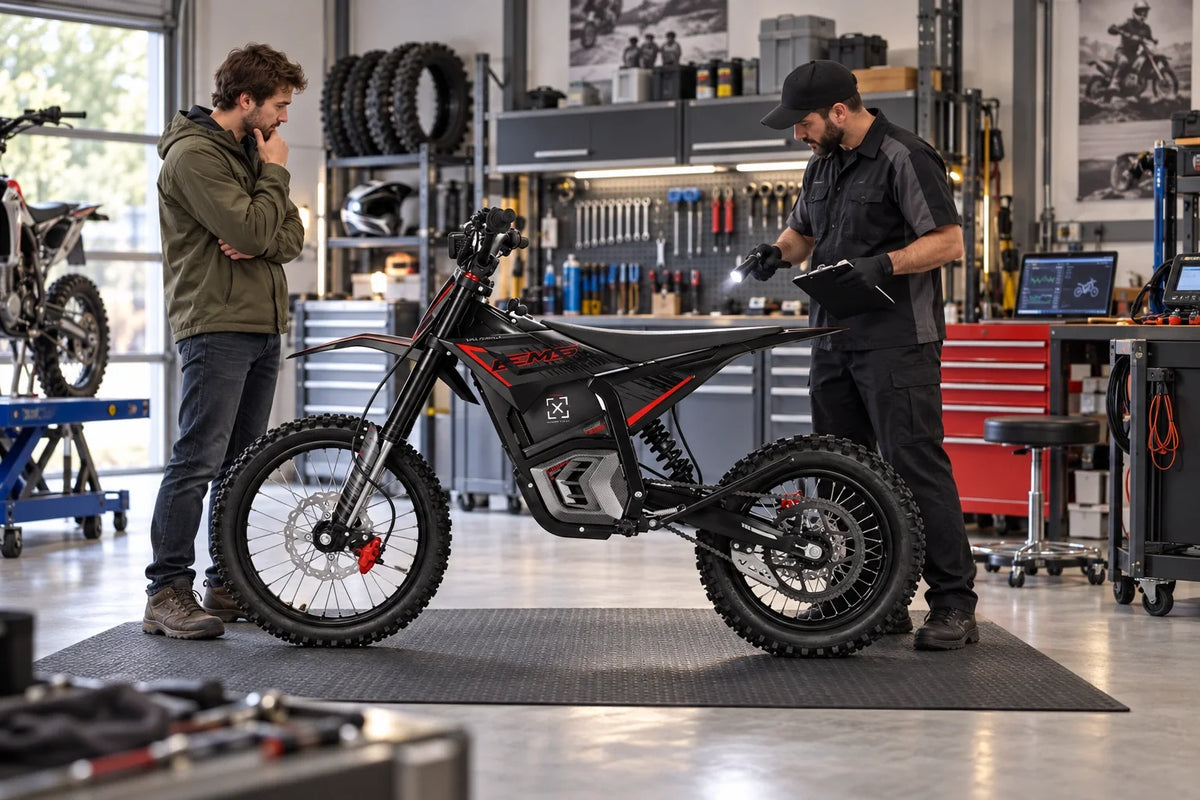
Inspect the Motorcycle With Power Off
Work through the exact-manual checks for tires and wheels, brakes, throttle return, steering, battery security, chain or drivetrain, suspension, foot controls, external wiring, fasteners and display warnings. The Valtinsu user manual page carries model-specific documentation, and MSF’s T-CLOCS checklist sets the general baseline for tires, controls, brakes, steering, chassis and electrical equipment.
Pass Gate
Proceed only when the motorcycle fits the rider, the protective equipment is correctly worn, and no mechanical or electrical concern remains unresolved.
Minutes 5–10: Rehearse the Controls With Drive Isolated

Identify Every Primary Control
Cover the throttle, front and rear brake controls, power control, motor-inhibit or stop control, ride-mode selector where fitted, display and warning indicators, side stand, and any model-specific controls.
Do not assume the layout matches a gas dirt bike, another electric motorcycle, or a bicycle. It frequently does not.
Practice Shutdown Before Startup
The rider rehearses closing the throttle and using the exact model’s manufacturer-designated stop, kill or power-off state; silence, a brake cutoff or a display indication alone does not prove isolation before learning powered movement. That order is intentional. The moments when shutdown matters most are the moments when nobody wants to be reading a manual: confusion, a fall, an unexpected motor response, a warning light, or someone walking into the practice area.
Rehearse Throttle Movement With Power Off
Find the closed position, open the throttle slightly, return it fully, then turn the handlebars without changing throttle position. No throttle percentage, wrist angle, hand position or repetition count gets prescribed. With power off, the rider learns closed-throttle position, free movement, smooth return and neutral wrist placement. The activation point and first repeatable response are introduced only during a clear, level walking-pace roll under direct instructor supervision.
Pass Gate
Proceed only when the rider can identify and operate the controls correctly without repeated coaching prompts.
Minutes 10–15: Practice Controlled First Movement

Select One Documented Configuration
Use one manufacturer-approved, coach-selected setup suited to the rider and venue. No universal beginner mode exists, because controller programming differs by model. Keep the configuration unchanged through the whole block so the coach is comparing attempts rather than settings.
Begin in a Straight Lane
The rider looks toward the stopping area, adds only enough drive to begin moving, stays aligned with the lane, then responds to the pre-briefed stop cue: throttle fully closed, motorcycle upright and straight, both mechanical brakes applied smoothly and progressively according to the exact control layout, eyes up, and pressure reduced if a wheel begins to skid. If the bike does not slow as expected, the instructor gives the abort signal and the rider uses the clear runoff. No universal speed or distance belongs here.
One Deliberate Roll-On vs Repeated On-Off Input
- One deliberate roll-on: creates a single predictable acceleration request and lets the rider feel how the motorcycle answers it
- Repeated on-off input: alternates acceleration and deceleration, makes balance and direction hard to assess, and usually signals tension or confusion
The second pattern is the most common thing a coach sees in a first block. It is a reset, not a failure.
Pass Gate
Proceed only when starts are predictable, the throttle closes fully, the rider stays inside the lane, and the coach does not need to intervene.
Minutes 15–20: Build Planned Straight-Line Stops
Mark the Stopping Process
Identify the start point, the throttle-close cue, the brake-application area, the intended final position, and runoff. Do not narrow the stop box during first attempts. Precision comes later; the habit comes now.
Separate Drive From Braking
The rider closes the drive request before completing the coach-approved stopping process. No universal percentage split or fixed stopping distance applies, but the foundational sequence remains: throttle closed, motorcycle straight and upright, both brakes applied smoothly and progressively through the exact model’s controls, eyes up, and pressure reduced if a wheel begins to skid, because brake layout, surface grip, motorcycle design and rider position all change the right answer.
Smooth Planned Stop vs Abrupt Reactive Stop
- Smooth planned stop: begins before urgency, keeps the motorcycle aligned, builds deceleration predictably
- Abrupt reactive stop: starts late, usually carries rider tension, may involve crossed throttle and brake inputs, and requires a reset
Pass Gate
Proceed only when the rider can start, travel straight, close the throttle, and stop without skidding, leaving the lane, confusing controls, or needing coach intervention.
Optional Block 5 — only after the straight start/stop gate is passed

Use a Wide Oval or One Sweeping Turn
The course should let the rider enter straight, look through the turn, change direction gradually, exit without a sudden throttle increase, and stop in a separate planned area. No universal radius or cone distance applies. This is not a tight-cone exercise.
Practice Left and Right Separately
Riders often show different control, vision, tension, steering, throttle and exit habits in each direction. Treat left and right as separate observations rather than one averaged result.
Limit Body-Position Instructions
The goal is a motorcycle following a wide planned path. Do not bury the rider under simultaneous instructions about elbows, knees, hips, foot pressure, sitting and standing. One correction at a time, chosen by the coach for that rider, that machine and that surface.
Pass Gate
The rider completes wide turns in both directions while looking toward the exit, maintaining predictable drive, staying inside the range, and reaching the planned stopping area.
Minutes 25–30: Cool Down, Shut Down, and Review
Finish With a Passed Drill
Repeat something the rider has already completed successfully. Do not introduce a higher mode, tighter turns, standing, a slope, loose terrain, emergency braking, a jump or a speed test. Finish with a previously passed drill so the session ends under predictable control and provides a clean baseline for the next lesson, so it should be a success.
Follow the Exact Shutdown Procedure
Park in the staging area, close the throttle, place the motorcycle in its documented non-driving state, and secure it according to the manual. Never treat silence as evidence that drive is isolated.
Complete a Brief Post-Session Inspection
Check for changed throttle or brake feel, tire damage, loose controls, chain or drivetrain concerns, battery warnings, new rubbing, leaks, error messages, and any damage from a tip-over. Our maintenance guide covers the routine version of these checks between sessions.
Review the Session
Three questions: which control felt easiest, which action stayed inconsistent, and which block should be repeated next time. Record each block as Passed, Repeat, Not Attempted or Stopped.
Use a Session Scorecard Without Scoring Speed
The scorecard documents repeatable control. It does not rank riders, and it awards nothing for speed, acceleration, distance, roost, turn tightness, or completing the full half hour.
|
Practice block |
Skill observed |
Pass indicators |
Reset indicators |
Stop indicators |
|
Fit and inspection |
Physical management and machine condition |
Reaches all controls, holds the bike, no unresolved fault |
Minor adjustment needed |
Fault found, or the bike does not fit |
|
Powered-off controls |
Recognition and shutdown |
Names and operates each control unprompted |
Needs a reminder |
Repeated control confusion |
|
Controlled starts |
Beginning drive predictably |
Single smooth roll-on, full throttle close |
Abrupt but controlled start |
Unexpected acceleration |
|
Straight-line stops |
Planned deceleration |
Straight path, stops in the planned area |
Misses the mark without panic |
Skid, crossed inputs, or panic |
|
Wide turns |
Directional change |
Both directions, looking through the exit |
Wider than intended |
Repeated lane departures |
|
Shutdown and review |
Closing procedure |
Correct non-driving state, clear self-report |
Needs prompting |
Any new fault or warning |
One column belongs on the sheet that no table can hold: the next-session decision. Write it down while the observations are fresh, because a coach who waits a week remembers the best run rather than the typical one.
Stop Rules vs Reset Rules
The difference between a correctable attempt and a session-ending condition is worth settling before the bike moves.
Reset the Drill When
The rider looks down. Reset only when the rider closes the throttle on command, remains in the marked lane, stops in the planned area and shows no control confusion. Stop the session if acceleration is unexpected, the rider freezes or panics, grip tension adds throttle, or the instructor must intervene. The planned stopping point gets missed without panic. A turn goes wider than intended. One reminder is needed. A marker gets moved. A task should simply be made easier.
Stop the Session When
The rider confuses throttle and brake. Acceleration arrives unexpectedly. The throttle fails to return. Brake response changes. There is a fall or tip-over. Lane departures repeat. Panic, freezing or an inability to follow instructions appears. Fatigue starts degrading control. A warning indicator shows. An unusual sound, smell, heat or looseness turns up. Another person or vehicle enters the range.
A reset preserves learning. A stop protects the rider and the motorcycle. After any tip-over or crash, the session ends and the machine gets inspected before it is ridden again.
First Session vs Later Sessions
First Session
Fit, controls, shutdown, straight starts, straight stops, wide turns, post-session inspection. That is the entire scope.
Later Sessions
Only after control repeats should a coach consider slow-speed balance work, more precise stopping, wider figure eights, standing practice, surface changes, gentle slopes, trail entry, or a change in power configuration. A second session may repeat the first plan in full. Progression follows consistency, not calendar days or accumulated ride time, and our riding guides cover the skills that come after this one.
Electric Controls vs Gas-Motorcycle Controls
Tasks Often Removed
Many electric dirt bikes remove clutch engagement, engine idle management, manual gear selection, and restarting after a stall.
Tasks That Remain
Throttle response, braking, steering, balance, traction, motorcycle weight, terrain, shutdown, battery status, and other trail users. None of that list gets shorter because the motor is electric.
Simpler Controls vs Easier Riding
Fewer controls can lower the initial workload, which is a real advantage for a first session. Some electric models can deliver strong low-speed response without a clutch transition, so beginners must learn model-specific throttle closure and braking early. Simpler is not the same as easier, and nothing here is effortless or risk-free.
Match the Motorcycle to the Adult Beginner
Evaluate Rider Fit
Seat height and width, motorcycle weight, handlebar reach, brake-control reach, peg position, the ability to walk and turn the machine with drive isolation, and the ability to recover it with appropriate help. Our sizing guide works through how those interact.
Connect Geared Torque to the First Lesson
A geared motor uses internal reduction to multiply wheel torque at low motor speed. Put an 80 kg adult on a dusty closed range and that mechanism is the first thing they meet: the same low-speed force that later helps on a trail climb arrives the instant they ask for movement. It rewards a deliberate input and punishes a careless one. Our watts and torque guide explains why peak wattage tells you so little about this.
EM-5 Fit Context
The Valtinsu EM-5 runs a 48V system with a 3,840W peak geared motor and a geared drivetrain with strong listed low-speed capability, listed at 40 mph top speed and a 50-mile maximum range. For a first session the relevant numbers are the other ones: 126 pounds net, a 28.3-inch seat height, 14-inch front and 12-inch rear wheels, and a 243-pound maximum load. These figures inform an in-person fit check; they do not prove that an adult can balance, walk or recover the 126-pound motorcycle. The EM-5 is rated 13+, so adult supervision, rider maturity and local rules still apply.
The EM-5 lists three speed settings. Those are documented settings, not a training ladder, and a coach selects one for the block rather than climbing through them.
Before You Train on Any Electric Dirt Bike

No model is automatically safest or easiest for every beginner. What differs is size, how power arrives, what can be adjusted, and what support exists afterward. Two of the five below are Valtinsu machines.
|
Model |
Size and weight |
Power delivery |
First-session consideration |
Ownership consideration |
|
Compact, 126 lb net, 28.3-inch seat, 14/12-inch wheels |
48V geared motor, 3,840W peak, three listed settings |
Compact dimensions and a 243 lb load rating suit supervised throttle practice, though adult fit still needs checking in person |
Lower entry price, model-specific manual and parts |
|
|
Larger, 143 lb net, 31.5-inch seat, 17/14-inch wheels |
60V geared motor, 5,600W peak |
A step-up platform, adults only at 18+, with more torque reserve to manage on a first day |
Signature Volt Green finish, same support structure |
|
|
Sur-Ron Light Bee X |
Light aluminum platform |
Removable 60V pack, selectable modes |
Familiar in training circles, and different commercial positioning that belongs in a separate buying guide |
Established aftermarket, large owner community, race history and strong resale recognition |
|
Talaria Sting R MX4 |
Comparable weight class, varies by version |
Gearbox-driven, adjustable regeneration |
Regeneration settings change closed-throttle behavior, so the level must stay fixed through a block |
Deep aftermarket and an active owner community |
|
Full-size enduro platform |
Power adjustable from roughly 10 to 80 hp |
Wide adjustment is useful, but full-size dimensions raise the physical demand on a first session |
Sophisticated software, dealer-based support |
Sur-Ron and Talaria are the honest reference points here. Both have deeper aftermarket ecosystems, larger owner communities and better resale recognition than Valtinsu, and Sur-Ron carries race history Valtinsu does not. What Valtinsu offers a first-time adult is adult-rated geared torque and a compact platform at a much lower price. Neither fact tells you whether a specific machine fits a specific rider.
Decide Whether the EM-5 Fits After the Practice Test
Work through the checks before the purchase, not after. Can the rider:
- Reach and operate every control
- Hold and walk the motorcycle safely
- Close the throttle without delay
- Perform repeatable straight starts
- Perform planned stops
- Manage the seat height and compact wheel setup
- Access a legal closed practice area
- Obtain qualified coaching
- Stay within the maximum load requirement
If those answers are yes, the EM-5 is worth a serious look, and the electric dirt bike collection shows where it sits against the rest of the range. If any answer is no, fix that first.
Avoid Common First-Session Mistakes
|
Mistake |
Why it creates risk |
Better decision |
|
Starting on a trail |
Terrain, other users and blind corners arrive before basic control exists |
Use a legal closed range |
|
Testing top speed |
Reveals nothing about control and removes the margin for error |
Score control, not speed |
|
Changing modes between attempts |
Makes it impossible to tell whether the rider or the machine changed |
Hold one approved configuration per block |
|
Several body-position instructions at once |
Overloads a rider who is still learning the controls |
One correction per attempt |
|
Tightening the course too early |
Forces precision before the path is repeatable |
Keep it wide until turns repeat |
|
Extending the session because battery remains |
Fatigue degrades control faster than the pack drains |
End on a passed drill |
|
Treating a fall as routine learning |
Hides possible machine damage and rider injury |
Stop and inspect |
|
Ending with a faster lap |
The rider remembers the least controlled moment |
Finish with a skill already passed |
|
Letting friends coach from the edge |
Competing instructions create hesitation at the worst moment |
One lead coach only |
|
Continuing after control quality declines |
Every following repetition trains the wrong habit |
Stop the session |
Conclusion
Fit and inspection come first. Then powered-off control rehearsal, controlled first movement, planned straight-line stops, wide turns in both directions, and a shutdown with a real review. Each moving block ends at a pass gate, and a stop condition always outranks finishing the schedule.
Thirty minutes organizes a first lesson. It does not certify anyone to ride a trail.
Use this only as a supervised orientation outline. Many true beginners will complete only the first two or three blocks; progression gates outrank the clock, and no stage is required merely because time remains, repeat any failed block on another day, and review the Valtinsu EM-5 only after the fit and control checks are done.
FAQs
Are electric dirt bikes good for adult beginners?
They can be, because there may be no clutch or manual shifting, but immediate torque still demands careful throttle control. A beginner-suitable setup should provide:
- A motorcycle that matches the rider’s approved age, size, control reach, and recoverable mass
- A documented low-output mode or predictable power setting
- A legal closed practice area with flat, consistent ground and clear runoff
- Full protective equipment and qualified off-road instruction
What should a first electric dirt bike practice session include?
The first session should prove basic control, not cover trail distance. A useful order is:
- Identify every control and the model’s ready, neutral, and non-driving states.
- Check fit and rehearse throttle closure with the drive disabled.
- Practice controlled starts and stops at walking pace.
- Add a wide straight line and gentle planned turns.
- Finish before fatigue or concentration changes technique.
Is 30 minutes enough to learn to ride an electric dirt bike?
No fixed time proves competence. Thirty minutes can organize a beginner session, but advancement should depend on repeatable starts, stops, throttle closure, line control, and calm abort decisions—not the clock.
Which ride mode should a beginner use?
Use the manufacturer-approved setting with the most predictable, controllable response for that rider and surface. Mode names are not standardized, so verify the manual and keep the same setting throughout each drill set.
How do you know when a beginner is ready for an easy trail?
Trail readiness requires consistent skills under supervision, not one successful lap. The rider should be able to:
- Close the throttle immediately and stop in a straight, controlled line
- Start, turn, and stop repeatedly without outside intervention
- Use the selected standing or seated position without losing control access
- Recognize fatigue, traction loss, a blocked line, or a mechanical warning and abort early
- Meet the trail’s local access, age, equipment, and supervision rules
Sources
- Motorcycle Safety Foundation, DirtBike School
- Motorcycle Safety Foundation, Tips & Practice Guide for the Off-Highway Motorcyclist
- Motorcycle Safety Foundation, T-CLOCS Pre-Ride Inspection Checklist
- National Highway Traffic Safety Administration, Motorcycle Safety
- National Highway Traffic Safety Administration, Choose the Right Motorcycle Helmet
- Bureau of Land Management, Off-Highway Vehicles
- USDA Forest Service, Off-Highway Vehicles, San Juan National Forest (Motor Vehicle Use Maps, registration and permits)
- Tread Lightly!, Respected Access


Looking for something else?
Electric Dirt Bike Loses Power Under Load: Causes and How to Fix It
LEARN MORE
Electric Dirt Bike Bolt Torque Checklist: What to Check and Where the Numbers Come From
LEARN MORE
How to Bleed Electric Dirt Bike Brakes Safely
LEARN MORE
Electric Dirt Bike Throttle Not Working: What to Check First
LEARN MORELooking for something else?
Electric Bike Battery Not Charging? Work Through This Before You Buy a New One
LEARN MORE
Electric Dirt Bike Error Codes: What They Mean and What to Check First
LEARN MORE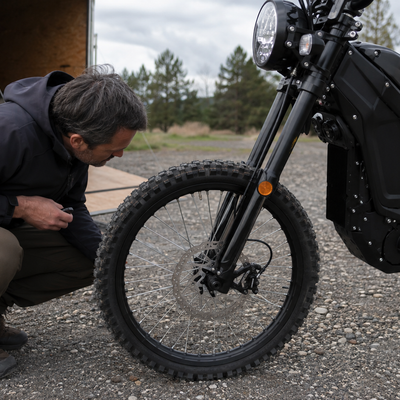
Electric Dirt Bike Brake Rotor Rubbing: Diagnose the Cause Before Adjusting
LEARN MOREYou may also like
Moto eléctrica todoterreno para adultos EM-5 con luz
VALTINSU EM-5 Pro Off-Road Black Electric Dirt Bike
VALTINSU EM-5 Pro Green Electric Dirt Bike
VALTINSU EM-5 Ultra Electric Dirt Bike
VALTINSU EM-5 & EM-5 Pro Combo
Further reading
Electric Dirt Bike Trailside Power Loss: Recovery Plan When the Battery Is Dead
Electric Dirt Bike Fall Riding on Wet Leaves: Grip, Hidden Obstacles and Braking
How to Lift a Fallen Electric Dirt Bike Without Hurting Yourself or the Bike