Electric Dirt Bike vs Electric Motorcycle: Key Differences for Adult Riders in This 2026 Buyer Guide
This electric dirt bike vs electric motorcycle guide helps adult riders choose the right machine for their terrain and needs. Whether you ride off-road on trails, across private land, or on approved paths, this guide explains how electric dirt bikes compare to street-legal electric motorcycles in power, handling, and usability.
So the spec sheet is the wrong starting point. Ride trails and ranch land most weekends? Get the off-road bike, an adult electric off-road motorcycle. Stick to city streets and highways? Then a road-legal electric motorcycle wins. We build off-road bikes at Valtinsu. This guide keeps the comparison honest, and it says plainly when a full street motorcycle is the better tool. Know your side of the line first. Then you can compare the off-road range.
Electric Dirt Bike vs Electric Motorcycle on core specs and use case
The short version first. Two machines, two jobs. The table below is the map. The sections under it fill in the detail.
|
Factor |
Electric Dirt Bike |
Electric Motorcycle |
|
Built for |
Dirt, trails, jumps, OHV parks |
Paved roads, traffic, commuting |
|
Top speed |
Roughly 40 to 56 mph |
Often 80 to 100+ mph |
|
Range |
50 to 75 miles, drops off-road |
100 to 200+ miles on road |
|
Weight |
Light, easy to move |
Heavy, planted at speed |
|
Tires |
Knobby, off-road grip |
Street tires, pavement grip |
|
Suspension |
Long-travel, absorbs hits |
Tuned for road comfort |
|
Street legal |
Usually no, OHV only |
Yes, with license + plate |
|
Typical price |
Value tier through race tier |
Higher, road systems add cost |

Best for off-road adults
Loose ground is where the dirt bike belongs. Dirt, gravel, mud, rock. It shows the second the surface goes soft. The bike is lighter than a road motorcycle. So it turns easy at low speed. Drop it and you can pick it back up without help. You ride it standing up too, weight shifting as the trail moves under you. For an off-road adult that control matters more than a top-speed number ever will.
Best for street riders
Pavement is a different world. The electric motorcycle owns it. Road tires, mirrors, lights, turn signals, a plate mount. Public traffic demands all of it. Most need a license, registration, and insurance on top. What counts here is steady braking. Road stability. Enough power to hold traffic speed. Trail agility does not make the list. The weight is part of the deal, and on a highway it can feel more planted, not less.
Best for mixed-use riders
Want both worlds? Look at a street-legal electric dirt bike. Or a dual-sport-style electric motorcycle. These try to mix trail handling with road gear. Lights, mirrors, a horn, a plate mount, DOT tires. The catch is legal, not mechanical. A bike can look street-ready and still be sold for off-road use only where you live. So check the title, VIN, and registration path first. Buy after you know. For pure dirt and teen riders, a bike like the EM-5 stays in the off-road lane on purpose.
What Is an Electric Dirt Bike?
An electric dirt bike is a battery-powered off-road motorcycle. No gas engine. No clutch. Nothing to shift. You twist a throttle and the motor delivers torque right away, right where a climb or a sand section needs it. Most have no pedals. That one fact sets them apart from legal e-bikes under U.S. rules.
The distinction is legal, not cosmetic. Federal law sets a clear bar for a low-speed electric bicycle: fully operable pedals, a motor under 750 watts, and a top motor-powered speed under 20 mph (Source: Cornell Law School, law.cornell.edu, 2026). A throttle-only off-road machine hitting 40 mph clears all three. That puts it closer to a dirt bike or an OHV in the eyes of the law.
Off-road frame and suspension
Trail hits are the whole design brief. Strong frames, long suspension travel. The fork eats front-wheel impacts. The rear shock handles jumps and landings. Both wheels stay on the ground. We have tested a lot of these setups, and the extra travel does more for rider fatigue on a long day than any peak-power number on the sheet.
Knobby tires and trail grip
The tires tell you what a bike is for. Knobby tread digs into loose dirt, mud, gravel. That is bite on climbs, in corners, under braking. Put those knobs on pavement and they go noisy and vague. Street tires stay smooth for a reason. Match the tire to the ground you actually ride.
Throttle control and low-end torque
Instant torque is the party trick. It is also the trap. The motor shoves hard from a dead stop. Great on hills, sand, awkward restarts. A shock to anyone who has never felt it. New to this? Start in a low-power mode. Every Valtinsu has three ride modes for that reason. On loose dirt, a smooth throttle hand beats a fistful of power.

What Is an Electric Motorcycle?
An electric motorcycle is a battery-powered road vehicle. Electric motor, a big battery pack, street tires, motorcycle controls. Built to work inside traffic law. Plenty are made for the city, the highway, or both. The whole point is legal road use, so they get registered and insured. Rules shift by state. That makes the DMV your first stop, not your last.
Road-focused build
Everything on the bike points at pavement. The frame and riding position want steady turns, smooth braking, higher speed. The seat suits longer stints. Road lighting, a dashboard, mirrors, turn signals, all standard. They have to be. You are sharing lanes with cars and trucks.
Higher speed and stability
Faster and heavier. Both facts matter. Many hit city and highway speeds a dirt bike never touches. The extra mass can feel calmer on smooth road. But speed raises the stakes. Stopping distance grows. Crash forces climb with it. NHTSA reported 6,228 motorcyclists killed in 2024, about 16% of all traffic deaths, and it tells riders to stay sober, stay visible, and wear a DOT-compliant helmet (Source: NHTSA, nhtsa.gov, 2026).
Street-legal equipment
The legal kit is a fixed list. Headlight, tail light, brake light, turn signals, mirrors, horn, plate mount. Some states add DOT tires and an inspection. Miss a piece and the bike can be stuck on private land or an OHV area, however road-ready it looks. This is where buyers get caught. Do not trust the silhouette. A title, VIN, and registration path matter as much as the lights.
Electric Dirt Bike vs Electric Motorcycle: The Differences That Matter
Both run on batteries. That is where the overlap ends. The split runs through everything: purpose, terrain, speed, range, weight, tires, suspension, price. Most guides nail speed and cost. Then they skip the thing that decides real use. Where can you legally ride it? A fast bike you cannot ride near home is not much of a bike.
Terrain and ride feel
Rough ground favors the dirt bike. Tall suspension, knobby tires, a narrow body. It feels natural on dirt, gravel, grass, rock. Pavement flips it. There the motorcycle wins, with road tires and a heavier frame that settle on streets and highways. A knobby-tired dirt bike would feel twitchy up there. Ride feel follows the hardware. Dirt bikes are light and eager. Motorcycles are smooth and planted.
Speed, torque, and range
Top speed goes to the motorcycle. Low-speed pull goes to the dirt bike. A 45 mph bike feels quick on a tight trail. A 70 mph motorcycle feels ordinary on an open road. So the number only means something in context. Range splits the same way. Road bikes carry bigger packs for 100-plus-mile days. Dirt bike range drops fast on hills, sand, hard throttle. Treat any claim as a best case. Want real off-road speed without race-bike money? The EM-5 Pro runs to 52 mph on a 5,600W geared motor, with a 59-mile range.

Weight, tires, and suspension
Lighter is easier to learn on. Dirt bikes turn easier, load into a truck faster, lift off the ground without a fight after a tip-over. That builds confidence for a newer adult. Motorcycles weigh more, from bigger batteries and road frames. The mass helps at speed. It hurts in a parking lot. Tires and suspension split the same way. Knobby and long-travel for dirt. Street rubber and road damping for pavement. Take a street bike onto rough trail and you risk the parts and yourself.
Where Can You Ride Each One?
This is the mistake adults make most. Where you can ride is set by the vehicle class, local law, land rules, and street-legal status. Not by how fun the bike is. A machine can be a blast and still be illegal in the wrong spot.

Public land is stricter than most people expect. The U.S. Forest Service allows Class 1, 2, and 3 e-bikes on motorized trails and roads in national forests and grasslands (Source: U.S. Forest Service, fs.usda.gov, 2026). The BLM adds a warning: its e-bike rule does not automatically open non-motorized trails (Source: Bureau of Land Management, blm.gov, 2026). And a throttle-only dirt bike is a separate case again. Often it counts as an OHV.
|
Where |
Electric Dirt Bike |
Electric Motorcycle |
|
Public roads |
Usually no, unless made street legal |
Yes, with license + registration |
|
Neighborhood streets |
Often no, quiet is not legal |
Yes, same road rules apply |
|
Bike lanes / sidewalks |
No, these are for bikes / legal e-bikes |
No, motorcycles use the road |
|
Dirt trails |
Only if marked for motorized use |
No, not built for it |
|
OHV parks / MX tracks |
Yes, often the best fit |
No, off-road only venues |
|
Private property |
Yes, with permission |
Yes, but wasted off pavement |
OHV parks and motocross tracks are where an off-road electric dirt bike belongs. Beginner loops, hill climbs, marked skill levels, all waiting. Registration can still apply, though. Take California. It treats off-highway electric motorcycles as subject to OHV registration, and it may want an ID plate or placard (Source: California DMV, dmv.ca.gov, 2026). A big-wheel bike like the EM23 suits open ground and fire roads. Once you know the local rule.
License, Registration, and Insurance
It all comes down to classification. Pedals, speed, wattage, VIN status, street equipment, intended use. Each one feeds the answer. A bike sold online as an e-bike may not pass the legal e-bike test at all. Save the spec sheet before you buy. Read it closely.
When a dirt bike needs registration
Count it as an OHV or a motorcycle and it may need registration. Common for throttle-only bikes with no pedals, built for off-road use. Some states want an OHV sticker, plate, or permit for public off-road areas. And registration is not only a road thing. Public trails and OHV parks can ask for proof too. Check the state DMV and the riding area before you load up.
When a motorcycle license is required
Ride on public roads as a motorcycle, moped, or motor-driven cycle, and a license usually applies. The exact line moves by state. Speed, power, equipment all set it. Do not assume a slower bike ducks the rule. Some are legal off-road only. Others need a regular license or a motorcycle endorsement. The state DMV page has the answer. Check it before you buy, every time.
Cost, Maintenance, and Ownership
The sticker price is the start, not the total. Budget for gear, tires, brake pads, chain parts, registration, insurance, transport, battery care. A cheap bike gets expensive fast. Parts go missing. The warranty turns out thin.
Electric does save on upkeep. No oil. No spark plugs. No air filter. No carburetor. Both types skip most gas-engine service (Source: U.S. DOE AFDC, afdc.energy.gov, 2026). You still mind the tires, brakes, suspension, bearings, chain, battery. Keep a quick pre-ride check in the routine. And a stash of spare parts and gear on hand.
|
Cost area |
Electric Dirt Bike |
Electric Motorcycle |
|
Upfront price |
Lower entry, climbs with power |
Higher, road systems add cost |
|
Routine service |
Chain, tires, brakes, suspension |
Tires, brake fluid, software, battery |
|
Registration |
OHV fees / permits in some states |
Road registration + plate |
|
Insurance |
Often optional off-road |
Usually required for road use |
|
Resale |
Strong for known brands with parts |
Depends on battery health + support |
Which One Should Adult Riders Choose?
Choose on where you can ride. Not on what looks fastest. Dirt-focused adults with trail access want the dirt bike. Road-focused adults who need legal street use want the motorcycle. A street-legal dirt bike can bridge the two, but only once the paperwork checks out. Match terrain, law, range, budget, skill. Then take a test ride if you can get one.
Choose an electric dirt bike if
- Off-road riding is the main goal, on trails, ranch paths, practice tracks, or rough private land.
- You own land or live near legal OHV areas and can focus on torque, suspension, and battery over highway speed.
- You want a lighter machine that is easier to learn on and simple to load, like the EM-5 for beginners and teens at 13+.
Choose an electric motorcycle if
- Public roads are where you ride, for commuting, city trips, or paved weekend runs.
- You need traffic-speed power, road stability, lighting, and a legal registration path.
- A cleaner, quieter alternative to a gas motorcycle appeals, and you will carry the same safety mindset.
Buying mistakes to avoid
- Buying only for top speed. More power is harder to ride, harder to insure, and illegal in more places.
- Assuming pedals make any machine a legal e-bike. They do not.
- Ignoring local trail and OHV rules, then finding out at the trailhead.
- Forgetting the cost of a helmet, boots, gloves, and armor.
- Trusting a range claim without checking real owner feedback.
- Picking a bike with no parts support or a vague warranty.
The Bottom Line
Electric dirt bike vs electric motorcycle is a question of place. Trails, private land, OHV parks point to a dirt bike. Light handling, strong low-speed torque. Roads, longer trips, higher speeds point the other way, to a street-legal electric motorcycle. Speed alone makes a poor tiebreaker. The fast bike is useless where it is not allowed.
For off-road adults picking a model, here is the short map. The EM-5 is the starter. 40 mph, rated 13+, easy to trust. The EM-5 Pro is the all-rounder most adults should buy. 52 mph. And the EM23 brings the highest torque and big wheels for open ground, rated 16+. Check the title, VIN, wattage, top speed, and local rules first. Then the right ride feels fun, legal, and easy to control.
Frequently Asked Questions
Are electric dirt bikes considered motorcycles?
Often, yes. Many electric dirt bikes count as motorcycles or off-highway vehicles. It happens once they lose the pedals, run on a throttle, and clear normal e-bike speed or wattage limits. That classification decides where you ride. And whether you register.
- Legal e-bike test: pedals, a motor under 750W, and a top motor-powered speed under 20 mph.
- Clear those limits and the bike lands closer to an OHV, moped, or motorcycle.
- Before buying, check the top speed, motor rating, pedal status, and any off-road-only label.
What's the difference between an e-bike and an electric dirt bike?
Pedals and power, mostly. An e-bike is a pedal bicycle with electric assist. An electric dirt bike is throttle-driven, built for dirt, hills, rough ground. Stronger frame. Knobby tires. Far more torque.
- E-bike: lighter, pedal-first, often allowed in bike lanes and on some paths.
- Dirt bike: throttle-first, heavier build, usually barred from those same lanes.
- No pedals and mostly throttle? Do not assume it belongs on a sidewalk or bike path.
Do you need a motorcycle license to ride an electric dirt bike?
Sometimes. It hinges on the road. On public roads, if the state calls the bike a motorcycle, moped, or motor-driven cycle, a license usually applies. On private land it may not. Local rules still matter.
- Off-road-only bikes are not street legal even when you hold a license.
- Some models can be registered as street-legal motorcycles if they meet equipment and paperwork rules.
- Public OHV areas may want their own registration or permits. Check the DMV and the riding area first.
Can I ride my electric dirt bike in my neighborhood?
Usually not. Not unless it is street legal and allowed locally. Neighborhood streets count as public roads in most places. So the bike may need registration, insurance, lights, mirrors, and a licensed rider. Quiet does not mean legal.
- Enforcement: a throttle-only, plate-free, off-road-marked bike reads as an unregistered motor vehicle.
- Sidewalks, parks, and bike paths are usually more restricted still.
- Call your local DMV or the police non-emergency line and ask how your exact model is classified.
Why are e-bikes banned on some trails?
Land managers split motorized from non-motorized use. The reasons vary: safety, crowding, soil damage, wildlife, past user conflict. Which is why even a legal Class 1 e-bike is not welcome everywhere. The rule ties to the exact trail. Not the bike class alone.
- Federal, state, county, and city managers each set their own rules for different paths.
- Forest Service: Class 1, 2, and 3 e-bikes are allowed on motorized trails and roads in national forests.
- That still does not open every non-motorized trail, so read the sign and the land manager map.
What happens if the police catch you riding where it is not allowed?
It ranges from a warning to a tow. A warning, a ticket, a fine, an impound, or charges tied to unregistered vehicle use. It depends on local law and how you were riding. Private land with permission is one thing. A public road or a closed trail is another.
- Things get worse fast if a rider runs, rides recklessly, has no license, or cannot prove ownership.
- Electric models are quieter, but they still fall under motor vehicle or OHV rules.
- Carry proof of ownership, know the local rules, and stick to approved areas.
What is the range difference between the two?
Road bikes usually go farther. Electric motorcycles carry bigger packs for 100-plus-mile road days. Steadier speeds and regen braking help. Electric dirt bikes run 50 to 75 miles. And that figure drops off-road.
- What drains a dirt bike: hills, sand, mud, and hard throttle, since loose ground and elevation cost energy.
- Highway speed drains a road pack faster too, mostly from wind resistance.
- Judge dirt bike range by ride time and terrain, not just miles, and check real owner numbers.
Which is cheaper to own overall?
Usually the electric dirt bike. It tends to start cheaper. Ride off-road and you can skip road registration and insurance, though OHV permits and park passes do add up. Electric motorcycles cost more upfront. Road systems and bigger batteries drive it.
- Both save on maintenance versus gas, with no oil, spark plugs, or carburetor.
- The real number is total ownership, not the sticker price.
- Weigh warranty support and parts availability as closely as motor power.
Sources
- Cornell Law School, Low-Speed Electric Bicycle Definition (15 U.S.C. 2085) (2026)
- National Highway Traffic Safety Administration, Motorcycle Safety (2026)
- U.S. Forest Service, Electric Bicycle Use (2026)
- Bureau of Land Management, E-Bikes (2026)
- California Department of Motor Vehicles, Off-Highway Vehicle Registration (2026)
- U.S. Department of Energy, Alternative Fuels Data Center, Electric Vehicle Maintenance (2026)


Looking for something else?
Electric Dirt Bike Replacement Parts Availability: What Buyers Should Verify Before Ordering
LEARN MORE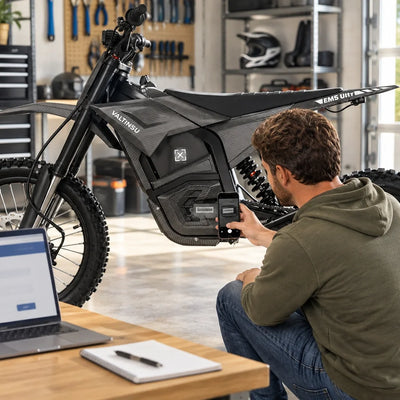
How to Check an Electric Dirt Bike for Safety Recalls by Model and Serial Number
LEARN MORE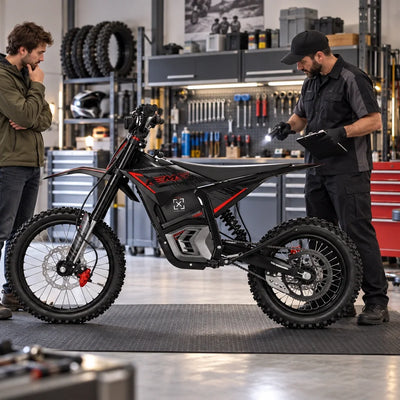
How to Choose an Electric Dirt Bike Repair Shop: Questions to Ask Before Service
LEARN MORE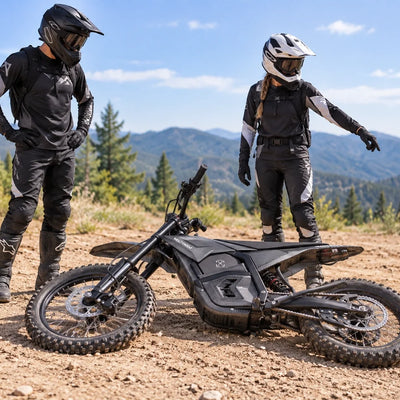
How to Lift a Fallen Electric Dirt Bike Without Hurting Yourself or the Bike
LEARN MORELooking for something else?
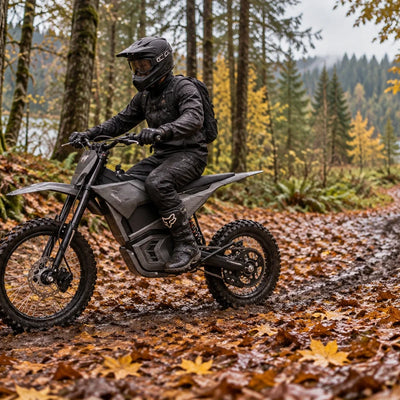
Electric Dirt Bike Fall Riding on Wet Leaves: Grip, Hidden Obstacles and Braking
LEARN MORE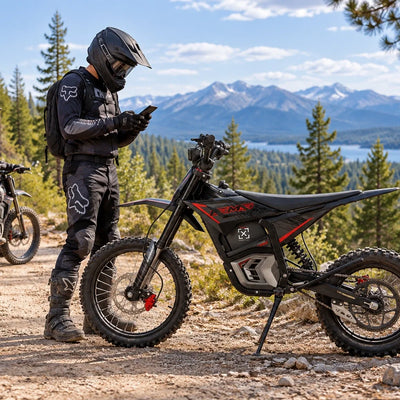
Electric Dirt Bike Trailside Power Loss: Recovery Plan When the Battery Is Dead
LEARN MORE